
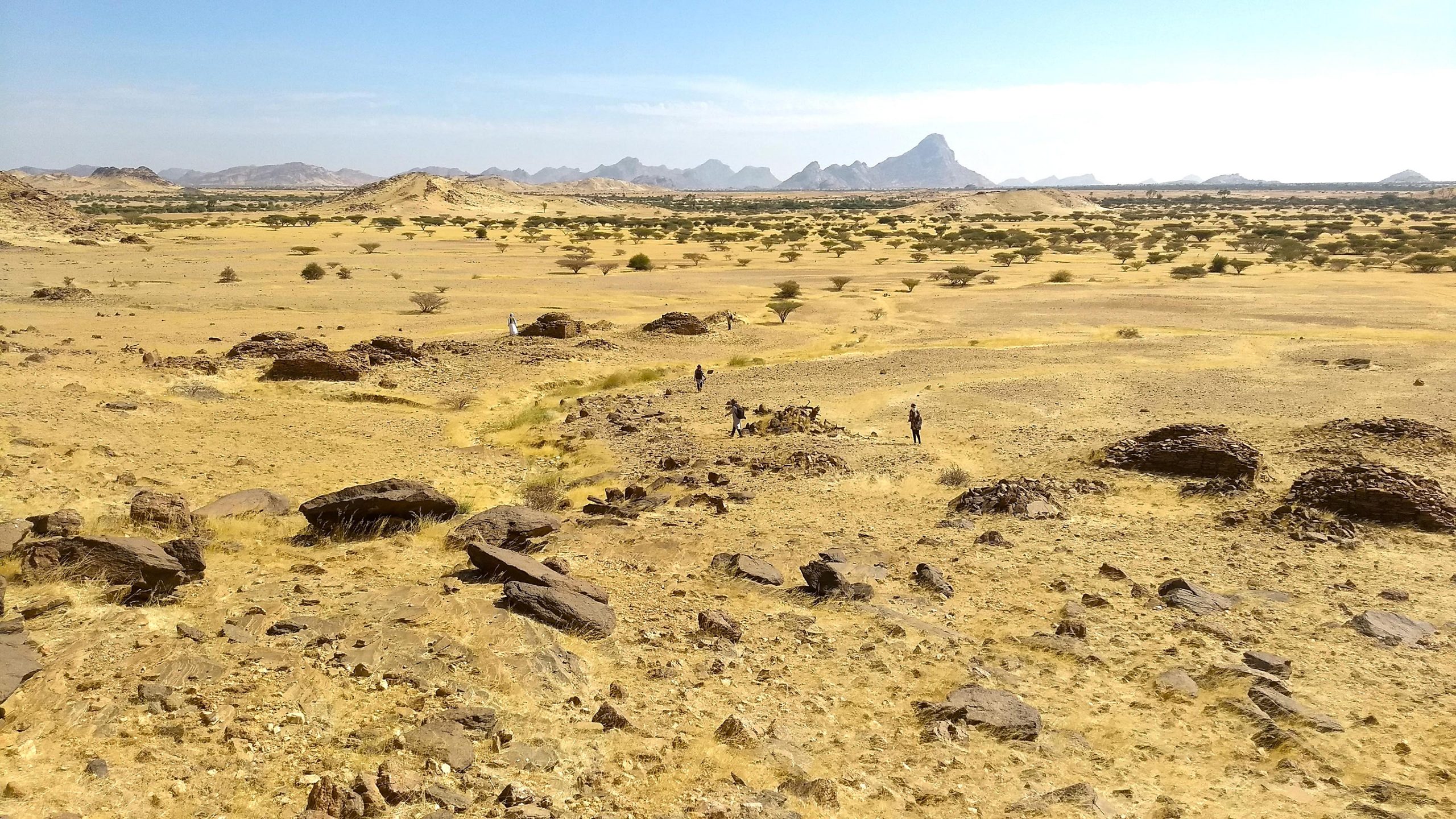
Statistical methods designed for cosmology reveal tomb distribution in Sudan over millennia governed by environmental and social factors.
Sudanese Islamic burial sites are distributed according to large-scale environmental factors and small-scale social factors, creating a galaxy-like distribution pattern, according to a study published July 7, 2021, in the open-access journal PLOS ONE by Stefano Costanzo of the University of Naples “L’Orientale” in Italy and colleagues.
The Kassala region of eastern Sudan is home to a vast array of funerary monuments, from the Islamic tombs of modern Beja people to ancient burial mounds thousands of years old. Archaeologists don’t expect these monuments are randomly placed; their distribution is likely influenced by geological and social factors. Unraveling the patterns of the funerary landscape can provide insight into ancient cultural practices of the people who built them.
Modeling Graves Like Galaxies
In this study, Costanzo and colleagues collected a dataset of over 10,000 funerary monuments in the region, distributed over 4,000 km2 (1,550 mi²), identified by field work and remote sensing using satellite imagery. They then analyzed the arrangement of these sites using a Neyman-Scott Cluster model, originally developed to study spatial patterns of stars and galaxies. This model revealed that, just like stars cluster around centers of high gravity, burials in Kassala cluster in the hundreds around central “parent” points which likely represent older tombs of importance.
The authors hypothesize that the larger-scale distribution of tombs is determined by the environment, with “high-gravity” areas centering on regions with favorable landscapes and available building materials. Smaller-scale distribution seems to be a social phenomenon, with tombs commonly built near older structures, possibly including recent family burials or more ancient burials of traditional importance. This is the first time this cosmological approach has been applied to archaeology, representing a fresh tool for answering questions about the origins of archaeological sites.
The authors add: “An international team of archaeologists discovered the environmental and societal drivers underlying the creation of the monumental funerary landscape of Eastern Sudan with a novel application of advanced geospatial analysis.”
Reference: “Creating the funerary landscape of Eastern Sudan” by Stefano Costanzo, Filippo Brandolini, Habab Idriss Ahmed, Andrea Zerboni and Andrea Manzo, 7 July 2021, PLOS ONE.
DOI: 10.1371/journal.pone.0253511
Funding: This research was made possible through the support of the fundings awarded to the Italian Archaeological Expedition to the Eastern Sudan (IAEES) by the University of Naples “L’Orientale”, the ISMEO — Associazione Internazionale di Studi sul Mediterraneo e l’Oriente, and the Italian Ministry of Foreign Affairs and International Cooperation. The IAEES is also supported by the Regional Government of the Kassala State, Sudan. Additional financial support was provided by Italian Ministry of Education, University, and Research through the project ‘Dipartimenti di Eccellenza 2018-2022’ (WP4 — Risorse del Patrimonio Culturale), awarded to the Dipartimento di Scienze della Terra ‘A. Desio’ (University of Milan, Italy). The funders had no role in study design, data collection and analysis, decision to publish, or preparation of the manuscript.
Never miss a breakthrough: Join the SciTechDaily newsletter.
Follow us on Google and Google News.
14 Comments
When does the adjective, ancient, apply? islam was invented 1500 years ago and took a few decades of the arab slave trade to introduce the “religion” to the black african non-enslaved population.
Not sure “ancient” is truly accurate.
Why you can call westerns civilizations but when it comes to Muslims no it’s not is it really ignorant is in it
More fakery for the dumbed dowm masses to buy as real. Give me a break.
Interesting, thank you
“They then analyzed the arrangement of these sites using a Neyman-Scott Cluster model, originally developed to study spatial patterns of stars and galaxies. This model revealed that, just like stars cluster around centers of high gravity, burials in Kassala cluster in the hundreds around central “parent” points which likely represent older tombs of importance.”
Mehh, without contextualizing if this is applies in other areas and if it’s a common pattern, how accurate and how significant are this findings people will go “wow!!” if they only read the title or “okk…” if they read the whole thing.
Slime mold looks more interesting to me.
https://www.nasa.gov/feature/goddard/2020/slime-mold-simulations-used-to-map-dark-matter-holding-universe-together/
Indeed kek, this is so dumb i can’t even fund words for it
Indeed kek, this is so dumb i can’t even find words for it
Science today is amazing. That they can use mathematical equations designed for physics and cosmology to find out that a group of people ate, slept, defecated and died somewhere, and then through the decades spread out from that single point to go do the same thing a bit further from where their forefathers defecated, is mindbogling.
I spread out my hand to grab a cog, to pull it into place, to wake up the Xln.
Islam is not ancient. It’s just about as old as Anglo-Saxon invasion of Great Britain.
Islam is not thousands of years old
Islamophobia in the comment section is stinking up the place. Sensitization of this redundant populance is advised.
Wow! Islamaphobia is alive and well in the comments. I guess when people don’t understand and accept the science, they rant against the people they don’t accept, too.
The first man on earth itself was a Muslim so Hw can islam not be ancient. Prophet Muhammed was the last messenger out of the 124,000 prophets/messengers of Islam
Ancient and Islamic don’t belong in the same sentence.