
Close Menu
    Facebook X (Twitter) Instagram
    SciTechDaily
    • Biology
    • Chemistry
    • Earth
    • Health
    • Physics
    • Science
    • Space
    • Technology
    Facebook X (Twitter) Pinterest YouTube RSS
    SciTechDaily
    Home»Space»Astrophysicists on the Hunt for “Hierarchical” Black Holes
    Space

    Astrophysicists on the Hunt for “Hierarchical” Black Holes

    By University of BirminghamJuly 31, 2021No Comments3 Mins Read
    Facebook Twitter Pinterest Telegram LinkedIn WhatsApp Email Reddit
    Share
    Facebook Twitter LinkedIn Pinterest Telegram Email Reddit
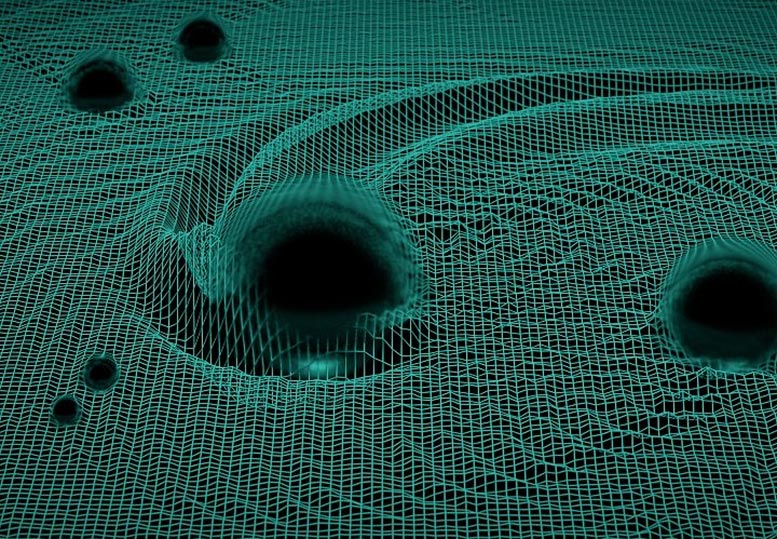
    Hierarchical Black Holes
    Artist’s illustration of Hierarchical Black Holes. Credit: Riccardo Buscicchio

    Black holes detected by their gravitational waves may sometimes be the products of earlier black hole mergers. While evidence so far has been limited, scientists are close to confirming these so-called hierarchical black holes. 

    Black holes, detected by their gravitational wave signal as they collide with other black holes, could be the product of much earlier parent collisions.

    Such an event has only been hinted at so far, but scientists at the University of Birmingham in the UK, and Northwestern University in the US, believe we are getting close to tracking down the first of these so-called ‘hierarchical’ black holes.

    In a review paper, published in Nature Astronomy, Dr. Davide Gerosa, of the University of Birmingham, and Dr. Maya Fishbach of Northwestern University, suggest that recent theoretical findings together with astrophysical modeling and recorded gravitational wave data will enable scientists to accurately interpret gravitational wave signals from these events. 

    Since the first gravitational wave was detected by the LIGO and Virgo detectors in September 2015, scientists have produced increasingly nuanced and sophisticated interpretations of these signals. 

    There is now fervent activity to prove the existence of so-called ‘hierarchical mergers’ although the detection of GW190521 in 2019 – the most massive black hole merger yet detected – is thought to be the most promising candidate so far.

    Clues to Distinctive Gravitational Wave Signatures

    “We believe that most of the gravitational waves so far detected are the result of first-generation black holes colliding,” says Dr. Gerosa. “But we think there’s a good chance that others will contain the remnants of previous mergers. These events will have distinctive gravitational wave signatures suggesting higher masses, and an unusual spin caused by the parent collision.”

    Understanding the characteristics of the environment in which such objects might be produced will also help narrow the search. This must be an environment with a large number of black holes, and one that is sufficiently dense to retain the black holes after they have merged, so they can go on and merge again.

    These could be, for example, nuclear star clusters, or accretion disks – containing a flow of gas, plasma, and other particles – surrounding the compact regions at the center of galaxies.

    “The LIGO and Virgo collaboration has already discovered more than 50 gravitational wave events,” says Dr. Fishbach. “This will expand to thousands over the next few years, giving us so many more opportunities to discover and confirm unusual objects like hierarchical black holes in the universe.”

    Reference: “Hierarchical mergers of stellar-mass black holes and their gravitational-wave signatures” by Davide Gerosa and Maya Fishbach, 26 July 2021, Nature Astronomy.
    DOI: 10.1038/s41550-021-01398-w

    Never miss a breakthrough: Join the SciTechDaily newsletter.
    Follow us on Google and Google News.

    Astronomy Astrophysics Black Hole Gravitational Waves Popular University of Birmingham
    Share. Facebook Twitter Pinterest LinkedIn Email Reddit

    Related Articles

    LIGO Detects Black Hole Smashup So Extreme It’s Bending Einstein’s Rules

    New Evidence of Gravitational Wave Background Permeating All of Spacetime

    The Odd Couple: Groundbreaking New Discovery From Gravitational Whispers

    Hawking’s Black Hole Theorem Confirmed Observationally for the First Time

    A New Type of Cataclysmic Event in the Cosmos: Astrophysicists Detect First Black Hole-Neutron Star Mergers

    “Heaviest Black Hole Collision” Detected by Gravitational Waves Might Actually Be a Boson Star Merger

    Massive Stellar Triples Leading to Sequential Binary Black-Hole Mergers

    Wealth of Discoveries From Gravitational-Wave Data Leads to Most Detailed Black Hole “Family Portrait”

    Ripples in the Fabric of Space and Time Offer New Clues to the Shape of Black Holes

    Leave A Reply Cancel Reply

    • Facebook
    • Twitter
    • Pinterest
    • YouTube

    Don't Miss a Discovery

    Subscribe for the Latest in Science & Tech!

    Trending News

    Scientists Discover How Coffee Impacts Memory, Mood, and Gut Health

    Why Did the Neanderthals Disappear? Scientists Reveal Humans Had a Hidden Advantage

    Physicists Propose Strange Experiment Where Time Goes Quantum

    Magnesium Magic: New Drug Melts Fat Even on a High-Fat, High-Sugar Diet

    Weight-Loss Drugs Like Ozempic May Come With an Unexpected Cost

    Mezcal “Worm” in a Bottle Mystery: DNA Testing Reveals a Surprise

    New Research Reveals That Your Morning Coffee Activates an Ancient Longevity Switch

    This Is What Makes You Irresistible to Mosquitoes

    Follow SciTechDaily
    • Facebook
    • Twitter
    • YouTube
    • Pinterest
    • Newsletter
    • RSS
    SciTech News
    • Biology News
    • Chemistry News
    • Earth News
    • Health News
    • Physics News
    • Science News
    • Space News
    • Technology News
    Recent Posts
    • Harvard Scientists Reveal Secret Structure Behind How You Smell
    • Scientists Just Discovered the Hidden Trick That Keeps Your Cells Alive
    • This Simple Movement Could Be Secretly Cleaning Your Brain
    • Male Birth Control Breakthrough: Scientists Find Way To Turn Sperm Production Off and Back On
    • A Common Vitamin Could Hold the Key to Treating Fatty Liver Disease
    Copyright © 1998 - 2026 SciTechDaily. All Rights Reserved.
    • Science News
    • About
    • Contact
    • Editorial Board
    • Privacy Policy
    • Terms of Use

    Type above and press Enter to search. Press Esc to cancel.