
Close Menu
    Facebook X (Twitter) Instagram
    SciTechDaily
    • Biology
    • Chemistry
    • Earth
    • Health
    • Physics
    • Science
    • Space
    • Technology
    Facebook X (Twitter) Pinterest YouTube RSS
    SciTechDaily
    Home»Health»Artificial Intelligence Can Quickly and Accurately Rule Out Cancer in Dense Breasts
    Health

    Artificial Intelligence Can Quickly and Accurately Rule Out Cancer in Dense Breasts

    By Radiological Society of North AmericaOctober 5, 2021No Comments5 Mins Read
    Facebook Twitter Pinterest Telegram LinkedIn WhatsApp Email Reddit
    Share
    Facebook Twitter LinkedIn Pinterest Telegram Email Reddit
    AI Cancer in Dense Breasts
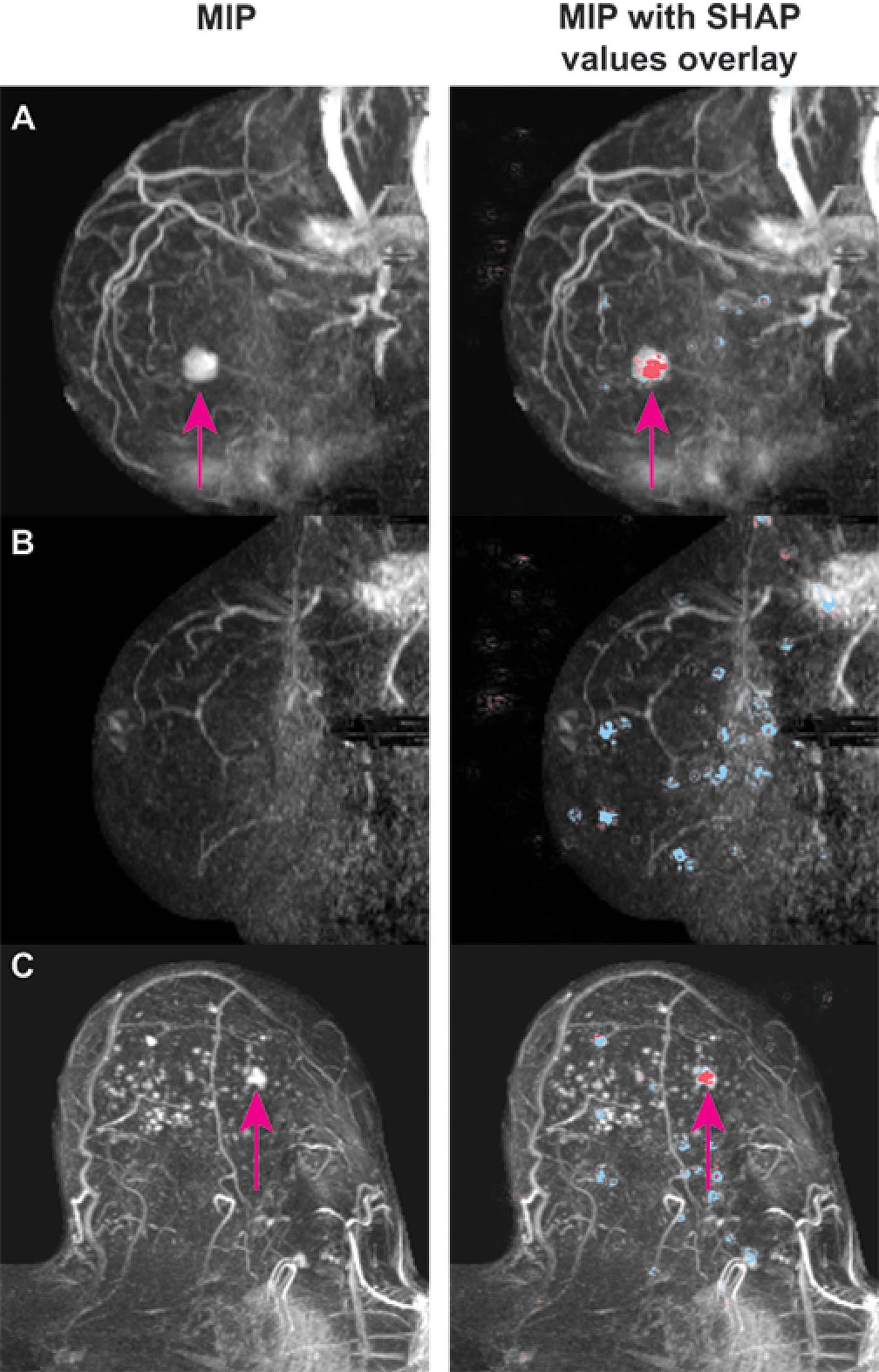
    Examples of deep Shapley additive explanations (SHAP) overlay images. Maximum intensity projection (MIP) images are on the left, and MIP images with the SHAP overlay are on the right. Positive SHAP values (red) show areas that contribute to a high probability of lesion presence, negative SHAP values (blue) show locations with reduced probability. (A) Sagittal MIP images of contrast-enhanced breast MRI scan of an invasive ductal carcinoma in a 57-year-old woman with Breast Imaging Reporting and Data System (BI-RADS) category 4. The deep learning (DL) model yielded a probability of lesion presence of 90%. Positive SHAP values (red) are shown to coincide with the location of the lesion (arrows). (B) Sagittal MIP images of contrast-enhanced breast MRI scan of a breast without lesions in a 53-year-old woman with BI-RADS 1 score. The DL model yielded a probability of lesion presence of 11%. Negative SHAP values (blue) are diffusely distributed in the breast region. (C) Transverse MIP images of contrast-enhanced breast MRI scan of a ductal carcinoma in situ in a 65-year-old woman with BI-RADS 4 score. The DL model yielded a probability of lesion presence of 32%—the lowest probability value among all breasts with malignant disease in our study. Positive SHAP values (red) are shown to coincide with the location of the lesion (arrows). Credit: Radiological Society of North America

    AI Streamlines Breast MRI Screening

    An automated system that uses artificial intelligence (AI) can quickly and accurately sift through breast MRIs in women with dense breasts to eliminate those without cancer, freeing up radiologists to focus on more complex cases, according to a study published in Radiology.

    Mammography has helped reduce deaths from breast cancer by providing early detection when the cancer is most treatable. However, it is less sensitive in women with extremely dense breasts than in women with fatty breasts. In addition, women with extremely dense breasts have a three- to six-times higher risk of developing breast cancer than women with almost entirely fatty breasts and a twofold higher risk than the average woman.

    Supplemental screening in women with extremely dense breasts increases the sensitivity of cancer detection. Research from the Dense Tissue and Early Breast Neoplasm Screening (DENSE) Trial, a large study based in the Netherlands, supported the use of supplemental screening with MRI.

    “The DENSE trial showed that additional MRI screening for women with extremely dense breasts was beneficial,” said study lead author Erik Verburg, M.Sc., from the Image Sciences Institute at the University Medical Center Utrecht in the Netherlands. “On the other hand, the DENSE trial confirmed that the vast majority of screened women do not have any suspicious findings on MRI.”

    Since most MRIs show normal anatomical and physiological variation that may not require radiological review, ways to triage these normal MRIs to reduce radiologist workload are needed.

    AI-Powered Deep Learning Approach

    In the first study of its kind, Verburg and colleagues set out to determine the feasibility of an automated triaging method based on deep learning, a sophisticated type of AI. They used breast MRI data from the DENSE trial to develop and train the deep learning model to distinguish between breasts with and without lesions. The model was trained on data from seven hospitals and tested on data from an eighth hospital.

    More than 4,500 MRI datasets of extremely dense breasts were included. Of the 9,162 breasts, 838 had at least one lesion, of which 77 were malignant, and 8,324 had no lesions.

    Promising Accuracy Without Missed Cancers

    The deep learning model considered 90.7% of the MRIs with lesions to be non-normal and triaged them to radiological review. It dismissed about 40% of the lesion-free MRIs without missing any cancers.

    “We showed that it is possible to safely use artificial intelligence to dismiss breast screening MRIs without missing any malignant disease,” Verburg said. “The results were better than expected. Forty percent is a good start. However, we have still 60% to improve.”

    The AI-based triaging system has the potential to significantly reduce radiologist workload, Verburg said. In the Netherlands alone, nearly 82,000 women may be eligible for biennial MRI breast screening based on breast density.

    “The approach can first be used to assist radiologists to reduce overall reading time,” Verburg said. “Consequently, more time could become available to focus on the really complex breast MRI examinations.”

    The researchers plan to validate the model in other datasets and deploy it in subsequent screening rounds of the DENSE trial.

    Reference: “Deep Learning for Automated Triaging of 4581 Breast MRI Examinations from the DENSE Trial” by Erik Verburg, Carla H. van Gils, Bas H. M. van der Velden, Marije F. Bakker, Ruud M. Pijnappel, Wouter B. Veldhuis and Kenneth G. A. Gilhuijs, 5 October 2021, Radiology.
    DOI: 10.1148/radiol.2021203960

    Collaborating with Erik Verburg were Carla H. van Gils, Ph.D., Bas H.M. van der Velden, Ph.D., Marije F. Bakker, Ph.D., Ruud M. Pijnappel, M.D., Ph.D., Wouter B. Veldhuis, M.D., Ph.D., and Kenneth G. A. Gilhuijs, Ph.D.

    Never miss a breakthrough: Join the SciTechDaily newsletter.
    Follow us on Google and Google News.

    Artificial Intelligence Breast Cancer Cancer Machine Learning Radiological Society of North America
    Share. Facebook Twitter Pinterest LinkedIn Email Reddit

    Related Articles

    Fewer False Positives: AI Transforms Breast Cancer Screenings With Sharper Accuracy

    AI’s Breast Cancer Blind Spots Exposed by New Study

    AI Demonstrates Superior Performance in Predicting Breast Cancer

    Deep Learning Artificial Intelligence Predicts Breast Cancer Risk Better

    Artificial Intelligence Classifies Brain Tumors With Single MRI Scan

    Artificial Intelligence Program Accurately Predicts Lung Cancer Risk

    MIT Mirai: Robust Artificial Intelligence Tools To Predict Future Cancer

    Artificial Intelligence Predicts Drug Combinations That Kill Cancer Cells More Effectively

    New Artificial Intelligence Tool Improves Breast Cancer Detection on Mammography

    Leave A Reply Cancel Reply

    • Facebook
    • Twitter
    • Pinterest
    • YouTube

    Don't Miss a Discovery

    Subscribe for the Latest in Science & Tech!

    Trending News

    Largest-Ever Study Finds Medicinal Cannabis Ineffective for Anxiety, Depression, PTSD

    250-Million-Year-Old Egg Solves One of Evolution’s Biggest Mysteries

    Living With Roommates Might Be Changing Your Gut Microbiome Without You Knowing

    Century-Old Cleaning Chemical Linked to 500% Increased Risk of Parkinson’s Disease

    What if Your Memories Never Happened? Physicists Take a New Look at the Boltzmann Brain Paradox

    One of the Universe’s Largest Stars May Be Getting Ready To Explode

    Scientists Discover Enzyme That Could Supercharge Ozempic-Like Weight Loss Drugs

    Popular Sweetener Linked to DNA Damage – “It’s Something You Should Not Be Eating”

    Follow SciTechDaily
    • Facebook
    • Twitter
    • YouTube
    • Pinterest
    • Newsletter
    • RSS
    SciTech News
    • Biology News
    • Chemistry News
    • Earth News
    • Health News
    • Physics News
    • Science News
    • Space News
    • Technology News
    Recent Posts
    • Challenging the Narrative: New Study Shows U.S. Life Expectancy Is Rising Across All States
    • Mystery Illness Kills 5 in Burundi As Doctors Scramble for Answers
    • Bone-Strengthening Discovery Could Reverse Osteoporosis
    • The Most Elusive Number in Physics Just Got Even More Mysterious
    • Scientists Uncover Hidden Trigger Behind Stem Cell Aging
    Copyright © 1998 - 2026 SciTechDaily. All Rights Reserved.
    • Science News
    • About
    • Contact
    • Editorial Board
    • Privacy Policy
    • Terms of Use

    Type above and press Enter to search. Press Esc to cancel.