
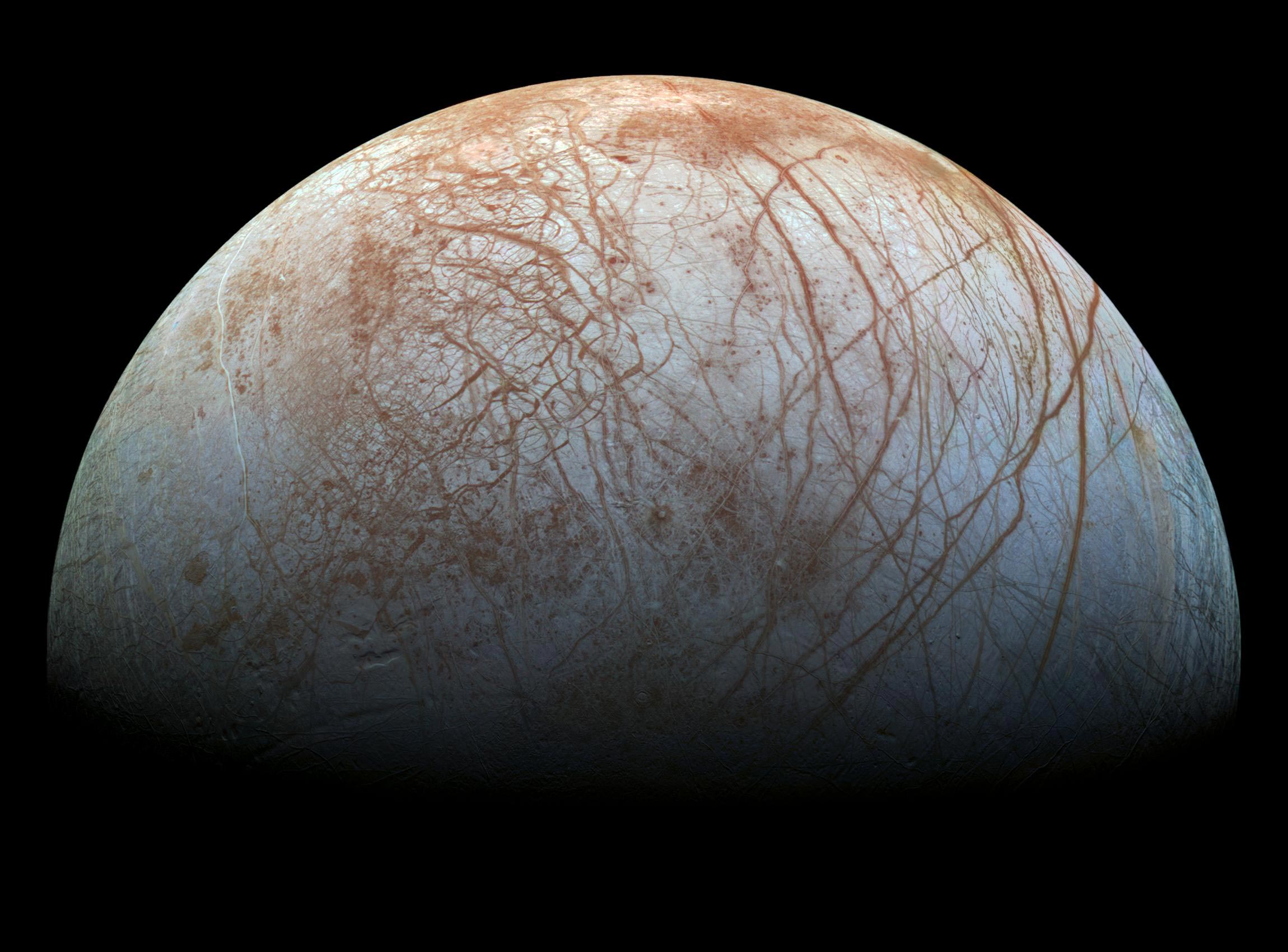
Ice Sublimating Off the Surface Replenishes a Tenuous Envelope
You would think that living half a billion miles from the Sun would be no place to call home. But planetary astronomers are very interested in exploring the moon Europa in search of life. Slightly smaller than Earth’s moon, Europa orbits monstrous Jupiter. Surface temperatures on the icy moon never rise above a frigid minus 260 degrees Fahrenheit (-160 degrees Celsius). A temperature so cold that water-ice is as hard as rock.
Yet, beneath the solid ice crust, there may be a global ocean with more water than found on Earth. And, where there is water, there could be life. Like a leaky garden hose, the ocean vents water vapor into space from geysers poking through cracks in the surface, as first photographed by the Hubble Space Telescope in 2013.
The latest twist comes from archival Hubble observations, spanning 1999 to 2015, which find that water vapor is constantly being replenished throughout one hemisphere of the moon. That’s a bit mysterious. Nevertheless, the atmosphere is only one-billionth the surface pressure of Earth’s atmosphere.
The water vapor wasn’t seen directly, but rather oxygen’s ultraviolet spectral fingerprint was measured by Hubble. Oxygen is one of the constituents of water. Unlike the geysers, this water vapor is not coming from Europa’s interior, but rather sunlight is causing the surface ice to sublimate. A similar water vapor atmosphere was recently found on the Jovian moon Ganymede.
Europa is so exciting as a potential abode of life it is a target of NASA’s Europa Clipper and the Jupiter Icy Moons Explorer (JUICE) of the European Space Agency – planned for launch within a decade.
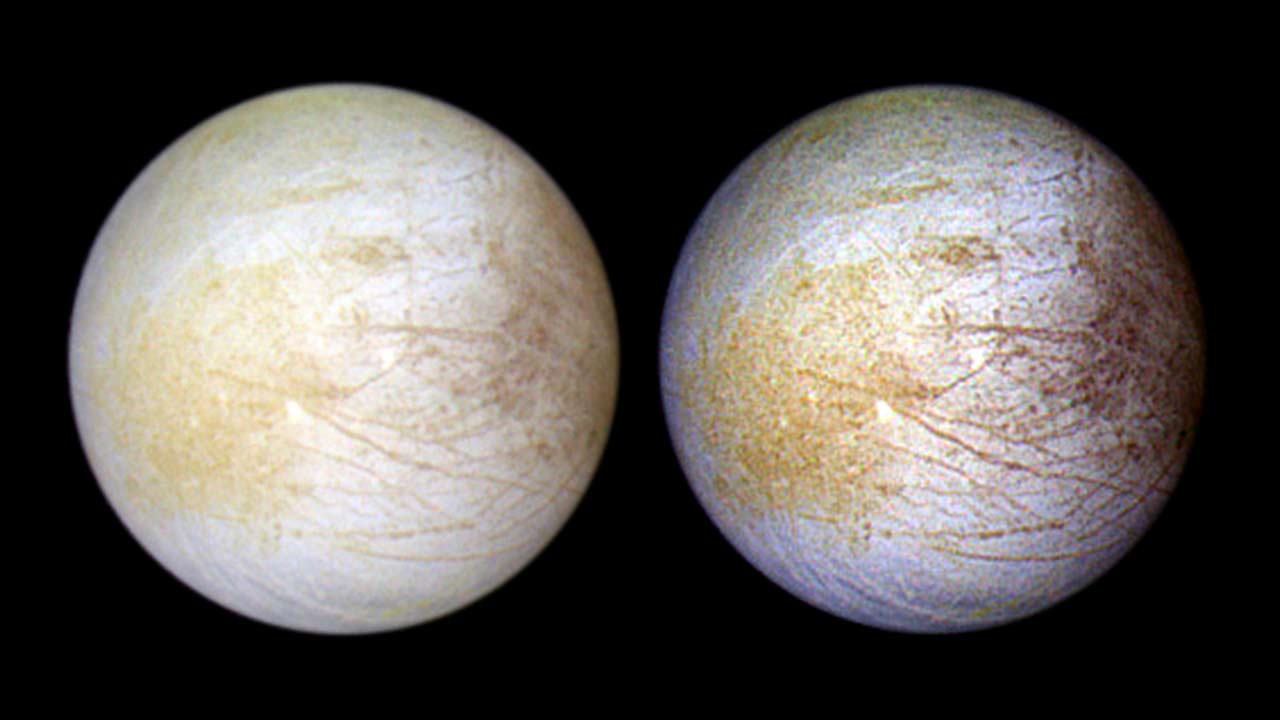
NASA’s Hubble Space Telescope observations of Jupiter’s icy moon Europa have revealed the presence of persistent water vapor — but, mysteriously, only in one hemisphere.
Potential for Life and Exploration
Europa harbors a vast ocean underneath its icy surface, which might offer conditions hospitable for life. This result advances astronomers’ understanding of the atmospheric structure of icy moons, and helps lay the groundwork for planned science missions to the Jovian system to, in part, explore whether an environment half a billion miles from the Sun could support life.
Previous observations of water vapor on Europa have been associated with plumes erupting through the ice, as photographed by Hubble in 2013. They are analogous to geysers on Earth, but extend more than 60 miles (96 kilometers) high. They produce transient blobs of water vapor in the moon’s atmosphere, which is only one-billionth the surface pressure of Earth’s atmosphere.
The new results, however, show similar amounts of water vapor spread over a larger area of Europa in Hubble observations spanning from 1999 to 2015. This suggests a long-term presence of a water vapor atmosphere only in Europa’s trailing hemisphere — that portion of the moon that is always opposite its direction of motion along its orbit. The cause of this asymmetry between the leading and trailing hemisphere is not fully understood.
This discovery is gleaned from a new analysis of Hubble archival images and spectra, using a technique that recently resulted in the discovery of water vapor in the atmosphere of Jupiter’s moon Ganymede, by Lorenz Roth of the KTH Royal Institute of Technology, Space and Plasma Physics, Sweden.
“The observation of water vapor on Ganymede, and on the trailing side of Europa, advances our understanding of the atmospheres of icy moons,” said Roth. “However, the detection of a stable water abundance on Europa is a bit more surprising than on Ganymede because Europa’s surface temperatures are lower than Ganymede’s.”
Sublimation in Extreme Cold
Europa reflects more sunlight than Ganymede, keeping the surface 60 degrees Fahrenheit cooler (33 degrees Celsius) than Ganymede. The daytime high on Europa is a frigid minus 260 degrees Fahrenheit. Yet, even at the lower temperature, the new observations suggest water ice is sublimating — that is, transforming directly from solid to vapor without a liquid phase — off Europa’s surface, just like on Ganymede.
To make this discovery, Roth delved into archival Hubble datasets, selecting ultraviolet observations of Europa from 1999, 2012, 2014 and 2015 while the moon was at various orbital positions. These observations were all taken with Hubble’s Space Telescope Imaging Spectrograph (STIS). The ultraviolet STIS observations allowed Roth to determine the abundance of oxygen — one of the constituents of water — in Europa’s atmosphere, and by interpreting the strength of emission at different wavelengths he was able to infer the presence of water vapor.
This detection paves the way for in-depth studies of Europa by future probes including NASA’s Europa Clipper and the Jupiter Icy Moons Explorer (JUICE) mission from the European Space Agency (ESA). Understanding the formation and evolution of Jupiter and its moons also helps astronomers gain insights into Jupiter-like planets around other stars.
These results have been published in the journal Geophysical Research Letters.
Reference: “A Stable H2O Atmosphere on Europa’s Trailing Hemisphere From HST Images” by Lorenz Roth, 13 September 2021, Geophysical Research Letters.
DOI: 10.1029/2021GL094289
The Hubble Space Telescope is a project of international cooperation between NASA and ESA (European Space Agency). NASA’s Goddard Space Flight Center in Greenbelt, Maryland, manages the telescope. The Space Telescope Science Institute (STScI) in Baltimore, Maryland, conducts Hubble science operations. STScI is operated for NASA by the Association of Universities for Research in Astronomy in Washington, D.C.
Never miss a breakthrough: Join the SciTechDaily newsletter.
Follow us on Google and Google News.
10 Comments
“All these worlds are yours except Europa. Attempt no landings there.”
Boring response, don’t you think?
“And, where there is water, there could be life.” More than water is needed. The most important thing is some protection from the Sun/star’s DNA damaging UV radiation. That means a source of oxygen to form ozone.
? It’s an ice moon – the ocean is protected by (thick) ice. No UV where the liquid water exist.
Crazy thought. They’re using the Hubble to look for water jets erupting from europa. NASA seems to have forgotten that the Juno orbiter is circling Jupiter why not retask it for a closer look at europa.
Is Juno equipped for that?
It can’t stand the heat (radiation).
That’s why we have Europa Express coming up. It will have thicker shields and do quick “dips” down in Jupiter’s massive radiation belts to do some closer science.
Ice sheets thousands of feet if not miles thick would provide protection from UV radiation.
“260 degrees Fahrenheit”
Wish you’d use the ISO unit of temperature (Celsius) especially with “science” in your publication’s name
@Ken Towe – the “great oxidation event” on Earth was CAUSED by life. Photosynthesising cyanobacteria existed for millions of years before the ozone layer formed, protected by the ocean. The natural by-product released oxygen into the atmosphere, some of which was subjected to electrolysis in electrical storms, creating the 03 molecules.