
Close Menu
    Facebook X (Twitter) Instagram
    SciTechDaily
    • Biology
    • Chemistry
    • Earth
    • Health
    • Physics
    • Science
    • Space
    • Technology
    Facebook X (Twitter) Pinterest YouTube RSS
    SciTechDaily
    Home»Earth»Exploring Earth From Space: Kourou – Home to Europe’s Spaceport in French Guiana [Video]
    Earth

    Exploring Earth From Space: Kourou – Home to Europe’s Spaceport in French Guiana [Video]

    By European Space Agency (ESA)December 17, 2021No Comments4 Mins Read
    Facebook Twitter Pinterest Telegram LinkedIn WhatsApp Email Reddit
    Share
    Facebook Twitter LinkedIn Pinterest Telegram Email Reddit
    Kourou, French Guiana
    Ahead of the upcoming Ariane 5 launch of the James Webb Space Telescope, the Copernicus Sentinel-2 mission takes us over Kourou – home to Europe’s Spaceport in French Guiana, an overseas department of France. Located around 60 km northwest of the French Guianese capital Cayenne, Kourou is a coastal town in the north-central part of the country and is visible in the lower right of the image. The town lies at the estuary of the Kourou River which, after its journey of 144 km, empties into the Atlantic Ocean. Its muddy waters appear brown most likely due to sediments picked up from the surrounding forest. Credit: Contains modified Copernicus Sentinel data (2020), processed by ESA, CC BY-SA 3.0 IGO

    Ahead of the upcoming Ariane 5 launch of the James Webb Space Telescope, the Copernicus Sentinel-2 mission takes us over Kourou – home to Europe’s Spaceport in French Guiana, an overseas department of France.

    Located around 60 km (37 mi) northwest of the French Guianese capital Cayenne, Kourou is a coastal town in the north-central part of the country and is visible in the lower right of the image. The town lies at the estuary of the Kourou River which, after its journey of 144 km (89 mi), empties into the Atlantic Ocean. Its muddy waters appear brown most likely due to sediments picked up from the surrounding forest.

    Long, white sandy beaches line the town’s ocean coast, while the riverbank and inland area consists mostly of mangrove and dense tropical rainforest. The surrounding area’s economy is largely agricultural, with coffee, cacao, and tropical fruits being grown.

    Just northwest of Kourou lies Europe’s Spaceport – chosen as a base from which to launch satellites in 1964 by the French Government, and currently home to ESA-developed rocket families Ariane and Vega.
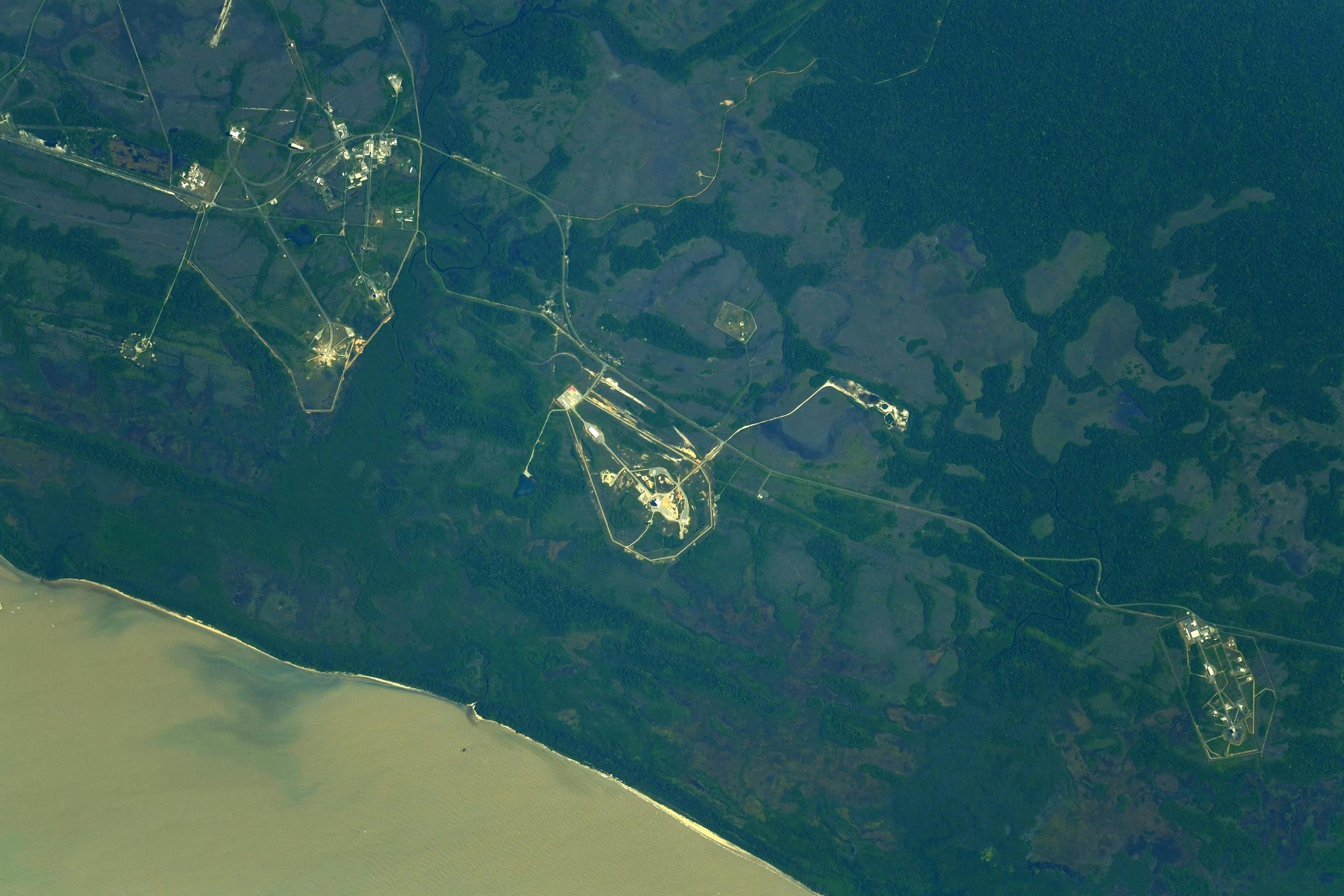
    Europe’s Spaceport Seen From Space
    Europe’s Spaceport in French Guiana guarantees independent, reliable access to space for Europe. This launch base and the jungle that surrounds it covers 690 km2. ESA owns the special infrastructure built for the Ariane, Soyuz and Vega rockets, this includes launch vehicle and satellite preparation buildings, launch operation facilities and a plant for making solid propellant and integrating solid rocket motors. Credit: ESA/NASA

    As Kourou lies just 500 km (310 mi) north of the equator, it makes it ideally placed for launches into orbit as the rockets gain extra performance thanks to a ‘slingshot effect’ from the speed of Earth’s rotation. In addition, there is no risk of cyclones or earthquakes. This launch base and the jungle that surrounds it covers 690 sq km (266 sq mi) and protects an abundance of wildlife and plants.
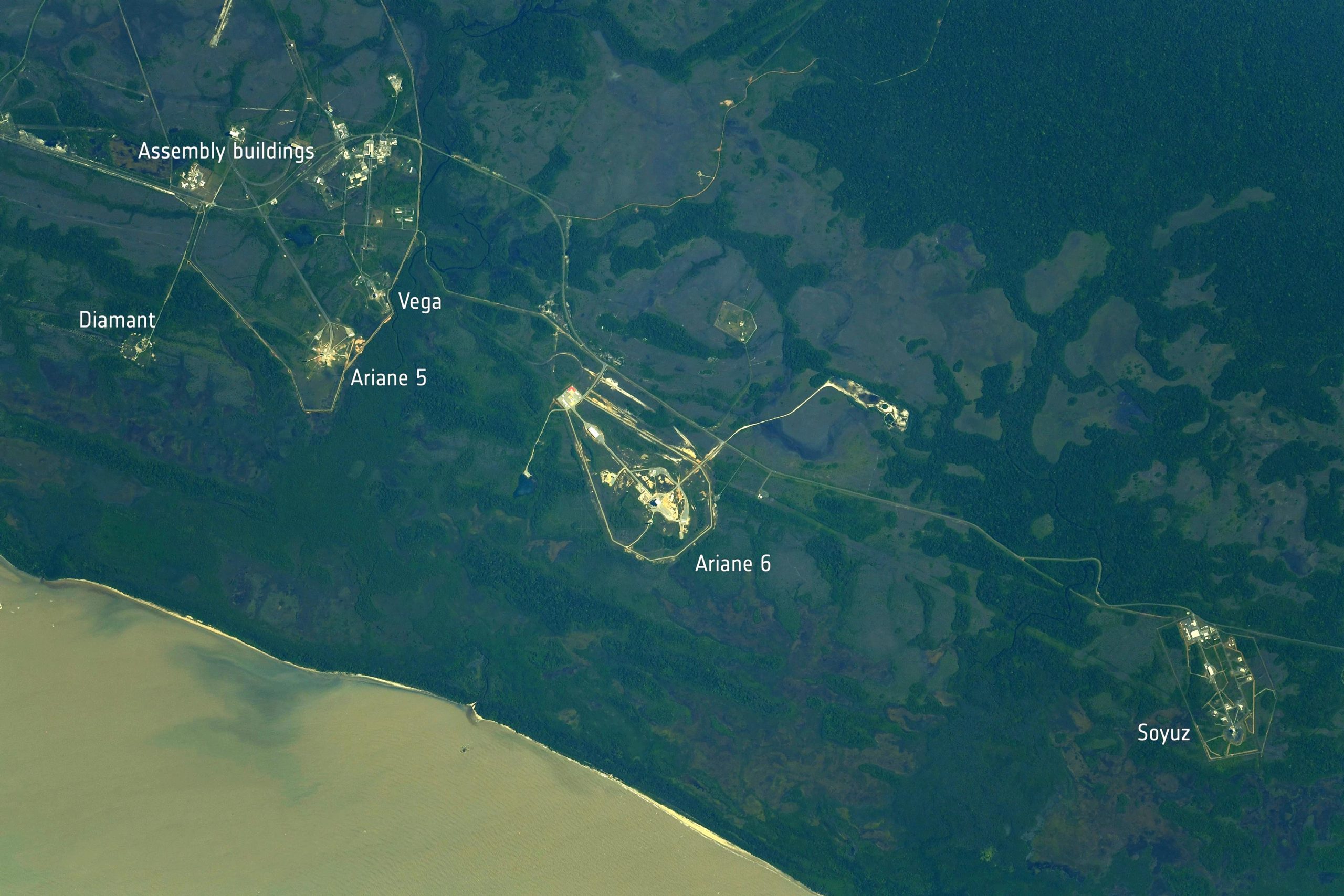
    Europe’s Spaceport Seen From Space Annotated
    At the center of the picture is the launch complex for Ariane 6, built for ESA by the French space agency, CNES and its partners, it was inaugurated on 28 September 2021. Available in two versions, with either two or four boosters, Ariane 6 will replace Europe’s heavy-lift Ariane 5 to offer more performance and flexibility. ESA’s upcoming Vega-C will use the same launch zone (pictured left) as its Vega predecessor. Credit: ESA/NASA

    From here, the largest and most powerful telescope ever launched into space – the James Webb Space Telescope – is scheduled for launch. After liftoff, it will embark on a month-long journey to its destination, around one and a half million kilometers from Earth.

    Following the footsteps of the Hubble Space Telescope, Webb is designed to answer questions about the Universe and to make breakthrough discoveries in all fields of astronomy. The telescope will be able to detect infrared light generated by galaxies as they formed more than 13.5 billion years ago, in the aftermath of the Big Bang. Webb will see farther into our origins – from the Universe’s first galaxies, to the birth of stars and planets, to exoplanets.

    In the first month after launch, Webb will unfold its sunshield, which is around the size of a tennis court, and deploy its 6.5-meter (21-foot) primary mirror. This will be used to detect the faint light of distant stars and galaxies with a sensitivity of a hundred times greater than that of Hubble.

    Webb is a joint project between NASA, ESA and the Canadian Space Agency (CSA).

    Never miss a breakthrough: Join the SciTechDaily newsletter.
    Follow us on Google and Google News.

    European Space Agency Geography
    Share. Facebook Twitter Pinterest LinkedIn Email Reddit

    Related Articles

    Breathtaking View of Andros, Bahamas From Space [Video]

    Stunning Views of Houston Texas From Copernicus Sentinel-1 Satellite

    Earth From Space: Bolivian Highland Heart [Video]

    Flevoland, Netherlands From Space: One of the Largest Land Reclamation Projects in the World

    Earth From Space: Lake George, Uganda – A Center for Biological Diversity [Video]

    Deforestation in Bolivia Spied From Space Satellite

    Earth From Space: Japanese Archipelago [Video]

    Earth From Space: Faroe Islands [Video]

    Earth From Space: Tromsø, Norway [Video]

    Leave A Reply Cancel Reply

    • Facebook
    • Twitter
    • Pinterest
    • YouTube

    Don't Miss a Discovery

    Subscribe for the Latest in Science & Tech!

    Trending News

    New “Nanozyme Hypothesis” Could Rewrite the Story of Life’s Origins

    Anatomy Isn’t Finished: The Human Body Still Holds Secrets

    “Pretty Close to Home”: The Hidden Earthquake Threat Beneath Seattle

    The Surprising Reason You Might Want To Sleep Without a Pillow

    Scientists Say This Natural Hormone Reverses Obesity by Targeting the Brain

    35-Million-Year-Old Mystery: Strange Arachnid Discovered Preserved in Amber

    Is AI Really Just a Tool? It Could Be Altering How You See Reality

    JWST Reveals a “Forbidden” Planet With a Baffling Composition

    Follow SciTechDaily
    • Facebook
    • Twitter
    • YouTube
    • Pinterest
    • Newsletter
    • RSS
    SciTech News
    • Biology News
    • Chemistry News
    • Earth News
    • Health News
    • Physics News
    • Science News
    • Space News
    • Technology News
    Recent Posts
    • Artificial Sweeteners May Harm Future Generations, Study Suggests
    • The Ocean Current Stronger Than All Rivers Changed Earth Forever
    • NASA Artemis II Splashdown and Astronaut Recovery Operation [Image Gallery]
    • Splashdown! NASA Artemis II Returns From Record-Breaking Moon Mission
    • Scientists Freeze a Spinning Nanoparticle to Its Quantum Limit
    Copyright © 1998 - 2026 SciTechDaily. All Rights Reserved.
    • Science News
    • About
    • Contact
    • Editorial Board
    • Privacy Policy
    • Terms of Use

    Type above and press Enter to search. Press Esc to cancel.