
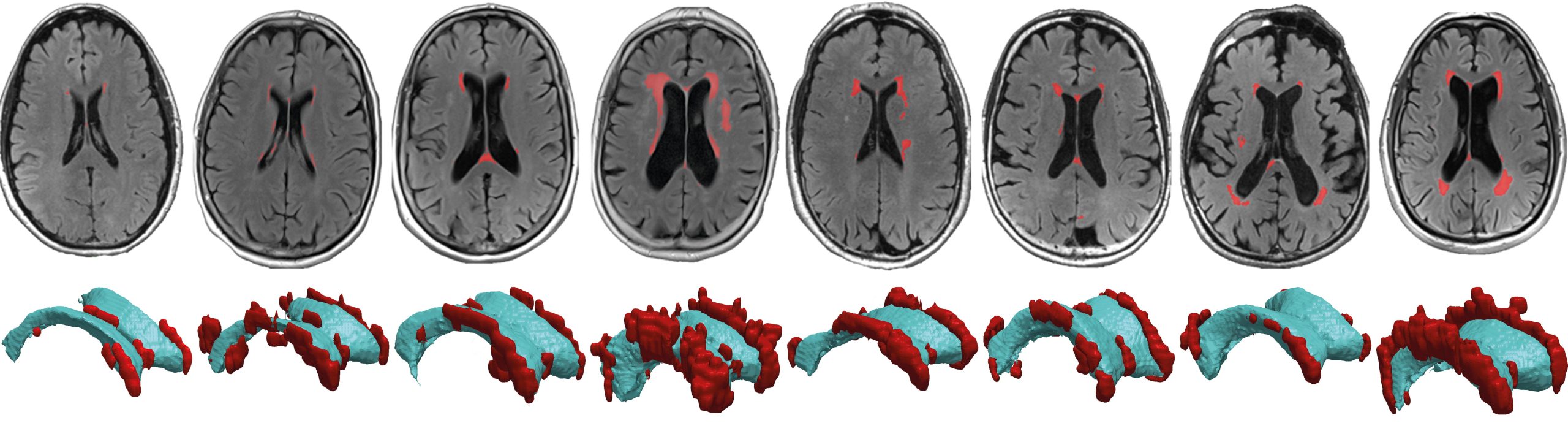
Researchers at Stevens Institute of Technology show that strain on ventricular walls explains where lesions develop in the aging brain.
As our brains age, small lesions begin to pop up in the bundles of white matter that carry messages between our neurons. The lesions can damage this white matter and lead to cognitive deficits. Now, researchers at Stevens Institute of Technology and colleagues not only provide an explanation for the location of these lesions but also how they develop in the first place.
The work, led by Johannes Weickenmeier, an assistant professor of mechanical engineering at Stevens, highlights the importance of viewing the brain as more than neural circuitry that underpins how thoughts are formed, and memories created. It’s also a physical object that’s prone to glitches and mechanical failures. “The brain is susceptible to wear and tear in vulnerable areas,” Weickenmeier said. “Especially in an aging brain, we need to look at its biomechanical properties to better understand how things can start to go wrong.”
These lesions — known as deep and periventricular white matter hyperintensities because they show up as bright white patches on MRI scans — are poorly understood. But they are not uncommon: most people have some by the time they reach their 60s, and changes only increase with age. The more lesions that accumulate and the faster they grow, the more prone we become to cognitive impairments ranging from memory problems to motor disorders.
Using MRI scans from eight healthy subjects, Weickenmeier worked with Valery Visser, now a doctorate student at the University of Zurich, and Henry Rusinek, a radiologist at NYU Grossman School of Medicine, to develop an individualized computer model of each subject’s brain. The team mapped the strain placed on ventricular walls, the linings of fluid-filled chambers deep in the brain, as waves of pressure pulse through the subject’s cerebral spinal fluid, or CSF. They found that hyperintensities tend to occur near areas that must stretch more to accommodate pressure changes of the circulating CSF because, as such areas wear thin, CSF can leak into the brain and cause lesions.
“The cell wall that lines the ventricles wears out over time, like a balloon that’s repeatedly blown up and deflated,” said Weickenmeier. “And the stresses aren’t uniform — they’re defined by the geometry of the ventricle, so we can predict where these failures will occur.”
The model provides a simple, physics-based explanation for the locations of these lesions, revealing that mechanical loads “must be a major contributor to the onset of disease,” said Weickenmeier.
The team’s research, published recently in Scientific Reports, used 2D imaging showing a cross-section of the brain, but Weickenmeier’s team has since expanded its research to a full 3D model of the brain. Next, Weickenmeier hopes to use advanced MRI technologies developed at Stevens to study the movement of the ventricle wall directly.
In the long term, the team’s findings might enable the development of new treatments for lesions. Ordinarily, pharmaceutical treatments struggle to cross the blood-brain barrier and reach affected areas, but the new research suggests that it might be possible to channel drugs to lesions directly through leaks in the ventricular wall. “That’s still a long way off, and we didn’t study it directly,” Weickenmeier cautioned. “But it’s an intriguing possibility.”
The broader takeaway from the team’s research, explained Weickenmeier, is that the brain’s aging process is mediated by physical processes, including the pressure of circulating blood and CSF. That underscores the need for healthy behaviors — such as getting enough exercise and avoiding harmful substances — that can reduce those strains on the brain.
Reference: “Peak ependymal cell stretch overlaps with the onset locations of periventricular white matter lesions” by Valery L. Visser, Henry Rusinek and Johannes Weickenmeier, 9 November 2021, Scientific Reports.
DOI: 10.1038/s41598-021-00610-1
Never miss a breakthrough: Join the SciTechDaily newsletter.
Follow us on Google and Google News.
11 Comments
Seconding “Egghead’s” comment. Willful ignorance is not a badge of honor.
These researchers are so useless. Millions of dollars spent to provide nothing. Get some creative people in there who can think outside the box and actually discover some real results. We put people in these positions who are good at memorization but lack street smarts or real smarts.
I also wish to endorse the message of ‘Egghead’. Scientists are often criticized for using technical jargon and yet ’10th man’ is offended by the use of ‘wear and tear’. I am also puzzled by his comment that none moving parts don’t suffer wear and tear when the article CLEARLY states that pressure waves propagating up the CSF cause stretching of the vessels in the brain. The article also cautions against the ingestion of harmful substance which, when combined with poor reading comprehension, lead to a downward spiral of obnoxiousness.
This article could not have been more clear or more understandable to the lay person and I thank you for it. As to wear and tear on non-moving parts, the exterior of our houses experiences wear and tear, as do cooking utensils and clothing. A garden hose under constant or intermittent high pressure will, over time, experience wear and tear. So the balloon analogy was a great one that all of us can relate to. I am by no means an “egghead” – I wish I were – and this article was completely understandable and enlightening. As a 74 year old, I thank you for the insight as to why I’m not as mentally sharp as I was at 30!
I came across this article as I was scrolling my Google news. I want to say that I’m so thankful that there are scientists that are searching for answers to help our brains. So many people’s lives would be improved. Keep up the good work!
Sorry I have to agree with 10th man here. He is entirely correct about scientists.
This article and research would have been useful if they figured out what the actual harmful substances were. But probably too scared to test man made substances because they are funded by big business. People in research are ego driven individuals who are afraid to rock the boat and spend entire lives trying to appease their teachers and big businesses that fund them.
Maybe by “harmful substances” they mean work in a late capitalist society. ‘Seems way more stressful than what we normally think of as “substances.”
Thank you for the response from one Egghead to another. I agree entirely with your response. Additionally, I would like to add: Our brains have been found to be very plastic especially while we are young. Therefore it is easier to repair some damage more easily in our youth vs as we age. They are only recently determining that neurons are able to repair themselves/regrow but again this plasticity is more common in our youth.
The idea of plasticity is excellent because few organs have this ability. Many things can cause lesions such as autoimmune disease or migraines. It is amazing that MRIs now provide science a better way to view and test brain function vs the previous option of only biopsy often after death.
Learning how our brains age specific to these holes in the stretches areas and the blood brain barrier should be very beneficial to most autoimmune diseases imho. The ability to transfer medicine across this barrier fully saturating areas where lesions exist could be a game changer for these patients. I look forward to seeing where this research leads.
Fascinating! I’d like to know more about the mechanics of the ” wear and tear”. I wonder if there are any common genetic or environmental factors for individuals with the indicative white spots. My goal is always prevention. Knowing if moderating diet,behavior, etc. could help improve chances of not needing medications to cross the blood brain barrier would be an equally Fascinating article to read.
We will be bearing my Daddy this coming Monday. He died three days after Christmas from lesions on his brain. I have never heard of that before. So I am happy to hear that someone is doing research on this area of the brain and maybe they will come up with a way to treat this disease. Thank you for this article. And please keep up the good work.