
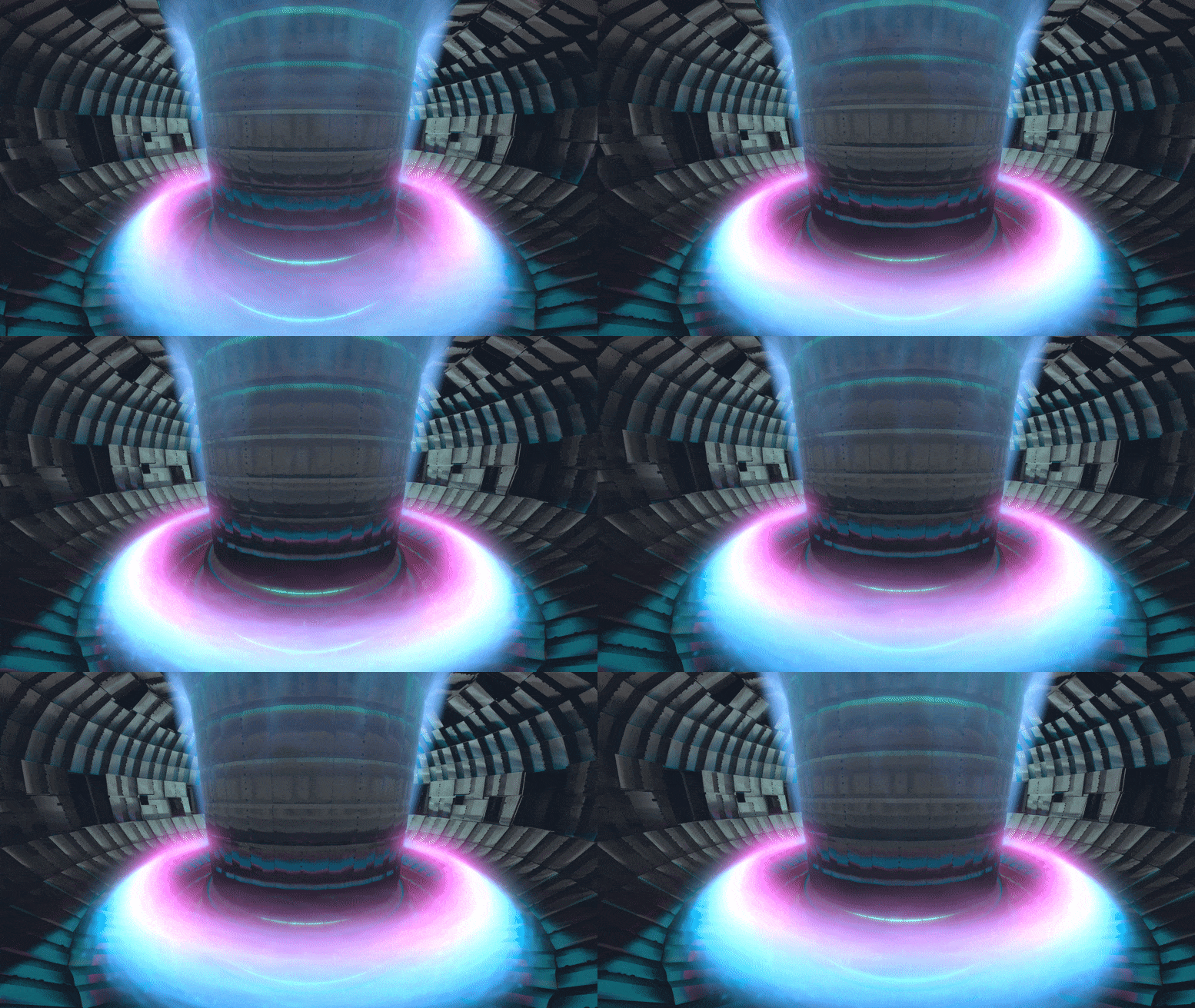
Researchers discovered that injecting boron into fusion devices boosts heat confinement and reaction efficiency, marking a significant advance in fusion technology. The experiment conducted on Japan’s Large Helical Device shows promising results for future fusion reactors.
Scientists have found that adding a common household cleaning agent – the mineral boron contained in such cleaners as Borax – can vastly improve the ability of some fusion energy devices to contain the heat required to produce fusion reactions on Earth the way the sun and stars do.
Improved Confinement in Stellarators
Physicists at the U.S. Department of Energy’s (DOE) Princeton Plasma Physics Laboratory (PPPL) working with Japanese researchers, made the observation on the Large Helical Device (LHD) in Japan, a twisty magnetic facility that the Japanese call a “heliotron.” The results demonstrated for the first time a novel regime for confining heat in facilities known as stellarators, similar to the heliotron. The findings could advance the twisty design as a blueprint for future fusion power plants.
Researchers produced the higher confinement regime by injecting tiny grains of boron powder into the LHD plasma that fuels fusion reactions. The injection through a PPPL-installed dropper sharply reduced turbulent swirls and eddies and raised the confined heat that produces the reactions.
“We could see this effect very clearly,” said PPPL physicist Federico Nespoli, lead author of a new paper that detailed the process in the journal Nature Physics. “The more power we put into the plasma the bigger the increase in heat and confinement, which would be ideal in real reactor conditions.”

Said David Gates, a principal research physicist at PPPL who heads the Advanced Projects Department that oversaw the work: “I am very excited about these excellent results that Federico has written up in this important paper about our collaborations with the team on the Large Helical Device. When we launched this project – the LHD Impurity Powder Dropper – in 2018 we had hopes that there might be an effect on energy confinement. The observations are even better than we expected with turbulence suppression across a large fraction of the plasma radius. I am very grateful to our Japanese colleagues for giving us the opportunity for our team to participate in these experiments.”
The findings also delighted Japanese researchers. “We are very pleased and excited to get these results,” said Masaki Osakabe, executive director of the LHD project and science adviser for nuclear fusion research for MEXT, the Japanese ministry responsible for nuclear power. “We are also honored to be collaborators with PPPL,” Osakabe said. “The findings revealed with this collaboration will provide a nice tool to control the high-performance plasma in a fusion reactor.”
Stellarator Design and Fusion Potential
Stellarators, first constructed in the 1950s under PPPL founder Lyman Spitzer, are a promising concept that have long trailed symmetrical magnetic facilities called tokamaks as the leading device for producing fusion energy. A history of relatively poor heat confinement has played a role in holding back stellarators, which can operate in a steady state with little risk of the plasma disruptions that tokamaks face.
Fusion combines light components in the form of plasma — the hot, charged state of matter made of free electrons and atomic nuclei, or ions that account for 99 percent of the visible universe — to produce tremendous quantities of energy. Tokamaks and stellarators are the primary magnetic designs used by scientists to capture safe, clean, and nearly infinite fusion power in order to provide fusion energy for mankind.
Boron’s Role in Reducing Turbulence
Although boron has long been used to condition walls and improve confinement in tokamaks, scientists have not previously seen, “a widespread turbulence reduction and temperature increase like the one reported in this article,” according to the paper. Moreover, absent from the observations were damaging bursts of heat and particles, called edge localized modes (ELMs), that can occur in tokamaks and stellarators during high-confinement, or H-mode, fusion experiments.
According to the paper, the notable improvement in heat and confinement in LHD plasma may have occurred from a decrease in what is known as the ion temperature gradient (ITG) instability, which induces turbulence and causes plasma to leak from confinement. The lowering of turbulence contrasts with the second major source of particle escape from stellarator confinement, a type of heat loss known as “neoclassical transport.”
Ongoing Research and Optimism for Stellarators
A new round of LHD experiments is now underway that will test whether the improvement in heat and confinement continues for an increased range of mass injection rates, plasma density, and heating power. Nespoli and colleagues would also like to see if carbon powder can work as well as boron. “Boron creates coating on the wall that is good for confinement and carbon will not do that,” he said. “We want to see if all powder is good or if it’s boron that makes conditions better.”
Additional goals include assessing the ability of boron to improve plasma performance during steady-state LHD operation, which is capable of extremely long plasma discharges of up to one hour. Such experiments could produce fresh evidence of the value of the stellarator design going forward.
Reference: “Observation of a reduced-turbulence regime with boron powder injection in a stellarator” by F. Nespoli, S. Masuzaki, K. Tanaka, N. Ashikawa, M. Shoji, E. P. Gilson, R. Lunsford, T. Oishi, K. Ida, M. Yoshinuma, Y. Takemura, T. Kinoshita, G. Motojima, N. Kenmochi, G. Kawamura, C. Suzuki, A. Nagy, A. Bortolon, N. A. Pablant, A. Mollen, N. Tamura, D. A. Gates and T. Morisaki, 10 January 2022, Nature Physics.
DOI: 10.1038/s41567-021-01460-4
Support for this work comes from the DOE Office of Science.
Never miss a breakthrough: Join the SciTechDaily newsletter.
Follow us on Google and Google News.