
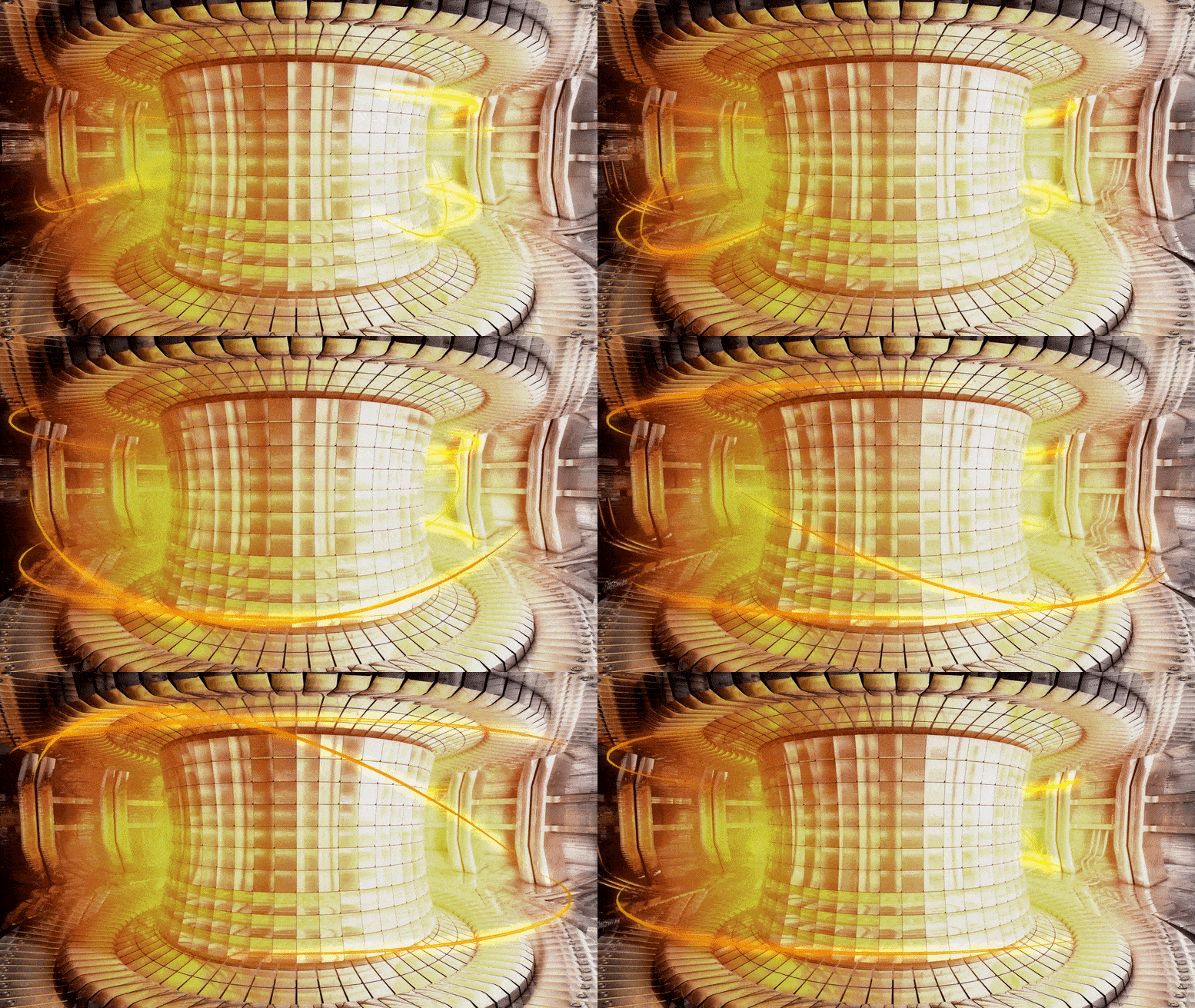
Household Boron Could Boost Fusion Power
Want to improve your chances of making electricity from fusion? Look no further than the cleaners under your kitchen sink.
Research led by scientists at the U.S. Department of Energy’s (DOE) Princeton Plasma Physics Laboratory (PPPL) provides new evidence that particles of boron, the main ingredient of Borax household cleaner, can coat internal components of doughnut-shaped plasma devices known as tokamaks and improve the efficiency of the fusion reactions.
“Our experiment brings key insights into how this technique works,” said PPPL physicist Alessandro Bortolon, lead author of a paper reporting the findings in Nuclear Fusion. “The results will help clarify whether the controlled injection of boron powder could be used to support efficient operation of future fusion reactors.”
Fusion combines light elements in the form of plasma — the hot, charged state of matter composed of free electrons and atomic nuclei — in a process that can generate massive amounts of energy. Scientists are seeking to harness fusion, which powers the sun and stars, to create a virtually inexhaustible supply of power to generate electricity.
The researchers found that the boron injection technique makes it easier to produce reliably high-performance plasmas in tokamaks with interior components lined with light elements like carbon, commonly used in present-day devices. The results were derived from experiments on the DIII-D National Fusion Facility that General Atomics operates for the DOE.

The research supplements previous findings from experiments conducted on the Axially Symmetric Divertor Experiment-Upgrade (ASDEX-U), operated by the Max Planck Institute for Plasma Physics in Garching, Germany. Those experiments showed that the boron injection technique enabled access to high-performance plasmas in tokamaks with interiors coated with metals like tungsten. Together, the DIII-D and ASDEX-U experiments provide strong evidence that the boron injection technique will ensure good plasma performance for a range of fusion machines.
The DIII-D experiments also filled in a missing piece of information confirming that the injection technique leads to laying down a boron layer inside a tokamak. “You would intuitively think that when boron powder drops into the plasma, the boron would dissolve and go somewhere in the tokamak,” Bortolon said. “But no one had ever tried to confirm the formation of a boron layer by the plasma itself. There was zero information. This is the first time this has been directly shown and measured using this technique.”
Keeping Plasmas Clean and Stable
The boron layer prevents material transferring from the interior wall into the plasma, keeping the plasma free from impurities that could dilute the main plasma fuel. Fewer impurities make the plasma more stable and reduces the frequency of disruptions.
The injection technique could complement or even replace the current technique for laying down boron, which requires shutting down the tokamak for up to several days. That technique, known as glow-discharge boronization, also involves toxic gas.
The boron powder method removes these issues. “If you use boron powder injection, you wouldn’t have to interrupt everything and turn off the tokamak’s magnetic coils,” Bortolon said. “Also, you don’t have to worry about handling a toxic gas. Having a tool like this could be extremely important for future fusion devices.”
Reference: “Observations of wall conditioning by means of boron powder injection in DIII-D H-mode plasmas” by A. Bortolon, R. Maingi, A. Nagy, J. Ren, J.D. Duran, A. Maan, D.C. Donovan, J.A. Boedo, D.L. Rudakov, A.W. Hyatt, T.W. Wilks, M.W. Shafer, C.M. Samuell, M.E. Fenstermacher, E.P. Gilson, R. Lunsford, D.K. Mansfield, T. Abrams and R. Nazikian, 28 September 2020, Nuclear Fusion.
DOI: 10.1088/1741-4326/abaf31
This research was supported by the DOE’s Office of Science (Fusion Energy Sciences). Collaborators included scientists from the University of Tennessee-Knoxville, the University of California-San Diego, the Massachusetts Institute of Technology, Oak Ridge National Laboratory, and Lawrence Livermore National Laboratory.
Never miss a breakthrough: Join the SciTechDaily newsletter.
Follow us on Google and Google News.
5 Comments
The sun is a star
Ok I have these house hold cleaners so now whats next I need to make electricity to power up my RV without useing my generator
This is interesting and counterintuitive, as boron kills the reactions. If this works well, I look forward to the write up. If it fails miserably, doe may need new consultants.
@Randy, you need to buy a fusion electric generator, hopefully a portable model. When you add water, you mix in about 2% boron containing cleaner. Don’t add too much.
Great, earth bound fusion just went from insanely impossible to completely impossible. One giant meaningless nothing.