
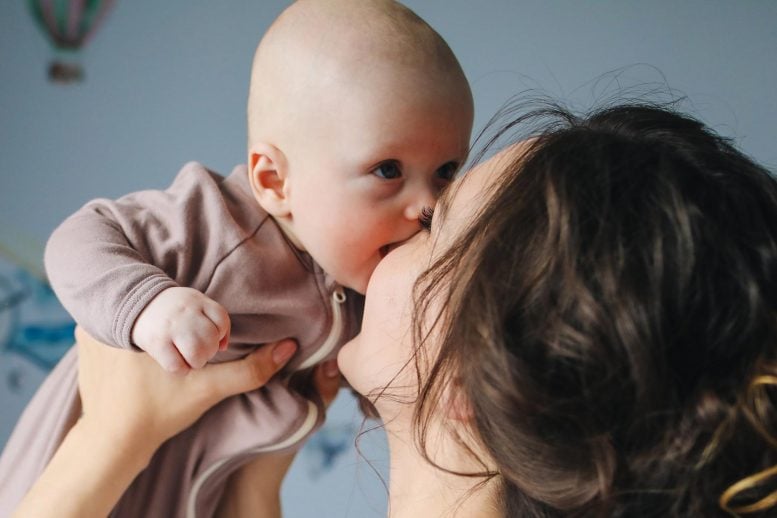
Sharing food and kissing are among the signals babies use to interpret their social world, according to a new study.
MIT scientists found that infants use saliva sharing as a cue to identify reliable social relationships, expecting more help from individuals who engage in actions like kissing or food sharing. This insight was gained through experiments observing babies’ reactions to different social interactions.
Learning to navigate social relationships is a skill that is critical for surviving in human societies. For babies and young children, that means learning who they can count on to take care of them.
MIT neuroscientists have now identified a specific signal that young children and even babies use to determine whether two people have a strong relationship and a mutual obligation to help each other: whether those two people kiss, share food, or have other interactions that involve sharing saliva.
In a new study, the researchers showed that babies expect people who share saliva to come to one another’s aid when one person is in distress, much more so than when people share toys or interact in other ways that do not involve saliva exchange. The findings suggest that babies can use these cues to try to figure out who around them is most likely to offer help, the researchers say.
“Babies don’t know in advance which relationships are close and morally obligating ones, so they have to have some way of learning this by looking at what happens around them,” says Rebecca Saxe, the John W. Jarve Professor of Brain and Cognitive Sciences, a member of MIT’s McGovern Institute for Brain Research and the Center for Brains, Minds, and Machines (CBMM), and the senior author of the new study.
MIT postdoc Ashley Thomas, who is also affiliated with the CBMM, is the lead author of the study, which appears today in Science. Brandon Woo, a Harvard University graduate student; Daniel Nettle, a professor of behavioral science at Newcastle University; and Elizabeth Spelke, a professor of psychology at Harvard, are also authors of the paper.
Sharing Saliva
In human societies, people typically distinguish between “thick” and “thin” relationships. Thick relationships, usually found between family members, feature strong levels of attachment, obligation, and mutual responsiveness. Anthropologists have also observed that people in thick relationships are more willing to share bodily fluids such as saliva.
“That inspired both the question of whether infants distinguish between those types of relationships, and whether saliva sharing might be a really good cue they could use to recognize them,” Thomas says.
To study those questions, the researchers observed toddlers (16.5 to 18.5 months) and babies (8.5 to 10 months) as they watched interactions between human actors and puppets. In the first set of experiments, a puppet shared an orange with one actor, then tossed a ball back and forth with a different actor.
After the children watched these initial interactions, the researchers observed the children’s reactions when the puppet showed distress while sitting between the two actors. Based on an earlier study of nonhuman primates, the researchers hypothesized that babies would look first at the person whom they expected to help. That study showed that when baby monkeys cry, other members of the troop look to the baby’s parents, as if expecting them to step in.
The MIT team found that the children were more likely to look toward the actor who had shared food with the puppet, not the one who had shared a toy, when the puppet was in distress.
In a second set of experiments, designed to focus more specifically on saliva, the actor either placed her finger in her mouth and then into the mouth of the puppet, or placed her finger on her forehead and then onto the forehead of the puppet. Later, when the actor expressed distress while standing between the two puppets, children watching the video were more likely to look toward the puppet with whom she had shared saliva.
Social Cues
The findings suggest that saliva sharing is likely an important cue that helps infants to learn about their own social relationships and those of people around them, the researchers say.
“The general skill of learning about social relationships is very useful,” Thomas says. “One reason why this distinction between thick and thin might be important for infants in particular, especially human infants, who depend on adults for longer than many other species, is that it might be a good way to figure out who else can provide the support that they depend on to survive.”
The researchers did their first set of studies shortly before COVID-19 lockdowns began, with babies who came to the lab with their families. Later experiments were done over Zoom. The results that the researchers saw were similar before and after the pandemic, confirming that pandemic-related hygiene concerns did not affect the outcome.
“We actually know the results would have been similar if it hadn’t been for the pandemic,” Saxe says. “You might wonder, did kids start to think very differently about sharing saliva when suddenly everybody was talking about hygiene all the time? So, for that question, it’s very useful that we had an initial data set collected before the pandemic.”
Doing the second set of studies on Zoom also allowed the researchers to recruit a much more diverse group of children because the subjects were not limited to families who could come to the lab in Cambridge during normal working hours.
In future work, the researchers hope to perform similar studies with infants in cultures that have different types of family structures. In adult subjects, they plan to use functional magnetic resonance imaging (fMRI) to study what parts of the brain are involved in making saliva-based assessments about social relationships.
Reference: “Early concepts of intimacy: Young humans use saliva sharing to infer close relationships” by Ashley J. Thomas, Brandon Woo, Daniel Nettle, Elizabeth Spelke and Rebecca Saxe, 20 January 2022, Science.
DOI: 10.1126/science.abh1054
The research was funded by the National Institutes of Health; the Patrick J. McGovern Foundation; the Guggenheim Foundation; a Social Sciences and Humanities Research Council Doctoral Fellowship; MIT’s Center for Brains, Minds, and Machines; and the Siegel Foundation.
Never miss a breakthrough: Join the SciTechDaily newsletter.
Follow us on Google and Google News.
1 Comment
Did you distinguish smell from taste?