
Close Menu
    Facebook X (Twitter) Instagram
    SciTechDaily
    • Biology
    • Chemistry
    • Earth
    • Health
    • Physics
    • Science
    • Space
    • Technology
    Facebook X (Twitter) Pinterest YouTube RSS
    SciTechDaily
    Home»Technology»Building-Block Solar Cells: Computer Algorithm Searches for New Materials for Better Organic Solar Cells
    Technology

    Building-Block Solar Cells: Computer Algorithm Searches for New Materials for Better Organic Solar Cells

    By Max Planck Institute for Polymer ResearchMarch 13, 2022No Comments3 Mins Read
    Facebook Twitter Pinterest Telegram LinkedIn WhatsApp Email Reddit
    Share
    Facebook Twitter LinkedIn Pinterest Telegram Email Reddit
    Building-Block Solar Cells
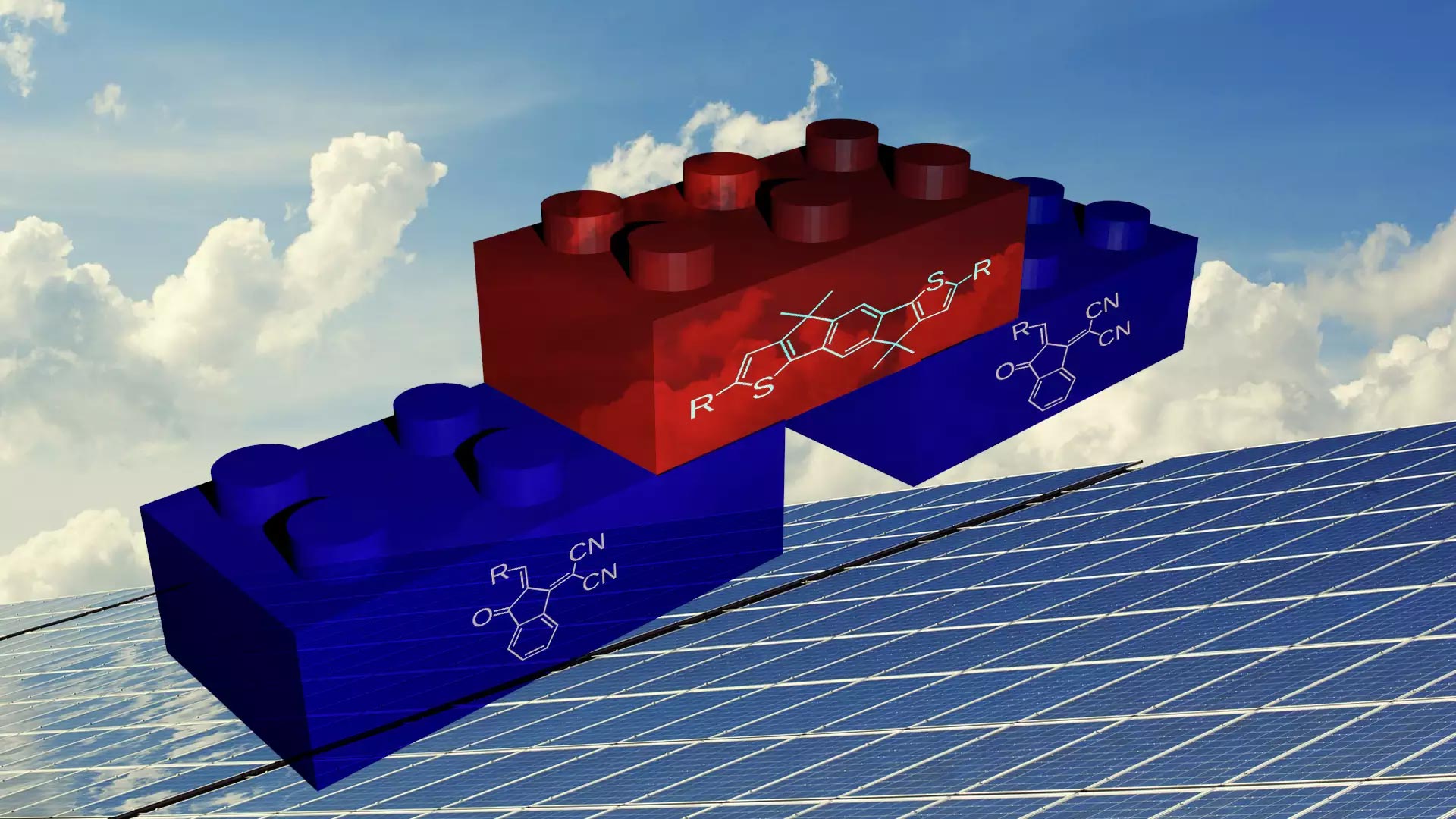
    An algorithm helps to find new efficient solar cell materials by reassembling already known molecular building blocks of solar cells and simulating the resulting molecules. Credit: © MPI-P

    Organic, carbon-based, materials already see widespread use in displays today, but they are also promising materials for new solar cells. However, tailoring their properties is time-consuming and requires extensive chemical synthesis and characterization. A new simulation protocol has now been developed at the Max Planck Institute for Polymer Research that combines already known molecular building blocks to form new structures and correlates them with the solar cell efficiency and could thus significantly simplify development processes.

    Organic solar cells could serve a key role in the transition towards renewable energies. However, a cheap synthetic route and a high cell efficiency are instrumental in aiding this transition. The discovery of a new material class, known as “non-fullerene acceptors,” provides a cost-efficient synthetic route as compared to the more traditional silicon solar cells, while providing a higher efficiency than the first organic solar cells.

    Challenges in Designing Efficient Organic Solar Cells

    The design of these “non-fullerene acceptor” materials with properties tailored for use in solar cells still poses challenges. A new simulation-based design methodology to simplify this procedure has now been developed in the group of Denis Andrienko, department of Kurt Kremer at the Max Planck Institute for Polymer Research, and colleagues. The design methodology makes use of already known organic solar cells with high efficiencies by dividing them into several building blocks. These fragments are made up of either electron-donating or electron-accepting molecular components, so-called “acceptors” and “donors.” Donor and acceptor building blocks from different known solar cells can be combined to give new “non-fullerene acceptor” molecules for use in solar cells.

    “It is a challenge to select the right one from the large number of existing molecular compounds – that is why we use our method to access already existing solar cells and combine their molecular components to create new solar cells,” says Kun-Han Lin, a co-author of the study.

    The design algorithm includes constraints that reduce the number of possible “non-fullerene acceptor” molecules – such as molecular symmetry, quadrupole moment, ionization energy and electron affinity. For example, in cases where an acceptor-donor-acceptor combination is used the two acceptor building blocks are always of the same type.

    This design methodology is already showing promise and helps to predict solar cell efficiency before materials are actually synthesized.

    “We were thrilled when we realized that our method worked: out of 12 predicted efficient solar cells, 10 have already been produced, and are highly efficient,” Andrienko said.

    They have published their work in the renowned journal Advanced Energy Materials.

    Reference: “Chemical Design Rules for Non-Fullerene Acceptors in Organic Solar Cells” by Anastasia Markina, Kun-Han Lin, Wenlan Liu, Carl Poelking, Yuliar Firdaus, Diego Rosas Villalva, Jafar I. Khan, Sri H. K. Paleti, George T. Harrison, Julien Gorenflot, Weimin Zhang, Stefaan De Wolf, Iain McCulloch, Thomas D. Anthopoulos, Derya Baran, Frédéric Laquai and Denis Andrienko, 8 October 2021, Advanced Energy Materials.
    DOI: 10.1002/aenm.202102363

    Never miss a breakthrough: Join the SciTechDaily newsletter.
    Follow us on Google and Google News.

    Algorithm Materials Science Max Planck Institute Photovoltaics Solar Cells Solar Energy
    Share. Facebook Twitter Pinterest LinkedIn Email Reddit

    Related Articles

    Scientists Solve a Long-Standing Solar Cell Problem, Boosting Efficiency by Nearly 30%

    Pushing Past Limits: Tandem Solar Cells Achieve Over 20% Efficiency

    Templating Approach Stabilizes “Ideal” Perovskite Material for Cheap, Efficient Solar Cells

    New “Tandem” Solar Cell to Harnesses More Sunlight

    Aluminum Studs Improve Solar Panel Efficiency

    New 3D Graphene Material – An Inexpensive Replacement for Platinum in Solar Cells

    Disordered Nature of Plastic Polymers Can Improve Performance of Plastic Solar Cells

    Layered Oxide Heterostructures Produce Efficient Solar Cells

    Highly Transparent Polymer Solar Cell Produces Energy by Absorbing Near-Infrared Light

    Leave A Reply Cancel Reply

    • Facebook
    • Twitter
    • Pinterest
    • YouTube

    Don't Miss a Discovery

    Subscribe for the Latest in Science & Tech!

    Trending News

    Giant Crocodylians Ruled South America’s Ancient Food Chain

    Breakthrough in a Bizarre Galaxy Could Help Unlock the Mystery of Dark Matter

    Just 4 Minutes of Daily Strength Training Can Quadruple Fitness in Older Adults

    Almost All Plant-Based Meat Alternatives Contain Mycotoxins, Study Finds

    Astronomers Detect a Record-Breaking “Cosmic Laser” From 8 Billion Light-Years Away

    A 47-Year-Old Scientist Tracked Himself for Months – His Biological Age Fell to 32

    Construction Crew Uncovers Giant 20-Meter Dinosaur in Brazil

    30 Years of Hurricane Data Reveal 4 Warning Signs Before Storms Strengthen

    Follow SciTechDaily
    • Facebook
    • Twitter
    • YouTube
    • Pinterest
    • Newsletter
    • RSS
    SciTech News
    • Biology News
    • Chemistry News
    • Earth News
    • Health News
    • Physics News
    • Science News
    • Space News
    • Technology News
    Recent Posts
    • Researchers Solve Two Major Problems Holding Back SiC Electronics
    • Physicists Hunted a Mysterious Particle – and Found Two Unexpected Structures Instead
    • Nanoscale “Defects” Unlock a Major Heat Transfer Breakthrough
    • World’s Largest Trial of Robotic Knee Surgery Delivers a Surprising Result
    • Scientists Develop an Implant That Could Help the Body Clock Recover From Jet Lag Faster
    Copyright © 1998 - 2026 SciTechDaily. All Rights Reserved.
    • Science News
    • About
    • Contact
    • Editorial Board
    • Privacy Policy
    • Terms of Use

    Type above and press Enter to search. Press Esc to cancel.