
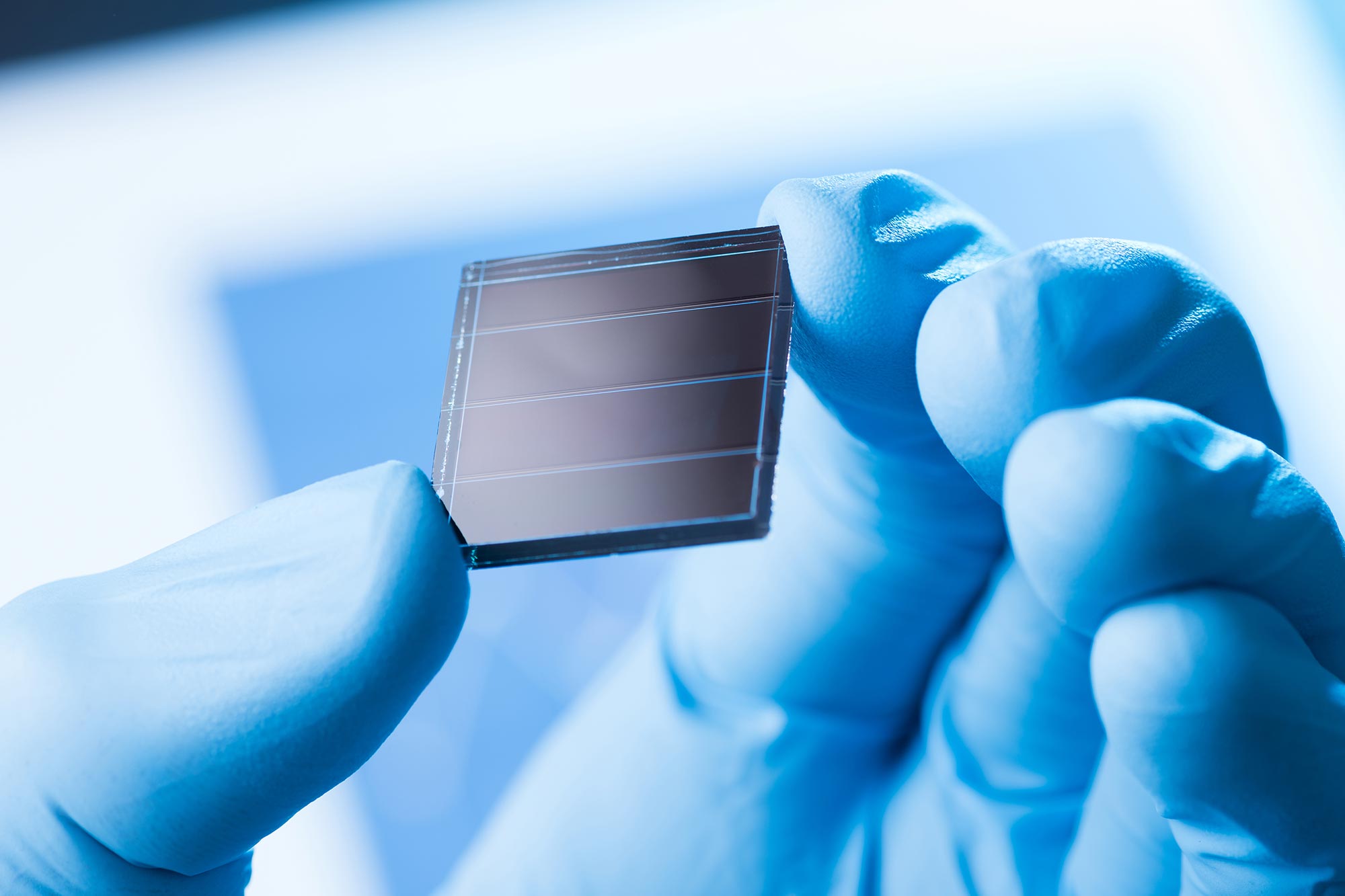
A tandem cell was constructed using perovskite and antimony selenide.
A research team has demonstrated for the first time a proof-of-concept tandem solar cell using antimony selenide as the bottom cell material and a wide-bandgap organic–inorganic hybrid perovskite material as the top cell material. The device achieved a power conversion efficiency of over 20 percent. This study shows that antimony selenide has great potential for bottom cell applications.
The research was recentlys published in the journal Energy Materials and Devices.
Photovoltaic technology, which harnesses sunlight and converts it into electricity, is popular because it provides a clean, renewable energy source. Scientists continue to work to improve the power conversion efficiency, or the measure of efficiency, in solar cells. They have achieved power conversion efficiencies of over 20 percent in conventional single-junction solar cells. To achieve power efficiency above the Shockley-Queisser limit in single-junction solar cells would require much greater costs. However, the Shockley-Queisser limit of single-junction solar cells can be overcome through the fabrication of tandem solar cells. With tandem solar cells, researchers are able to gain a higher energy efficiency by stacking solar cell materials on top of each other.
Development of Antimony Selenide Tandem Solar Cells
The research team worked to create tandem solar cells, using a semiconductor called antimony selenide. Past research with antimony selenide has focused mainly on applications in single-junction solar cells. However, the research team knew that from a band gap perspective, this semiconductor might prove to be an appropriate bottom cell material for tandem solar cells.
“Antimony selenide is a suitable bottom cell material for tandem solar cells. However, because of the rarity of reported tandem solar cells using it as a bottom cell, little attention has been paid to its application. We assembled a tandem solar cell with high conversion efficiency using it as the bottom cell to demonstrate the potential of this material,” said Tao Chen, professor of Materials Science and Engineering at the University of Science and Technology of China. Tandem solar cells are better able to absorb sunlight than single junction solar cells that use a single layer of semiconductor material. The tandem solar cells convert a larger portion of sunlight into electricity, so they are more energy efficient than single junction solar cells.

Enhancements in Solar Cell Design
The team fabricated perovskite/antimony selenide tandem solar cells that have a transparent conducting electrode for an optimized spectral response. They were able to adjust the thickness of the transparent electrode layer of the top cell to obtain a high efficiency of greater than 17 percent. They optimized the antimony selenide bottom cell by introducing a double electron transport layer and achieved a power conversion efficiency of 7.58 percent.
When they mechanically assembled the top and bottom cells to create the four-terminal tandem solar cell, the power conversion efficiency exceeded 20.58 percent, which is higher than that of the independent subcells. Their tandem solar cell exhibits excellent stability with nontoxic compositional elements. “This work provides a new tandem device structure and demonstrates that antimony selenide is a promising absorber material for bottom cell applications in tandem solar cells,” said Chen.
Looking ahead, the team hopes to work toward a more integrated two-terminal tandem solar cell and further improve device performance. “The high stability of antimony selenide provides great convenience for the preparation of two-terminal tandem solar cell, which means that it may have good results when paired with quite a few different types of top cell materials.”
Reference: “Sb2Se3 as a bottom cell material for efficient perovskite/Sb2Se3 tandem solar cells” by Zhiyuan Cai, Jia Sun, Huiling Cai, Yuehao Gu, Rongfeng Tang, Changfei Zhu, Paifeng Luo and Tao Chen, 4 March 2024, Energy Materials and Devices.
DOI: 10.26599/EMD.2024.9370027
The research team includes Zhiyuan Cai, Huiling Cai, Yuehao Gu, Rongfeng Tang, Changfei Zhu, and Tao Chen from the University of Science and Technology of China, along with Jia Sun and Paifeng Luo from Hefei University of Technology.
This research is funded by the National Key Research and Development Program of China; National Natural Science Foundation of China; School-Local Cooperation Industrial Innovation Guidance Fund Key Project, Hefei University of Technology, China; Wuhu Major Engineering Application Project, China; and the Collaborative Innovation Program of Hefei Science Center, CAS.
Never miss a breakthrough: Join the SciTechDaily newsletter.
Follow us on Google and Google News.
1 Comment
“A research team has demonstrated for the first time a proof-of-concept tandem solar cell …”
Then why am I not surprised? I have been reading about stacked cells for years.
According to Wiki’, “As of 2024, the world record for solar cell efficiency is 47.6%, set in May 2022 by Fraunhofer ISE, with a III-V four-junction concentrating photovoltaic (CPV) cell.” That rather takes the wind out of the sail of a claim of 20.6%, being more than twice the efficiency.