
Close Menu
    Facebook X (Twitter) Instagram
    SciTechDaily
    • Biology
    • Chemistry
    • Earth
    • Health
    • Physics
    • Science
    • Space
    • Technology
    Facebook X (Twitter) Pinterest YouTube RSS
    SciTechDaily
    Home»Space»Standing Tall: Massive Moon Rocket Milestone for Artemis
    Space

    Standing Tall: Massive Moon Rocket Milestone for Artemis

    By European Space Agency (ESA)March 20, 20221 Comment5 Mins Read
    Facebook Twitter Pinterest Telegram LinkedIn WhatsApp Email Reddit
    Share
    Facebook Twitter LinkedIn Pinterest Telegram Email Reddit
    SLS Rocket Before Rollout
    The rocket that will launch NASA’s Orion spacecraft to the Moon with the European Service Module on the eve of rollout to the launchpad. The rocket has been moved to the launchpad in Florida, USA, for its first full test before the Artemis I launch later this year. Credit: ESA–A. Conigli

    The rocket that will launch NASA’s Orion spacecraft with the European Service Module to the Moon has been moved to the launchpad in Florida, USA, for its first full test before the Artemis I launch later this year.

    The Space Launch Systems rocket (SLS), with Orion atop it, left the Vehicle Assembly Building at NASA’s Kennedy Space Center at around 23:00 CET (22:00 GMT) on March 17 to begin its 6.5 km (4 mi) trip to Launchpad LC39B.

    The first Artemis mission will send Orion to the Moon and back, farther than any human-rated spacecraft has traveled before. ESA’s European Service Module is the powerhouse that fuels and propels Orion and provides everything needed to keep astronauts alive, including water, oxygen, power, and temperature control.


    One of the many milestones in the leadup to the launch of Artemis is its rollout: this is when a crawler will carry the SLS rocket with Orion and ESM from the Vehicle Assembly Building to launchpad 39B. NASA’s John Giles gives us a tour of the crawler and explains the adaptations made to this “wonderful piece of machinery” since it was first built for the Apollo program in the 1960s. ESA is playing a key role in NASA’s Artemis program, which will bring astronauts back to the Moon. The European Service Module – or ESM – will provide propulsion, power, and thermal control for the Orion spacecraft. Credit: ESA – European Space Agency

    A Short but Long Trip

    While the rocket will propel Orion to supersonic speeds, the rocket itself is moved slowly but securely to the launchpad. Traveling at a maximum speed of just 1.3 km/h (1.2 ft/s), the 6.5-km voyage took nearly 12 hours to complete on a specially designed crawler vehicle.
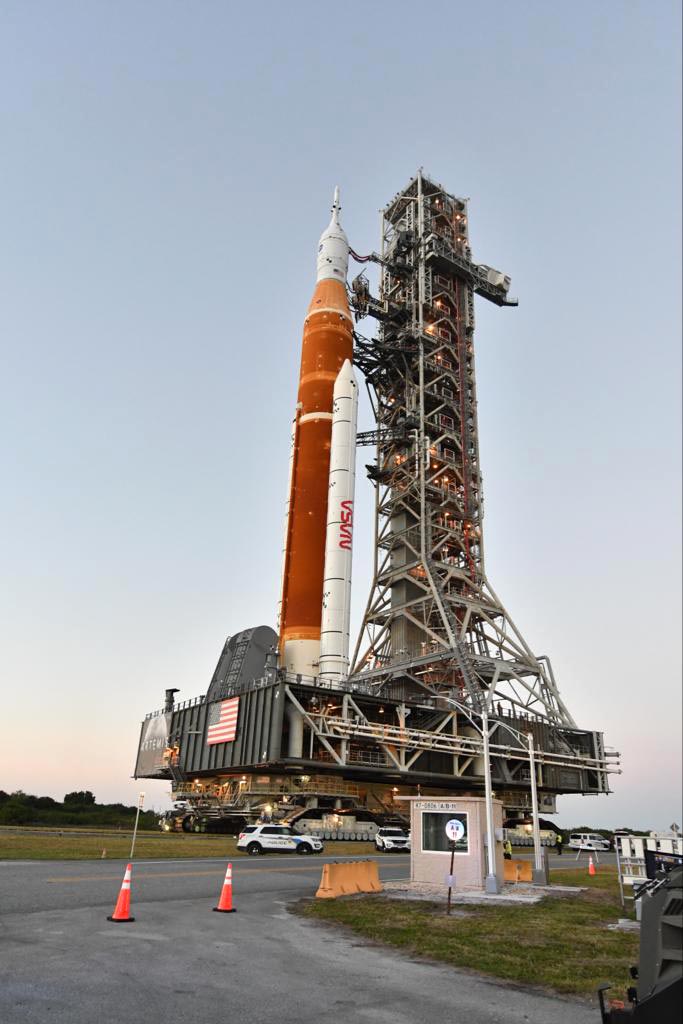
    Artemis I Moon Rocket Rollout
    The rocket that will launch NASA’s Orion spacecraft to the Moon with the European Service Module on its way to the launchpad in Florida, USA, for its first full test before the Artemis I launch later this year. Credit: ESA–A. Conigli

    Launching Orion and the European Service Module into Earth orbit and onto the Moon requires a huge amount of energy and the size of the mega-Moon rocket SLS is hard to convey in photos.

    At 100 m tall, it is roughly the height of the Elizabeth Tower (Big Ben) in London, UK, or 16 giraffes stacked on top of each other. If you laid the rocket on the ground, it would take over a minute to walk from the engines to the tip of the launch abort system.
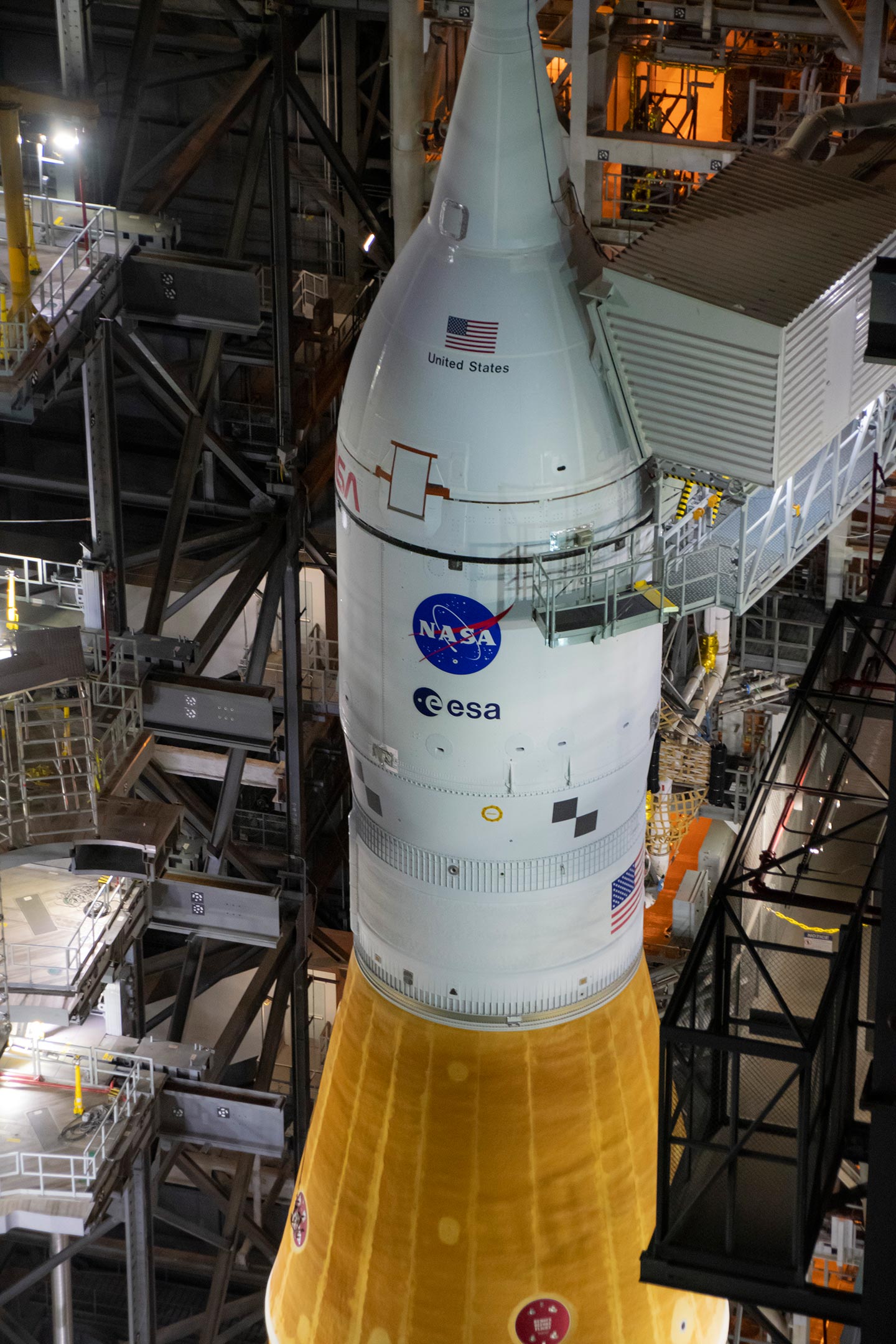
    Logos on Artemis I Moon Rocket
    A zoom on the logos on the rocket that will launch NASA’s Orion spacecraft to the Moon with the European Service Module on the eve of rollout to the launchpad. The rocket has been moved to the launchpad in Florida, USA, for its first full test before the Artemis I launch later this year. Credit: ESA–A. Conigli

    We Are Going

    “Seeing the complete rocket on the launchpad with the ESA and NASA logos on the fairing is an amazing view,” says ESA’s Pierre Boisvert on location, “to think that the European Service Module is inside there, ready to power a human-rated spacecraft to the Moon and back is a spine-tingling moment.

    “Many of us in the ESA team have been working for years with our NASA partners on this spacecraft, and to see it on the launchpad is driving it home, we are going forward to the Moon!”

    The first Artemis mission will be without astronauts, but it will include two mannequins to chart radiation received during the trip in deep space.

    Meanwhile the second and third Artemis missions are being prepared for their launch. The second European Service Module is undergoing pressure checks to ensure the welds connecting it to the rest of the Orion spacecraft were done correctly. This service module will power the first Artemis mission with astronauts around the Moon.
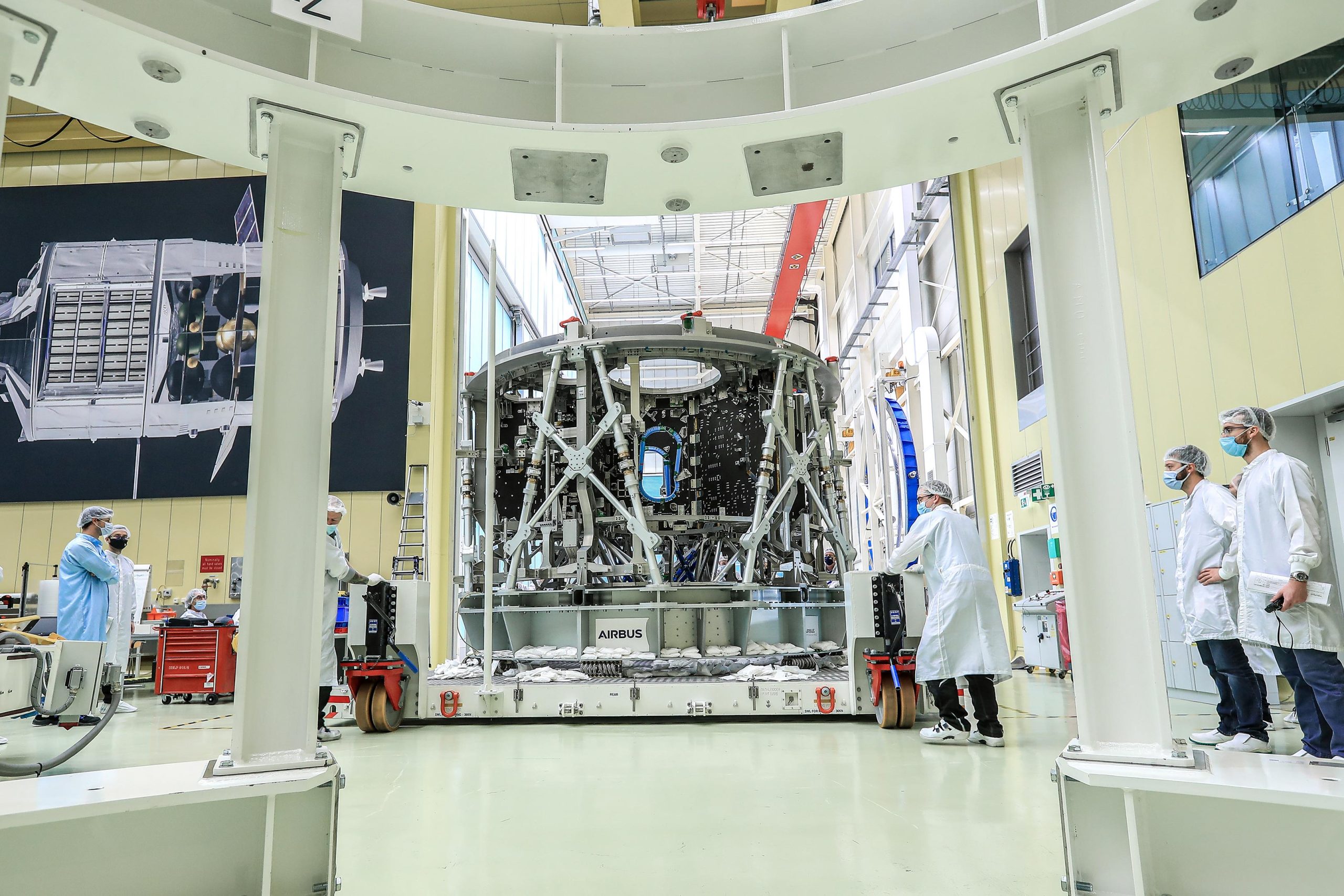
    Moving Third European Service Module Structure
    The structure that will fly the first woman and next man to land on the Moon and return on the Artemis III mission by 2024 arrives at the Airbus integration hall in Bremen, Germany, from its Thales Alenia Space manufacturing site in Turin, Italy. Credit: Airbus

    The third European Service Module is being built up in Bremen, Germany, after the structure arrived from Torino, Italy. Technicians at the Airbus integration hall have started laying kilometers of electric cables, the groundwork for sharing information and sending commands in the advanced Orion spacecraft. It has the honor of powering the Artemis III mission that will send astronauts to the Moon’s surface for the first time in over 60 years.


    The Orion spacecraft with European Service Module will fly farther from Earth than any human-rated vehicle has ever flown before. This video gives an overview of the first mission – without astronauts – for Artemis, focusing on ESA’s European Service Module that powers the spacecraft. Credit: ESA – European Space Agency

    Never miss a breakthrough: Join the SciTechDaily newsletter.
    Follow us on Google and Google News.

    ARTEMIS Mission European Space Agency NASA Popular Rocket Space Launch System
    Share. Facebook Twitter Pinterest LinkedIn Email Reddit

    Related Articles

    NASA’s Engineering Marvel: Preparing the Gateway to the Moon

    Moonbound Majesty: Astronauts’ Inside Look at SLS, the Engine of Artemis Dreams

    NASA Tests Upgraded Artemis Moon Rocket Engines at 113% Power Level

    NASA’s Artemis I Moon Rocket Ready To Launch – How To Watch Live

    NASA Completes Artemis I Moon Rocket Test, Moves Forward Toward Launch

    NASA Artemis I Moon Rocket Test: SLS Fully Fueled for First Time Despite Leak

    NASA’s Latest Plans for Critical Artemis I Moon Rocket Testing

    First Rollout of NASA’s Massive Artemis I Moon Rocket

    NASA’s Mega Moon Rocket Is Ready To Roll: Watch the Artemis I Rollout Trailer

    1 Comment

    1. EASWARAN on March 21, 2022 3:29 am

      HATS OFF TO THE ARTEMIS TEAM AT NASA AND EUROPE. MAY GOD BLESS YOU ALL.

      Reply
    Leave A Reply Cancel Reply

    • Facebook
    • Twitter
    • Pinterest
    • YouTube

    Don't Miss a Discovery

    Subscribe for the Latest in Science & Tech!

    Trending News

    Surgeons Warn: Don’t Ignore These Colorectal Cancer Symptoms, No Matter Your Age

    Scientists Unlock Hidden DNA From 1,300-Year-Old Manuscripts

    Scientists Discover Ultrasound May Stop Arthritis Before It Starts

    Scientists Discover Why the Same Volcano Erupted in Two Completely Different Ways

    Scientists Challenge a Fundamental Assumption About Consciousness

    A Giant Scorpion the Size of a Coffee Table Is Forcing Scientists To Rethink Evolution

    Hidden Virus May Have Infected 9.4 Million People – Scientists Say We’ve Missed Most Cases

    NASA Moon Base Could Become Earth’s First Defense Against Alien Microbes

    Follow SciTechDaily
    • Facebook
    • Twitter
    • YouTube
    • Pinterest
    • Newsletter
    • RSS
    SciTech News
    • Biology News
    • Chemistry News
    • Earth News
    • Health News
    • Physics News
    • Science News
    • Space News
    • Technology News
    Recent Posts
    • This Strange Martian Rock Contains a Mineral Scientists Never Expected To Find
    • James Webb Uncovers the Atmosphere of a Hellish Lava World 41 Light-Years Away
    • Scientists Warn: Colorectal Cancer Is Rising Fast in Younger Adults, Reversing Decades of Progress
    • Could We Have Been Wrong About Fish Oil and Brain Health? New Study Raises Major Questions
    • Scientists Say Intermittent Fasting Could Make Weight Loss Easier
    Copyright © 1998 - 2026 SciTechDaily. All Rights Reserved.
    • Science News
    • About
    • Contact
    • Editorial Board
    • Privacy Policy
    • Terms of Use

    Type above and press Enter to search. Press Esc to cancel.