
Close Menu
    Facebook X (Twitter) Instagram
    SciTechDaily
    • Biology
    • Chemistry
    • Earth
    • Health
    • Physics
    • Science
    • Space
    • Technology
    Facebook X (Twitter) Pinterest YouTube RSS
    SciTechDaily
    Home»Space»Hubble Has Directly Photographed Evidence of a Planet Forming in an Unconventional Way
    Space

    Hubble Has Directly Photographed Evidence of a Planet Forming in an Unconventional Way

    By European Space Agency (ESA)April 8, 2022No Comments2 Mins Read
    Facebook Twitter Pinterest Telegram LinkedIn WhatsApp Email Reddit
    Share
    Facebook Twitter LinkedIn Pinterest Telegram Email Reddit
    AB Aurigae b Hubble Images
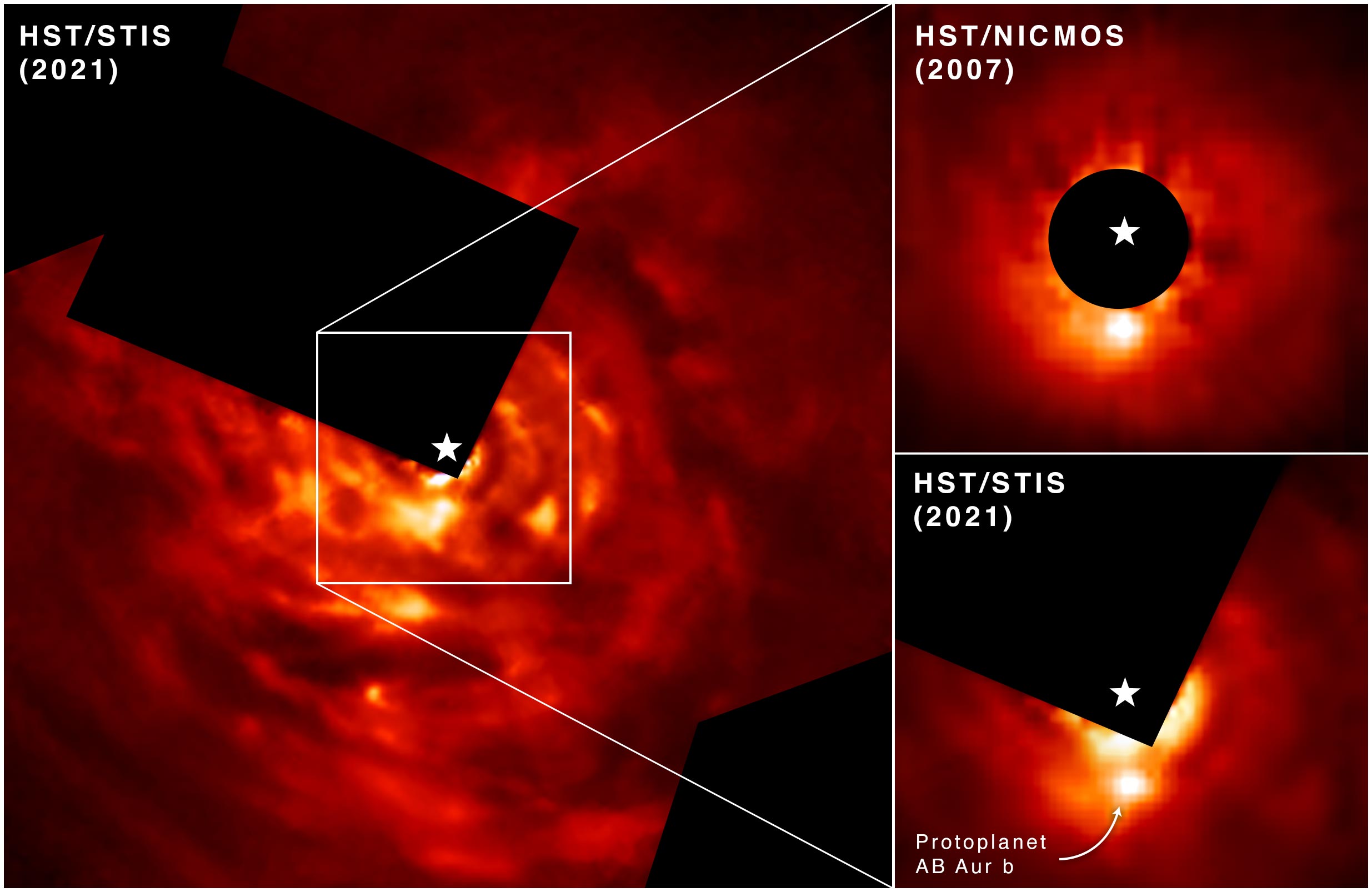
    Researchers were able to directly image newly forming exoplanet AB Aurigae b over a 13-year span using Hubble’s Space Telescope Imaging Spectrograph (STIS) and its Near Infrared Camera and Multi-Object Spectrograph (NICMOS). In the top right, Hubble’s NICMOS image captured in 2007 shows AB Aurigae b in a due south position compared to its host star, which is covered by the instrument’s coronagraph. The image captured in 2021 by STIS shows the protoplanet has moved in a counterclockwise motion over time. Credit: Science: NASA, ESA, Thayne Currie (Subaru Telescope, Eureka Scientific Inc.); Image Processing: Thayne Currie (Subaru Telescope, Eureka Scientific Inc.), Alyssa Pagan (STScI)

    The NASA/ESA Hubble Space Telescope has directly photographed evidence of a Jupiter-like protoplanet forming through what researchers describe as an “intense and violent process.” This discovery supports a long-debated theory for how planets like Jupiter form, called “disk instability.”

    The new world under construction is embedded in a protoplanetary disk of dust and gas with distinct spiral structure swirling around surrounding a young star that’s estimated to be around 2 million years old. That’s about the age of our solar system when planet formation was underway. (The solar system’s age is currently 4.6 billion years.)

    Researchers were able to directly image newly forming exoplanet AB Aurigae b over a 13-year span using the Hubble Space Telescope Imaging Spectrograph (STIS) and its Near Infrared Camera and Multi-Object Spectrograph (NICMOS).

    In the top right, Hubble’s NICMOS image captured in 2007 shows AB Aurigae b in a due south position compared to its host star, which is covered by the instrument’s coronagraph. The image captured in 2021 by STIS shows the protoplanet has moved in a counterclockwise motion over time.

    For more on this discovery, see Hubble Finds a Massive Planet – 9 Times the Size of Jupiter – Forming Through a Violent Process.

    Reference: “Images of embedded Jovian planet formation at a wide separation around AB Aurigae” by Thayne Currie, Kellen Lawson, Glenn Schneider, Wladimir Lyra, John Wisniewski, Carol Grady, Olivier Guyon, Motohide Tamura, Takayuki Kotani, Hajime Kawahara, Timothy Brandt, Taichi Uyama, Takayuki Muto, Ruobing Dong, Tomoyuki Kudo, Jun Hashimoto, Misato Fukagawa, Kevin Wagner, Julien Lozi, Jeffrey Chilcote, Taylor Tobin, Tyler Groff, Kimberly Ward-Duong, William Januszewski, Barnaby Norris, Peter Tuthill, Nienke van der Marel, Michael Sitko, Vincent Deo, Sebastien Vievard, Nemanja Jovanovic, Frantz Martinache and Nour Skaf, 4 April 2022, Nature Astronomy.
    DOI: 10.1038/s41550-022-01634-x

    Never miss a breakthrough: Join the SciTechDaily newsletter.
    Follow us on Google and Google News.

    Astronomy Astrophysics European Space Agency Hubble Space Telescope Planets
    Share. Facebook Twitter Pinterest LinkedIn Email Reddit

    Related Articles

    Astronomy & Astrophysics 101: Jupiter

    Astronomy & Astrophysics 101: Exoplanet

    Astronomy & Astrophysics 101: Dwarf Planet

    Our Giant Universe: Hubble Spots Massive Galaxy Cluster With a Wealth of Exciting Possibilities

    Tantrums of a Baby Star: Herbig-Haro Objects

    Unexpected Discovery: Hubble Space Telescope Uncovers Concentration of Small Black Holes

    “Unprecedented” – Unusual Planetary Nebula Fades Mere Decades After It Arrived

    Hubble Captures Unprecedented Fading of Stingray Nebula – “This Is Very, Very Dramatic, and Very Weird”

    Einstein’s General Theory of Relativity: Contorting Giants

    Leave A Reply Cancel Reply

    • Facebook
    • Twitter
    • Pinterest
    • YouTube

    Don't Miss a Discovery

    Subscribe for the Latest in Science & Tech!

    Trending News

    Scientists May Have Solved a Long-Standing Melanoma Treatment Mystery

    This Flesh-Eating Fly Is Back in the U.S. – Scientists Are Tracking Where It Could Strike Next

    Scientists Have Uncovered a Troubling New Pattern Hidden in America’s Rivers

    “Entirely Surprising” – Scientists Have Found a Martian Meteorite Unlike Any Known Before

    “Find of the Year” – Archaeologists Discover the Smallest Ice Age Figurines Ever Found

    New Research Challenges Common Exercise Advice for Bone Health

    Avoiding These 3 Health Risks in Midlife Linked to 13 More Years Without Dementia

    Where Were All the Tiny Dinosaurs? Scientists May Finally Have an Answer

    Follow SciTechDaily
    • Facebook
    • Twitter
    • YouTube
    • Pinterest
    • Newsletter
    • RSS
    SciTech News
    • Biology News
    • Chemistry News
    • Earth News
    • Health News
    • Physics News
    • Science News
    • Space News
    • Technology News
    Recent Posts
    • The Ancient Mediterranean Diet Wasn’t What You Think
    • 11,000-Year-Old Grains Reveal a Surprise About the Origins of Agriculture
    • Lost Vatican Letter Recasts 1066 as a Holy War Against “Followers of Satan”
    • This Common Gut-Bacteria Compound May Be Linked to Alzheimer’s Disease
    • Scientists Are Discovering Unexpected Benefits of GLP-1 Drugs
    Copyright © 1998 - 2026 SciTechDaily. All Rights Reserved.
    • Science News
    • About
    • Contact
    • Editorial Board
    • Privacy Policy
    • Terms of Use

    Type above and press Enter to search. Press Esc to cancel.