
First Model That Is Fully Consistent With All Fast Blue Optical Transient Observations
New simulations developed by Northwestern University’s Ore Gottlieb and Sasha Tchekovskoy present a potential explanation for the origins of a mysterious phenomenon called fast blue optical transients, or FBOTs. The model shows a massive star collapsing, launching outflows of debris at rates near the speed of light. These outflows, or jets, collide into collapsing layers of the dying star to form a “cocoon” around the jet. The new model shows that as the jet pushes the cocoon outward — away from the core of the collapsing star — it cools, releasing heat as an observed FBOT emission.
Ever since they were discovered in 2018, fast blue optical transients (FBOTs) have completely surprised and utterly perplexed both observational and theoretical astrophysicists.
These mysterious objects, which are so hot that they glow blue, are the brightest known optical phenomenon in the universe. However, with only a few discovered thus far, the origins of FBOTs have remained elusive.
Now a Northwestern University team of astrophysics presents a bold new explanation for the origin of these curious anomalies. Using a new model, these scientists believe FBOTs could result from the actively cooling cocoons that surround jets launched by dying stars. It marks the first astrophysics model that is fully consistent with all FBOT observations to date.
The research was published on April 11, 2022, in the journal Monthly Notices of the Royal Astronomical Society.
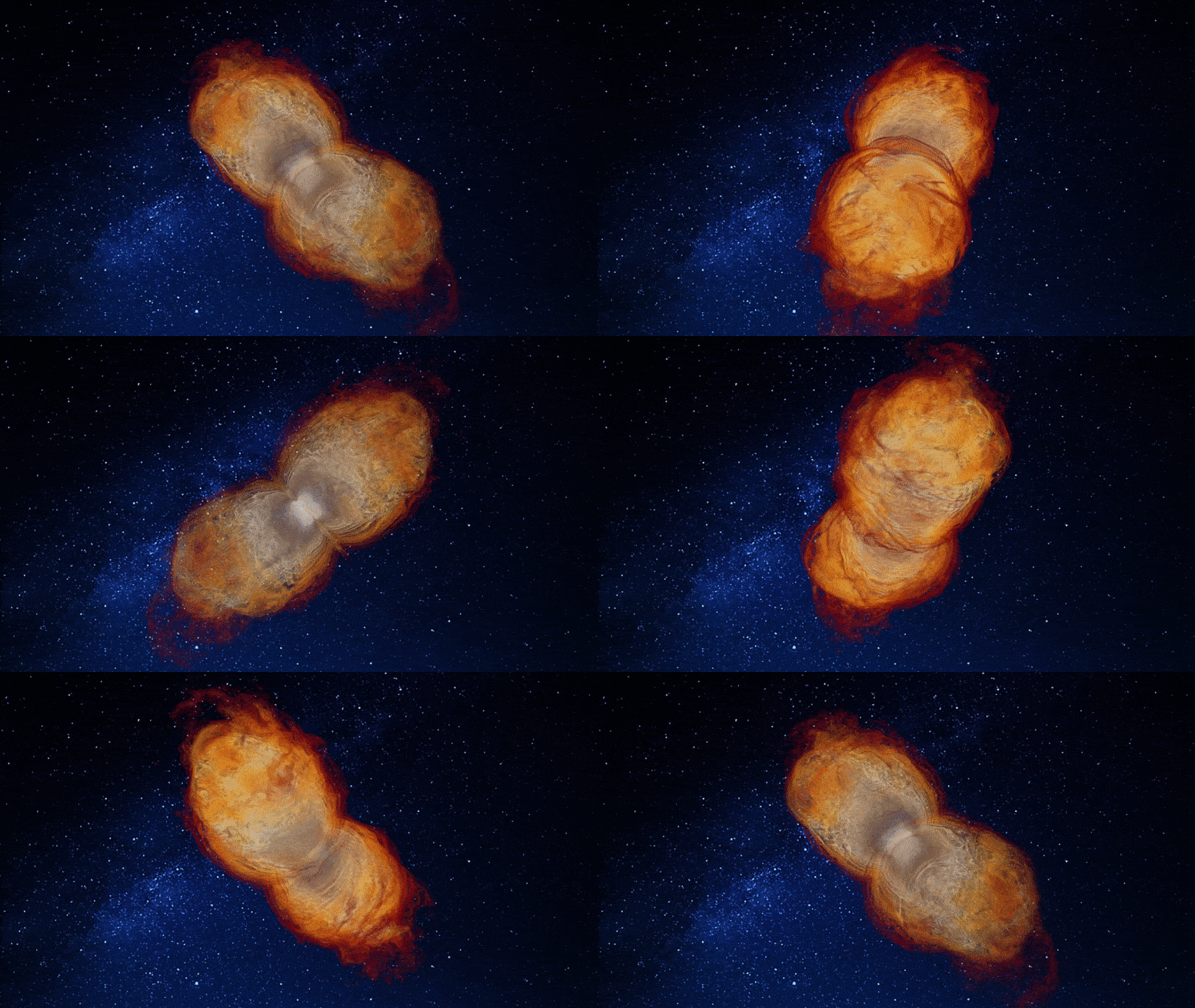
Full simulation of a star collapsing and launching jets, which collide into stellar material to form a cocoon. As the cocoon cools, it releases heat as an FBOT emission. Credit: Ore Gottlieb/Northwestern University
As a massive star collapses, it can launch outflows of debris at rates near the speed of light. These outflows, or jets, collide into collapsing layers of the dying star to form a “cocoon” around the jet. The new model shows that as the jet pushes the cocoon outward — away from the core of the collapsing star — it cools, releasing heat as an observed FBOT emission.
“A jet starts deep inside of a star and then drills its way out to escape,” said Northwestern’s Ore Gottlieb, who led the study. “As the jet moves through the star, it forms an extended structure, known as the cocoon. The cocoon envelopes the jet, and it continues to do so even after the jet escapes the star, this cocoon escapes with the jet. When we calculated how much energy the cocoon has, it turned out to be as powerful as an FBOT.”
Gottlieb is a Rothschild Fellow in Northwestern’s Center for Interdisciplinary Exploration and Research in Astrophysics (CIERA). He coauthored the paper with CIERA member Sasha Tchekovskoy, an assistant professor of physics and astronomy in Northwestern’s Weinberg College of Arts and Sciences.
The Hydrogen Problem
FBOTs (pronounced F-bot) are a type of cosmic explosion initially detected in the optical wavelength. As their name implies, transients fade almost as quickly as they appear. FBOTs reach peak brightness within a matter of days and then quickly fade — much faster than standard supernovae rise and decay.
After discovering FBOTs just four years ago, astrophysicists wondered if the mysterious events were related to another transient class: gamma-ray bursts (GRBs). The strongest and brightest explosions across all wavelengths, GRBs also are associated with dying stars. When a massive star exhausts its fuel and collapses into a black hole, it launches jets to produce a powerful gamma-ray emission.
“The reason why we think GRBs and FBOTs might be related is because both are very fast — moving at close to the speed of light — and both are asymmetrically shaped, breaking the spherical shape of the star,” Gottlieb said. “But there was a problem. Stars that produce GRBs lack hydrogen. We don’t see any signs of hydrogen in GRBs, whereas in FBOTs, we see hydrogen everywhere. So, it could not be the same phenomenon.”
Using their new model, Gottlieb and his coauthors think they might have found an answer to this problem. Hydrogen-rich stars tend to house hydrogen in their outermost layer — a layer too thick for a jet to penetrate.
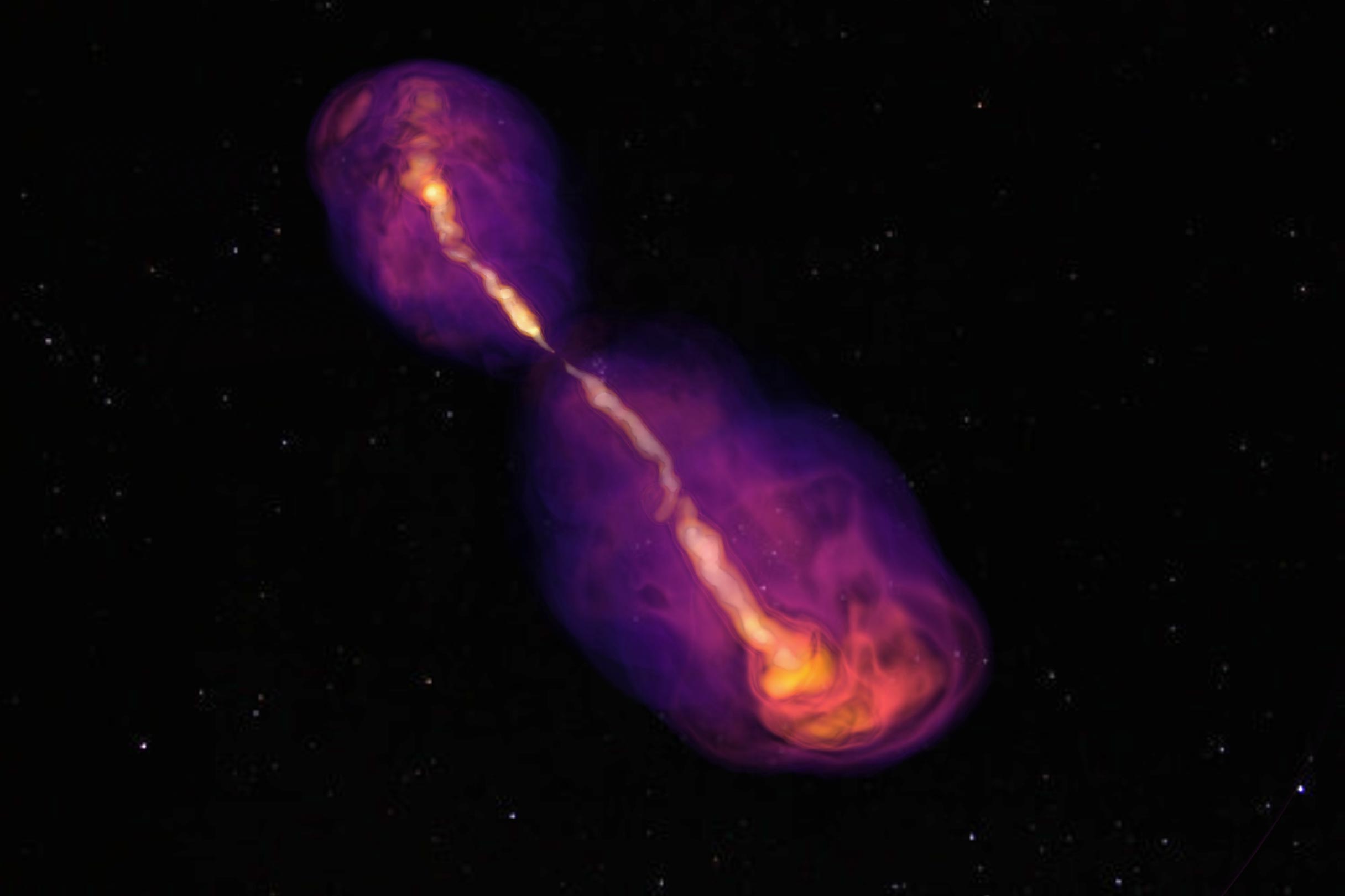
The cocoon envelopes the jet and escapes the star with it. As the cocoon cools, it releases heat as a fast blue optical transient (FBOT) emission. Credit: Ore Gottlieb/Northwestern University
“Basically, the star would be too massive for the jet to pierce through,” Gottlieb said. “So the jet will never make it out of the star, and that’s why it fails to produce a GRB. However, in these stars, the dying jet transfers all its energy to the cocoon, which is the only component to escape the star. The cocoon will emit FBOT emissions, which will include hydrogen. This is another area where our model is fully consistent with all FBOT observations.”
Putting the Picture Together
Although FBOTs glow bright in optical wavelengths, they also emit radio waves and X-rays. Gottlieb’s model explains these too.
When the cocoon interacts with the dense gas surrounding the star, this interaction heats up stellar material to release a radio emission. And when the cocoon expands far enough away from the black hole (formed from the collapsed star), X-rays can leak out from the black hole. The X-rays join radio and optical light to form a full picture of the FBOT event.
A jet piercing through the inside of a dying star. Credit: Ore Gottlieb/Northwestern University
While Gottlieb is encouraged by his team’s findings, he says more observations and models are needed before we can definitively understand FBOTs’ mysterious origins.
“When we calculated how much energy the cocoon has, it turned out to be as powerful as an FBOT.”
Ore Gottlieb, astrophysicist
“This is a new class of transients, and we know so little about them,” Gottlieb said. “We need to detect more of them earlier in their evolution before we can fully understand these explosions. But our model is able to draw a line among supernovae, GRBs, and FBOTs, which I think is very elegant.”
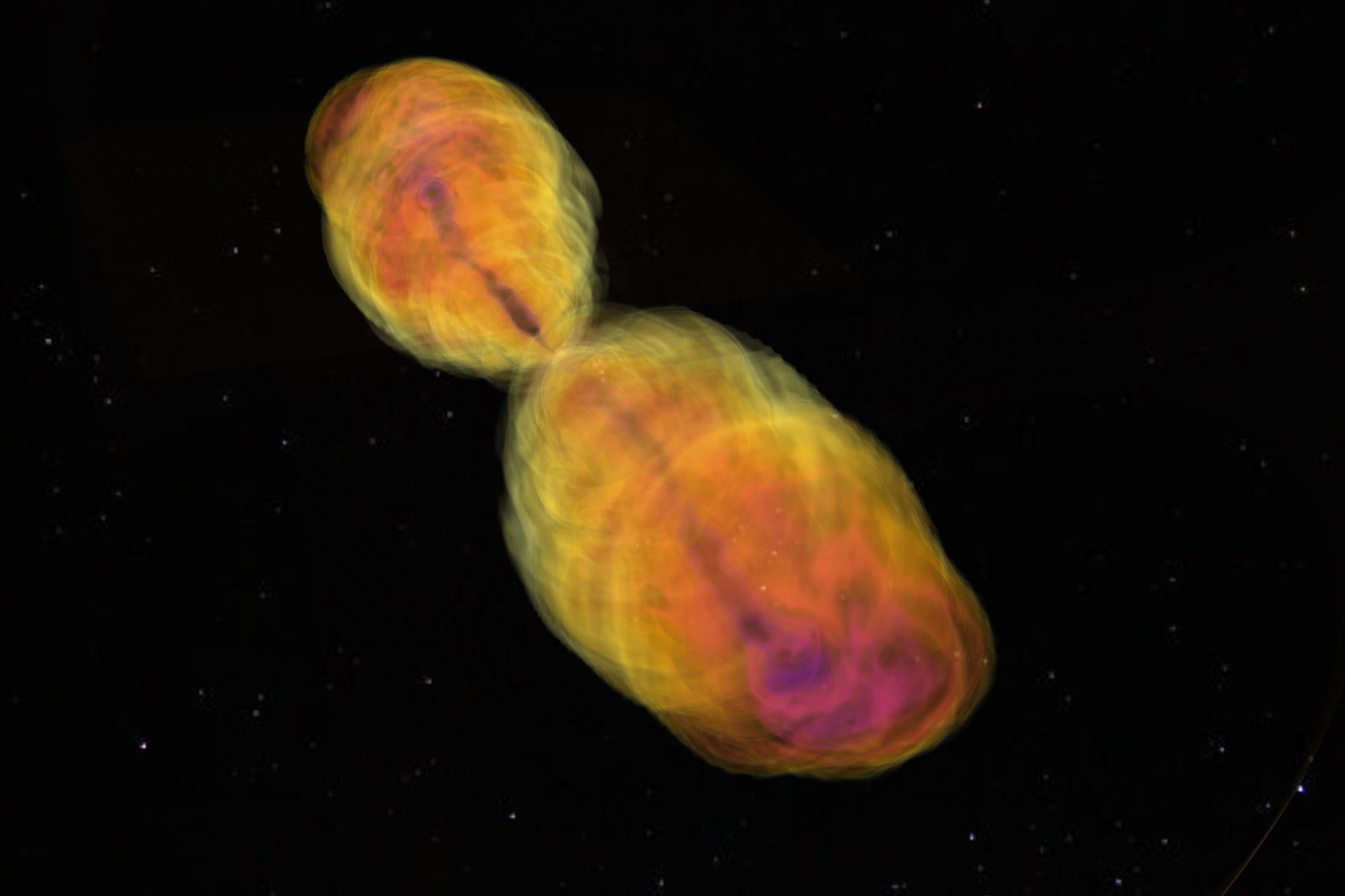
A cocoon surrounding the jet of a collapsing star. As this cocoon escapes the star, it cools — releasing heat as a fast blue optical transient (FBOT) emission. Credit: Ore Gottlieb/Northwestern University
“This study paves the way for more advanced simulations of FBOTs,” Tchekovskoy said. “This next-generation model will allow us to directly connect the physics of the central black hole to the observables, enabling us to reveal otherwise hidden physics of the FBOT central engine.”
Reference: “Shocked jets in CCSNe can power the zoo of fast blue optical transients” by Ore Gottlieb, Alexander Tchekhovskoy and Raffaella Margutti, 11 April 2022, Monthly Notices of the Royal Astronomical Society.
DOI: 10.1093/mnras/stac910
The study, “Shocked jets in CCSNe can power the zoo of fast blue optical transients,” was supported by the National Science Foundation (award numbers AST-1815304 and AST-2107839). The authors developed the simulation using supercomputers at the Texas Advanced Computing Center at the University of Texas at Austin.
Never miss a breakthrough: Join the SciTechDaily newsletter.
Follow us on Google and Google News.