
Close Menu
    Facebook X (Twitter) Instagram
    SciTechDaily
    • Biology
    • Chemistry
    • Earth
    • Health
    • Physics
    • Science
    • Space
    • Technology
    Facebook X (Twitter) Pinterest YouTube RSS
    SciTechDaily
    Home»Space»Hubble Spies an Exquisite Hidden Galaxy
    Space

    Hubble Spies an Exquisite Hidden Galaxy

    By NASA's Goddard Space Flight CenterMay 16, 2022No Comments2 Mins Read
    Facebook Twitter Pinterest Telegram LinkedIn WhatsApp Email Reddit
    Share
    Facebook Twitter LinkedIn Pinterest Telegram Email Reddit
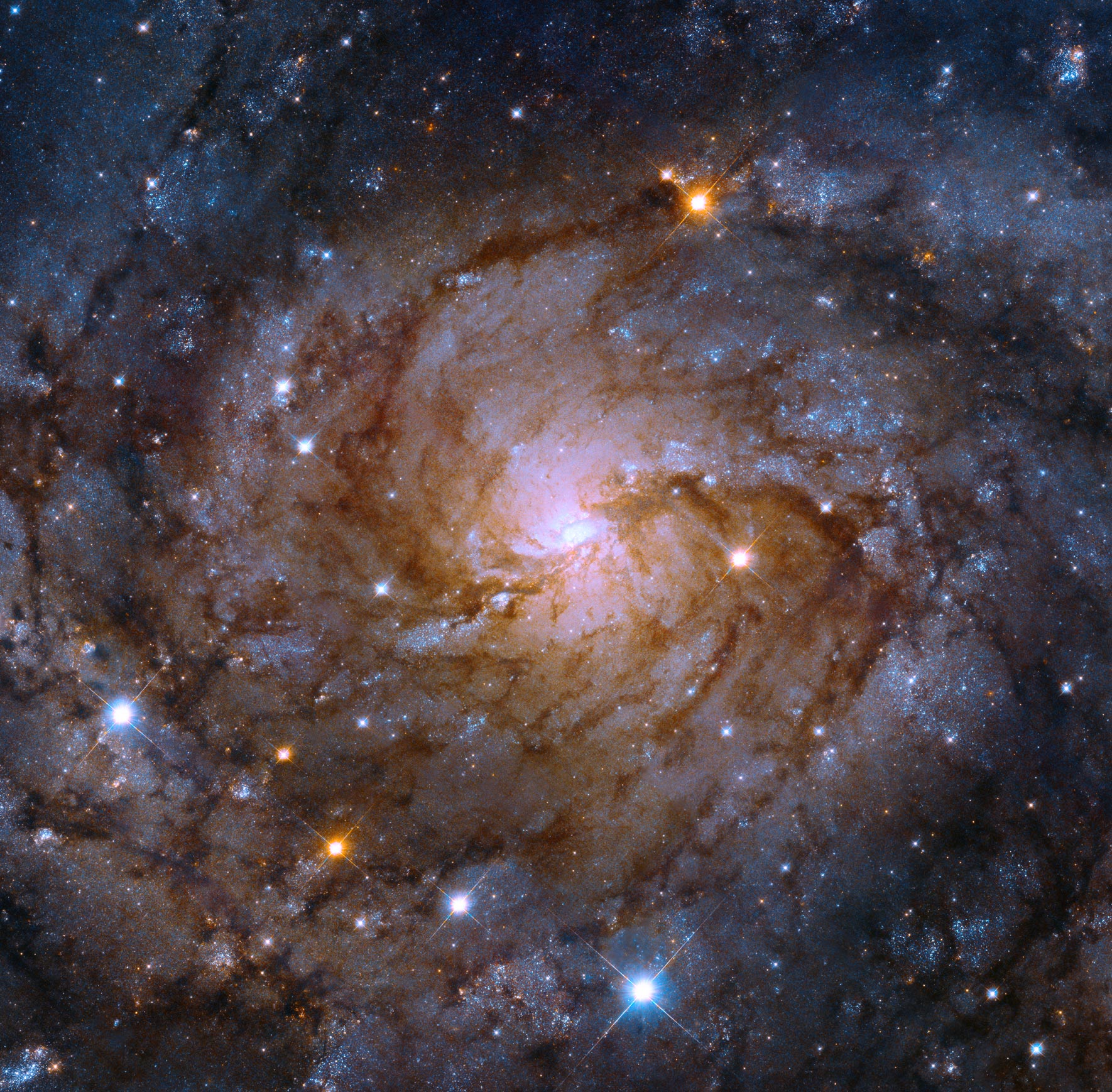
    Spiral Galaxy IC 342
    Hubble Space Telescope image of the spiral galaxy IC 342, also known as Caldwell 5, which has the nickname, Hidden Galaxy. Credit: NASA, ESA, P. Sell (University of Florida), and P. Kaaret (University of Iowa); Image processing: G. Kober (NASA Goddard/Catholic University of America

    Spiral galaxy IC 342, also known as Caldwell 5, is located approximately 11 million light-years from Earth. The Hubble Space Telescope captured this sparkling, face-on view of the center of the galaxy, which displays intertwined tendrils of dust in spectacular arms that wrap around a brilliant core of hot gas and stars.

    This core is a specific type of region called an H II nucleus – an area of atomic hydrogen that has become ionized. Such regions are energetic birthplaces of stars where thousands of stars can form over a couple of million years. Each young, extremely hot, blue star emits ultraviolet light, further ionizing the surrounding hydrogen.

    Despite its relatively bright 8.4 magnitude, this galaxy doesn’t stand out in the sky. It appears near the equator of the Milky Way’s pearly disk, which is crowded with thick cosmic gas, dark dust, and glowing stars that all obscure our view. This has earned Caldwell 5 the nickname of the Hidden Galaxy.

    Were it not obscured by so much interstellar matter, the Hidden Galaxy would be one of the brightest galaxies in our sky. A relatively close galaxy, it is roughly 50,000 light-years across and billions of years old.

    Never miss a breakthrough: Join the SciTechDaily newsletter.
    Follow us on Google and Google News.

    Astronomy Hubble Space Telescope NASA
    Share. Facebook Twitter Pinterest LinkedIn Email Reddit

    Related Articles

    Hubble Reveals a Star Disk Three Times Hotter Than the Sun’s Surface

    A Star’s Unexpected Heatwave: FU Orionis Challenges Astrophysics Models

    NASA’s Hubble Reveals How the LMC Defied Galactic Destruction

    Legendary Star’s Smooth Disk Mystifies Astronomers, Challenges Planet Formation Theories

    Cosmic Horror Unveiled: NASA Reveals “Blood-Soaked Eyes” Staring From Deep Space [Video]

    Spanning 248 Billion Miles: Stunning Hubble Timelapse Captures a Star’s Violent Eruptions

    Jupiter’s Great Red Spot Enigma: Unexplained Oscillations Baffle Astronomers

    Unlocking Uranus: NASA’s Dual Observations Pave the Way to Discovering New Worlds

    Astronomers Baffled by Black Hole Jets Igniting Star Explosions

    Leave A Reply Cancel Reply

    • Facebook
    • Twitter
    • Pinterest
    • YouTube

    Don't Miss a Discovery

    Subscribe for the Latest in Science & Tech!

    Trending News

    Don’t Miss: A Brilliant Venus and Glowing Harvest Moon Light Up the Sky

    New Twist on the Einstein Problem Reveals Unexpected Physics

    JWST Captures Stunning Evidence of How Supermassive Black Holes Feed

    Early Exercise May Permanently Change How Much Energy the Body Uses To Move

    New Molecule Wipes Out Aggressive Lymphoma Tumors in Mice in Just 11 Days

    The Human Family Tree May Need a Major Rewrite

    Scientists Find a Surprising Cancer-Fighting Effect in Dark Sweet Cherries

    New AI Detects Hidden Warning Signs of Solar Eruptions Hours Before They Emerge

    Follow SciTechDaily
    • Facebook
    • Twitter
    • YouTube
    • Pinterest
    • Newsletter
    • RSS
    SciTech News
    • Biology News
    • Chemistry News
    • Earth News
    • Health News
    • Physics News
    • Science News
    • Space News
    • Technology News
    Recent Posts
    • Africa’s Giant Herbivores Were Disappearing Millions of Years Before Humans Could Hunt Them
    • This Utah Mountain Is Hiding Enough Ice To Fill 600 Olympic Pools
    • Vagus Nerve Stimulation Could Unlock the Brain’s Hidden Learning Potential
    • Your Mother’s Age May Leave a Biological Mark That Lasts for Generations
    • Women Who Ate More Antioxidants Had Strikingly Lower Rates of Cervical Cancer
    Copyright © 1998 - 2026 SciTechDaily. All Rights Reserved.
    • Science News
    • About
    • Contact
    • Editorial Board
    • Privacy Policy
    • Terms of Use

    Type above and press Enter to search. Press Esc to cancel.