
Close Menu
    Facebook X (Twitter) Instagram
    SciTechDaily
    • Biology
    • Chemistry
    • Earth
    • Health
    • Physics
    • Science
    • Space
    • Technology
    Facebook X (Twitter) Pinterest YouTube RSS
    SciTechDaily
    Home»Technology»Scientists Make Brighter LEDs by Mimicking Fireflies
    Technology

    Scientists Make Brighter LEDs by Mimicking Fireflies

    By SciTechDailyJanuary 11, 2013No Comments3 Mins Read
    Facebook Twitter Pinterest Telegram LinkedIn WhatsApp Email Reddit
    Share
    Facebook Twitter LinkedIn Pinterest Telegram Email Reddit
    firefly-brighter-led
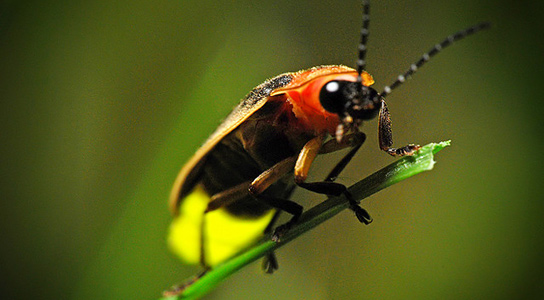
    Inspired by fireflies, scientists have enhanced LED design, boosting light extraction by up to 55%.

    Fireflies have inspired scientists to modify LEDs so that they are more than one and a half times more efficient. Researchers have studied the internal structure of firefly lanterns, the organs responsible for the insects’ bioluminescence.

    The scientists published their findings in two papers in the journal Optics Express. The scientists identified an unexpected pattern of jagged scales, which enhances the overall glow. If this were to be applied to the LED design, it would create an LED overlayer that mimics the natural structure. This overlayer would increase light extraction by up to 55% and could be easily tailored to existing designs.

    Fireflies create light thanks to a chemical reaction taking place in photocytes. The light is emitted through the cuticle, which is part of the insect’s exoskeleton. Light travels slower through the cuticle than through air, so there is a portion of the light that is reflected back into the lantern, dimming the glow. The unique surface geometry of the fireflies’ cuticle helps minimize internal reflections, allowing more light escapes to reach the eyes of potential firefly suitors.
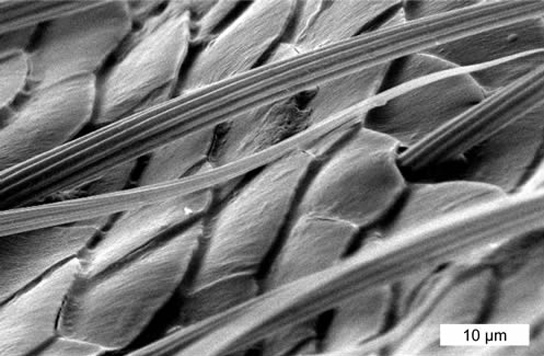
    The misfit scales found on the lantern of the Photuris firefly. Researchers found that the sharp edges of the scales let out the most light. Credit: Optics Express.
    The misfit scales found on the lantern of the Photuris firefly. Researchers found that the sharp edges of the scales let out the most light. Credit: Optics Express.

    Using scanning electron microscopes, the researchers were able to identify structures like nanoscale ribs and misfit scales on the fireflies’ cuticles¹. They then used computer simulations to model the structures to see how they would affect light transmission, finding that the sharp edges of the jagged, misfit scales let out the most light.

    The researchers refer to the edge structures as having a factor roof shape, where the tips of the scales protrude and have a tilted slope. The protrusions repeat every 10 micrometers, with a height of about 3 micrometers. The researchers also found that a big-scale structure was more effective at reflecting light than the nanoscale ones.

    In the other paper², the researchers created a jagged overlayer on top of a standard gallium nitride LED. Light-sensitive material was deposited on top of the LED, and sections were exposed using a laser to create the triangular factory roof profile. The dimensions were adjusted for the size of the LED.

    Other research groups have studied the photonic structures in firefly lanterns as well, and have even mimicked some of the structures to enhance light extraction in LEDs, but their work focused on nanoscale features.

    References:

    “Improved light extraction in the bioluminescent lantern of a Photuris firefly (Lampyridae)” by Annick Bay, Peter Cloetens, Heikki Suhonen and Jean Pol Vigneron, 8 January 2013, Optics Express.
    DOI: 10.1364/OE.21.000764

    “Optimal overlayer inspired by Photuris firefly improves light-extraction efficiency of existing light-emitting diodes” by Annick Bay, Nicolas André, Michaël Sarrazin, Ali Belarouci, Vincent Aimez, Laurent A. Francis and Jean Pol Vigneron, 8 January 2013, Optics Express.
    DOI: 10.1364/OE.21.00A179

    Never miss a breakthrough: Join the SciTechDaily newsletter.
    Follow us on Google and Google News.

    Bioluminescence Entomology Nanotechnology Popular
    Share. Facebook Twitter Pinterest LinkedIn Email Reddit

    Related Articles

    Researchers Use Nanotechnology To Harness the Natural Light Produced by Fireflies

    Graphene Based Composite Being Developed as Rust Proofing Alternative

    Generator Produces Electricity by Harnessing the Piezoelectric Properties of Biological Material

    Double-Walled Silicon Nanotube Battery Shows Promise

    Engineered Nanoparticles Deliver Antibiotics Directly to Bacteria

    Nanotextures Make Anti-Fogging, Self-Cleaning and Glare-Free Glass

    Engineered Coating for Implants Reduces the Risk of Complications

    Bringing Microfluidics to the Marketplace

    High Resolution 3D Printer Prints 5 Meters per Second

    Leave A Reply Cancel Reply

    • Facebook
    • Twitter
    • Pinterest
    • YouTube

    Don't Miss a Discovery

    Subscribe for the Latest in Science & Tech!

    Trending News

    Wasp Colonies Explode Into Violence After Losing Their Queen

    Scientists Create “Living Plastic” That Self-Destructs in Just Six Days

    Your Blood May Carry a 700-Million-Year-Old Secret

    Scientists Discover Some “Zombie Cells” May Actually Help You Live Longer

    Earth May Be Seeding Venus With Life, According to New Research

    What Scientists Found Inside a 117-Year-Old Woman Reveals New Clues to Long Life

    Scientists Discover Mysterious Creature Living in the Great Salt Lake – and It Exists Nowhere Else on Earth

    It’s Alive? Surprising Discovery Changes What We Know About Fog

    Follow SciTechDaily
    • Facebook
    • Twitter
    • YouTube
    • Pinterest
    • Newsletter
    • RSS
    SciTech News
    • Biology News
    • Chemistry News
    • Earth News
    • Health News
    • Physics News
    • Science News
    • Space News
    • Technology News
    Recent Posts
    • A Psychologist Explains Why 40% of People Are Avoiding the News
    • Scientists Discover Alzheimer’s-Linked Proteion’s Surprising Role in Making Memories Last
    • Vitamin D Drug Shows Surprising Promise Against One of the Deadliest Cancers
    • Scientists Crack Major Ammonia Problem With a Platinum Catalyst Breakthrough
    • MIT Engineers Solve a Major Lidar Problem That Has Stumped Researchers for Years
    Copyright © 1998 - 2026 SciTechDaily. All Rights Reserved.
    • Science News
    • About
    • Contact
    • Editorial Board
    • Privacy Policy
    • Terms of Use

    Type above and press Enter to search. Press Esc to cancel.