
Close Menu
    Facebook X (Twitter) Instagram
    SciTechDaily
    • Biology
    • Chemistry
    • Earth
    • Health
    • Physics
    • Science
    • Space
    • Technology
    Facebook X (Twitter) Pinterest YouTube RSS
    SciTechDaily
    Home»Space»Astronomers May Have Discovered the Youngest Planet Ever Detected in Our Galaxy
    Space

    Astronomers May Have Discovered the Youngest Planet Ever Detected in Our Galaxy

    By National Radio Astronomy ObservatoryAugust 11, 2022No Comments4 Mins Read
    Facebook Twitter Pinterest Telegram LinkedIn WhatsApp Email Reddit
    Share
    Facebook Twitter LinkedIn Pinterest Telegram Email Reddit
    Circumplanetary Disk Star AS 209
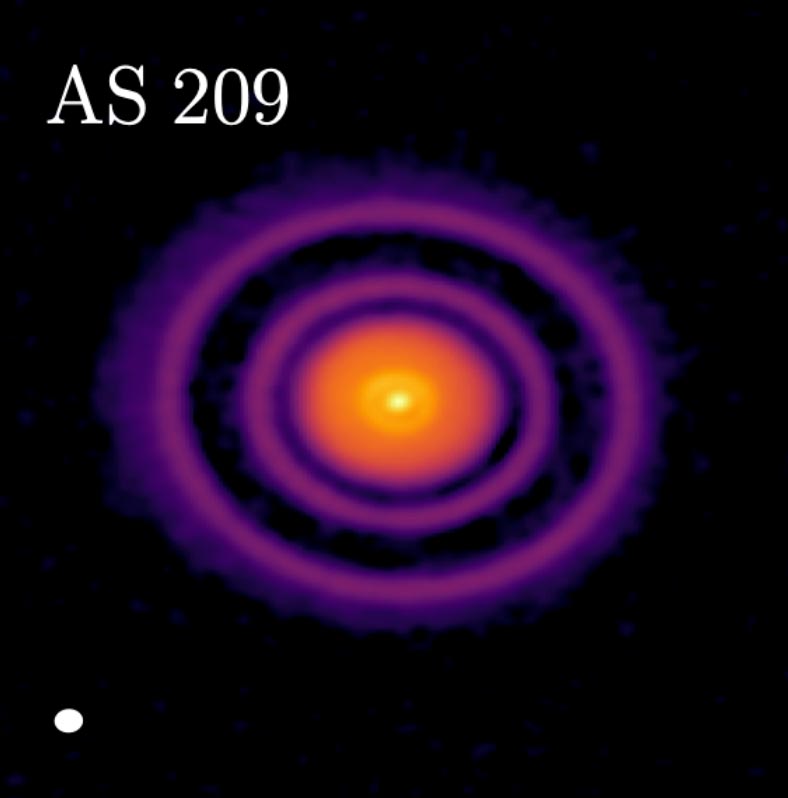
    Scientists studying the young star AS 209 have detected gas in a circumplanetary disk for the first time, which suggests the star system may be harboring a very young Jupiter-mass planet. Science images from the research show (right) blob-like emissions of light coming from otherwise empty gaps in the highly-structured, seven-ring disk (left). Credit: ALMA (ESO/NAOJ/NRAO), J. Bae (University of Florida)

    ALMA Makes First-Ever Detection of Gas in a Circumplanetary Disk

    Astronomers using the Atacama Large Millimeter/submillimeter Array (ALMA) to study planet formation have made the first-ever detection of gas in a circumplanetary disk. What’s more, the detection also suggests the presence of a very young exoplanet. The results of the research were published on July 27 in The Astrophysical Journal Letters.

    Circumplanetary disks are an accumulation of gas, dust, and debris around young planets. These disks contain the material that may form moons and other small, rocky objects, and control the growth of young, giant planets. Analyzing these disks in their earliest stages may help shed light on the formation of our own Solar System, including that of Jupiter’s Galilean moons, which scientists believe formed in a circumplanetary disk of Jupiter around 4.5 billion years ago.

    While studying AS 209 — a young star located approximately 395 light-years from Earth in the constellation Ophiuchus — astronomers observed a blob of emitted light in the middle of an otherwise empty gap in the gas surrounding the star. That led to the detection of the circumplanetary disk surrounding a potential Jupiter-mass planet.

    Researchers are closely watching the system, both because of the planet’s distance from its star and the star’s age. The exoplanet is located more than 200 astronomical units (an astronomical unit is the distance between the Earth and the Sun), or 18.59 billion miles, away from the host star. This vast distance challenges currently accepted theories of planet formation. And if the host star’s estimated age of just 1.6 million years holds true, this exoplanet could be one of the youngest ever detected. Further research is needed, and astrophysicists hope that upcoming observations with the James Webb Space Telescope will confirm the planet’s presence.

    “The best way to study planet formation is to observe planets while they’re forming. We are living in a very exciting time when this happens thanks to powerful telescopes, such as ALMA and JWST,” said Jaehan Bae, a professor of astronomy at the University of Florida and the lead author of the paper.
    Star AS 209
    AS 209 is a young star in the Ophiuchus constellation that scientists have now determined is host to what may be one of the youngest exoplanets ever. Credit: ALMA (ESO/NAOJ/NRAO), A. Sierra (U. Chile)

    What Is AS 209?

    AS 209 is a young star located around 395 light-years from Earth in the constellation Ophiuchus. The star system has been of interest to scientists working in the ALMA MAPS — Molecules with ALMA at Planet-forming Scales — collaboration for more than five years due to the presence of seven nested rings, which researchers believed to be associated with ongoing planet formation. The new results provide additional evidence of planet formation around the young star.
    Circumplanetary Disk PDS 70
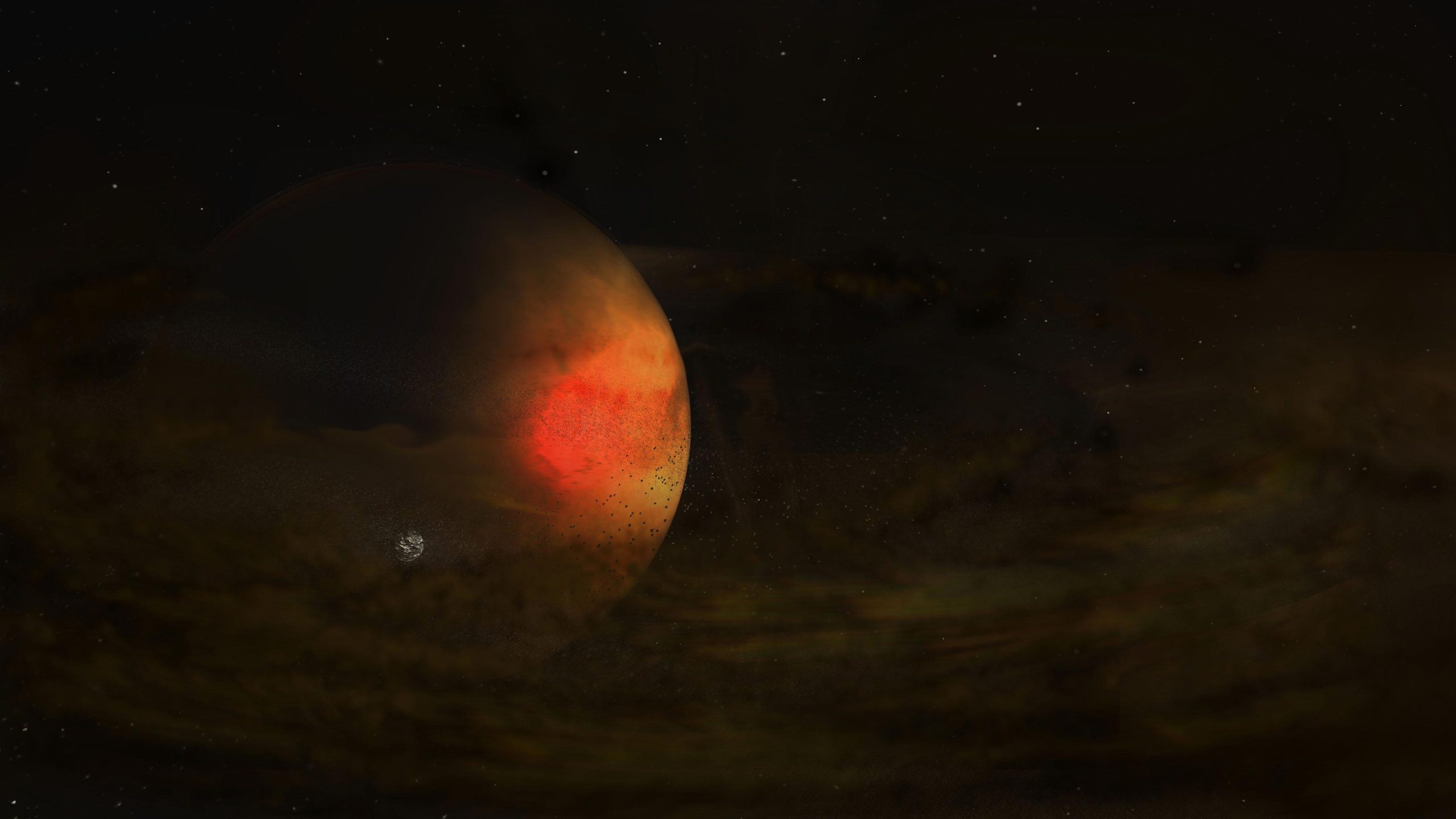
    Artist impression of the circumplanetary disk discovered in 2021 around a young planet in the PDS 70 star system. Credit: ALMA (ESO/NAOJ/NRAO), S. Dagnello (NRAO/AUI/NSF)

    The Discovery at AS 209 Is Only the Third Confirmed Detection Ever of a Circumplanetary Disk

    Astronomers have long suspected the presence of circumplanetary disks around exoplanets, but until recently were unable to prove it. In 2019, ALMA scientists made the first-ever detection of a circumplanetary, moon-forming disk while observing the young exoplanet PDS 70c, and confirmed the find in 2021. The new observations of gas in a circumplanetary disk at AS 209 may reveal additional details about the development of planetary atmospheres and the processes by which moons are formed.

    Reference: “Molecules with ALMA at Planet-forming Scales (MAPS): A Circumplanetary Disk Candidate in Molecular-line Emission in the AS 209 Disk” by Jaehan Bae, Richard Teague, Sean M. Andrews, Myriam Benisty, Stefano Facchini, Maria Galloway-Sprietsma, Ryan A. Loomis, Yuri Aikawa, Felipe Alarcón, Edwin Bergin, Jennifer B. Bergner, Alice S. Booth, Gianni Cataldi, L. Ilsedore Cleeves, Ian Czekala, Viviana V. Guzmán, Jane Huang, John D. Ilee, Nicolas T. Kurtovic, Charles J. Law, Romane Le Gal, Yao Liu, Feng Long, François Ménard, Karin I. Öberg, Laura M. Pérez, Chunhua Qi, Kamber R. Schwarz, Anibal Sierra, Catherine Walsh, David J. Wilner and Ke Zhang, 27 July 2022, The Astrophysical Journal Letters.
    DOI: 10.3847/2041-8213/ac7fa3

    Never miss a breakthrough: Join the SciTechDaily newsletter.
    Follow us on Google and Google News.

    Astronomy Astrophysics Exoplanet National Radio Astronomy Observatory Planets Popular Stars
    Share. Facebook Twitter Pinterest LinkedIn Email Reddit

    Related Articles

    Cracking the Magnetic Code: Distant Radio Signals Reveal Earth-Like Exoplanets’ Hidden Force

    Surprise Planet Discovered Around Extreme Star Pair

    Mind the Gap: Direct Link Uncovered Between Protoplanetary Disk Structures and Giant Exoplanets

    On the Quest for Other Earths in the Search for Extraterrestrial Life

    Earth Has a Hot New Neighbor – And It Could Change How We Look for Life in the Universe

    Vaporized Crusts of Earth-Like Planets Discovered in Dying Stars

    Astronomers Detect Possible Radio Emission From Exoplanet for the First Time

    Stellar Flares With a Chance of Radio Bursts: Space Weather Discovery Puts “Habitable Planets” at Risk

    A White Dwarf’s Surprise Planetary Companion: First-of-Its-Kind Exoplanet Detected Around Dead Star

    Leave A Reply Cancel Reply

    • Facebook
    • Twitter
    • Pinterest
    • YouTube

    Don't Miss a Discovery

    Subscribe for the Latest in Science & Tech!

    Trending News

    Don’t Miss: A Brilliant Venus and Glowing Harvest Moon Light Up the Sky

    New Twist on the Einstein Problem Reveals Unexpected Physics

    JWST Captures Stunning Evidence of How Supermassive Black Holes Feed

    Early Exercise May Permanently Change How Much Energy the Body Uses To Move

    New Molecule Wipes Out Aggressive Lymphoma Tumors in Mice in Just 11 Days

    The Human Family Tree May Need a Major Rewrite

    Scientists Find a Surprising Cancer-Fighting Effect in Dark Sweet Cherries

    New AI Detects Hidden Warning Signs of Solar Eruptions Hours Before They Emerge

    Follow SciTechDaily
    • Facebook
    • Twitter
    • YouTube
    • Pinterest
    • Newsletter
    • RSS
    SciTech News
    • Biology News
    • Chemistry News
    • Earth News
    • Health News
    • Physics News
    • Science News
    • Space News
    • Technology News
    Recent Posts
    • Vagus Nerve Stimulation Could Unlock the Brain’s Hidden Learning Potential
    • Your Mother’s Age May Leave a Biological Mark That Lasts for Generations
    • Women Who Ate More Antioxidants Had Strikingly Lower Rates of Cervical Cancer
    • A Hidden Hormone Disorder May Be Driving Millions of High Blood Pressure Cases
    • This Self-Rebuilding Electrode Could Supercharge Green Hydrogen Production
    Copyright © 1998 - 2026 SciTechDaily. All Rights Reserved.
    • Science News
    • About
    • Contact
    • Editorial Board
    • Privacy Policy
    • Terms of Use

    Type above and press Enter to search. Press Esc to cancel.