
Close Menu
    Facebook X (Twitter) Instagram
    SciTechDaily
    • Biology
    • Chemistry
    • Earth
    • Health
    • Physics
    • Science
    • Space
    • Technology
    Facebook X (Twitter) Pinterest YouTube RSS
    SciTechDaily
    Home»Space»Celebrate “International Observe the Moon Night 2022” With NASA
    Space

    Celebrate “International Observe the Moon Night 2022” With NASA

    By NASASeptember 30, 2022No Comments3 Mins Read
    Facebook Twitter Pinterest Telegram LinkedIn WhatsApp Email Reddit
    Share
    Facebook Twitter LinkedIn Pinterest Telegram Email Reddit
    International Observe the Moon Night NASA
    Join with NASA in celebrating “International Observe the Moon Night” on October 1, 2022. Credit: NASA/Vi Nguyen

    NASA invites the public to participate in the celebration of “International Observe the Moon Night” on Saturday, October 1. This annual, worldwide public engagement event takes place when the Moon is close to first quarter – a great phase for evening observing. Last year approximately 500,000 people participated in the event. That included people from 122 different countries and all seven continents.

    This celebration provides special opportunities to observe celestial bodies, learn about lunar science and exploration, and honor cultural and personal connections to the Moon.

    First Quarter Moon
    A first quarter Moon is ideal for observing. This is when the Moon is a quarter of the way through its monthly journey and you see half of its illuminated side. People may casually call this a half moon, but remember, that’s not really what you’re witnessing in the sky. You’re seeing just a slice of the entire Moon ― half of the illuminated half. A first quarter moon rises around noon and sets around midnight. It’s high in the sky in the evening and makes for excellent viewing. Credit: NASA’s Scientific Visualization Studio/Ernie Wright

    How to participate:

    • Host an event in your community; participate in an event; or observe with your family, friends, or on your own. Events can be in-person, virtual, or hybrid.
    • Register your participation to add yourself to the map of lunar observers worldwide.
    • Connect with lunar enthusiasts around the world and share your Moon viewing experience on social media, tagging #ObserveTheMoon.
    • On October 1, tune into a NASA TV Broadcast from 7 p.m.–8 p.m. EST and find views of the Moon from telescopes around the world on the program’s Live Streams page.
    • Find more information and resources on moon.nasa.gov/observe.
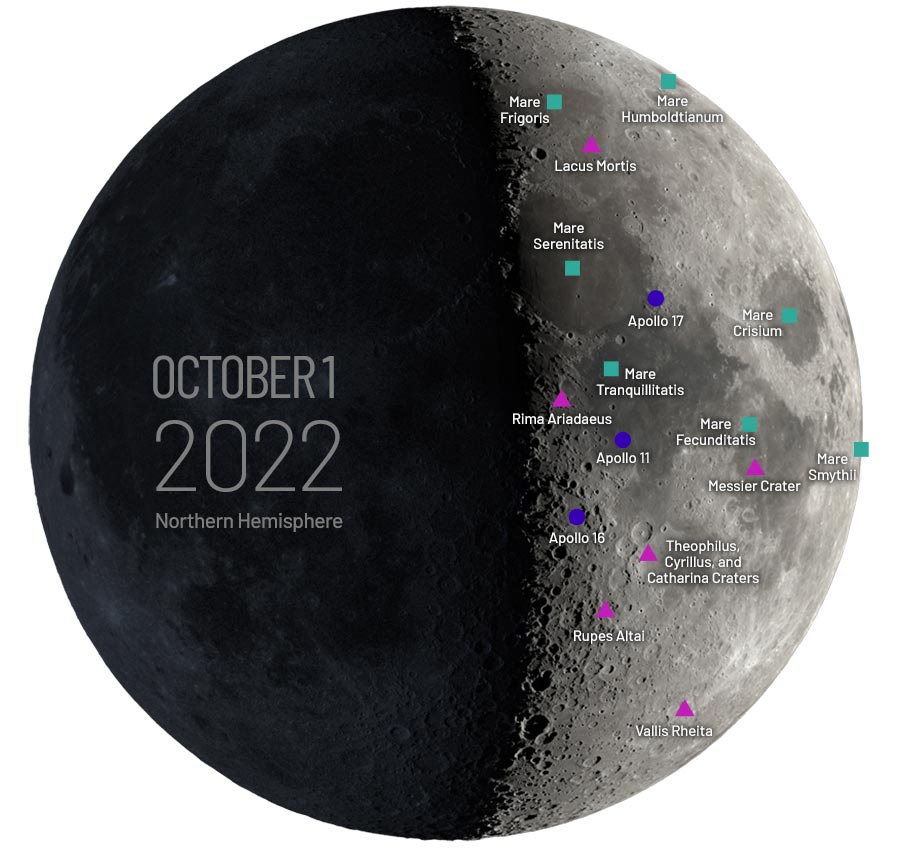
    NASA Moon Map 2022

    Refer to NASA’s Moon viewing guides, activity guides, and custom 2022 program Moon maps to make the most of your observations:

    • Viewing Guide
    • Photography Guide
    • Activity Guide
    • Moon Maps

    The Moon is a stepping stone to learning more about our solar system, galaxy, and universe. NASA is preparing to launch its Artemis I test flight to the Moon, a major step forward in a new era of human deep-space exploration.

    NASA will land the first woman and the first person of color on the Moon through Artemis missions. They will use innovative technologies to explore more of the lunar surface than ever before for the benefit of the world.

    International Observe the Moon Night is sponsored by NASA’s Lunar Reconnaissance Orbiter (LRO) mission and the Solar System Exploration Division of NASA’s Goddard Space Flight Center in Greenbelt, Maryland, with support from many partners. LRO launched on June 18, 200, and has collected a treasure trove of data with its seven powerful instruments, making an invaluable contribution to our knowledge about the Moon. LRO is managed by NASA Goddard for the Science Mission Directorate at NASA Headquarters in Washington, D.C.

    Never miss a breakthrough: Join the SciTechDaily newsletter.
    Follow us on Google and Google News.

    Astronomy Moon NASA
    Share. Facebook Twitter Pinterest LinkedIn Email Reddit

    Related Articles

    Five Fascinating Facts About the Moon

    Unraveling the Moon Illusion: How It Plays Tricks on Your Eyes

    Don’t Miss November’s Dazzling Supermoon and Cosmic Spectacle

    Last Chance To See a Supermoon in 2024 – What Makes This “Beaver” Moon Special

    Tonight’s Must-See: The Hunter’s Moon Shines As 2024’s Brightest Supermoon

    Don’t Miss September’s Sky Show: The Harvest Moon Eclipse

    August 2024 Supermoon Rises Over “Rocket City”

    Super Blue Moons Uncovered: Your Complete Guide

    NASA’s Apollo 15 Captures Earth’s Crest Over the Lunar Horizon

    Leave A Reply Cancel Reply

    • Facebook
    • Twitter
    • Pinterest
    • YouTube

    Don't Miss a Discovery

    Subscribe for the Latest in Science & Tech!

    Trending News

    Einstein Was Right Again: Scientists Discover Chemical Bonds That Defy Textbook Rules

    NASA Space Telescope Meets Fiery End After Nearly 22 Years in Orbit

    Look Up: Three Meteor Showers, a Supermoon, and a Historic Space First Are Coming in November

    Scientists Discover Something Unexpected 90 Kilometers Beneath Earth

    A Healthier Form of Salt Could Prevent Nearly 3 Million Deaths Every Year, Scientists Say

    Deep-Sea Scientists Capture Extraordinary 4K Footage of a Fish With a See-Through Head

    A Hidden Substance in Drinking Water May Be Linked to Heart Problems in Children

    Chemical Breakthrough Could Unlock the “Holy Grail” of Solid-State Battery Technology

    Follow SciTechDaily
    • Facebook
    • Twitter
    • YouTube
    • Pinterest
    • Newsletter
    • RSS
    SciTech News
    • Biology News
    • Chemistry News
    • Earth News
    • Health News
    • Physics News
    • Science News
    • Space News
    • Technology News
    Recent Posts
    • A Hidden Cancer-Killing Mechanism Could Change the Future of Immunotherapy
    • Massive Study of 2.8 Million People Reveals New Secrets of Alzheimer’s Disease
    • An Ancient Virus May Hold the Secret to What Makes the Human Brain Different
    • James Webb Discovers a Nearly Pristine Galaxy From the Dawn of the Universe
    • Something Unusual Is Swirling around the Monster Black Hole at the Center of Our Galaxy
    Copyright © 1998 - 2026 SciTechDaily. All Rights Reserved.
    • Science News
    • About
    • Contact
    • Editorial Board
    • Privacy Policy
    • Terms of Use

    Type above and press Enter to search. Press Esc to cancel.