
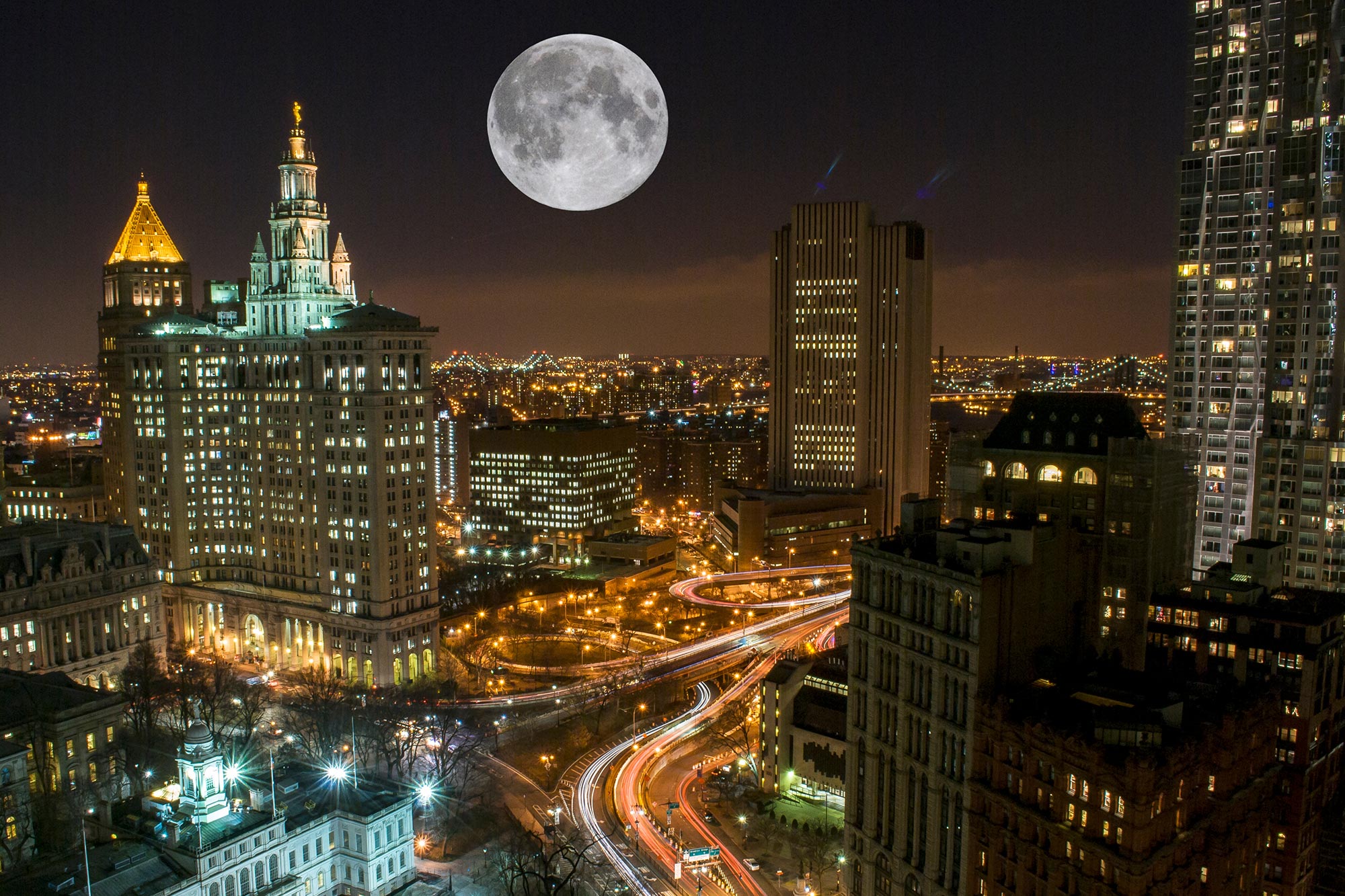
Experience the Moon illusion, a captivating phenomenon where the Moon looms larger near the horizon—a trick played by our brains, unexplained by science but visually spectacular, creating memorable scenes during moonrise or moonset.
Why does the Moon look so large when it rises or sets? This phenomenon, known as the Moon illusion, is a trick our brains play on us. Despite how it appears to our eyes, photographs show that the Moon is the same size whether it’s near the horizon or high in the sky. The illusion is rooted in how our brains process visual information, but even after thousands of years of observation, science still lacks a definitive explanation.

On a full moon night, find a good spot to watch it rise. The view can be breathtaking, often inspiring an audible “Wow!” from anyone watching. Near the horizon, the Moon can appear enormous, whether it’s framed by a mountain, rising from the ocean, silhouetted behind a cityscape, or hovering above a grove of trees. This striking illusion never fails to captivate.
But here’s the thing: it’s all in your head. Really. The Moon’s seeming bigness is an actual illusion, rather than an effect of our atmosphere or some other physics. You can prove it for yourself in a variety of ways.
Debunking Myths with Practical Tests
Hold up your outstretched index finger next to the Moon. You’ll find that your fingernail and the Moon are about the same size. Or try looking at the Moon through a paper tube, or bend over and look backward between your legs. When you view it like this, the Moon will be nowhere near as big as it had seemed.
Another ironclad way to size-check the Moon is to take a photo when it’s near the horizon, and another when it’s high in the sky. If you keep your camera zoom settings the same, you’ll find that the Moon is the same width, side to side, in both photos. (It may actually appear a little bit squashed in the vertical direction when it’s near the horizon. This is the result of the atmosphere acting like a weak lens.)
The Aesthetic Effects of Perspective
Photographers can simulate the Moon illusion by taking pictures of the Moon low on the horizon using a long lens, with buildings, mountains, or trees in the frame. So, remember when you see dazzling photos that feature a giant Moon above the landscape: those images are created by zooming in on distant objects near the ground. In other words, the Moon looks bigger in those photos because it’s a zoomed-in view.
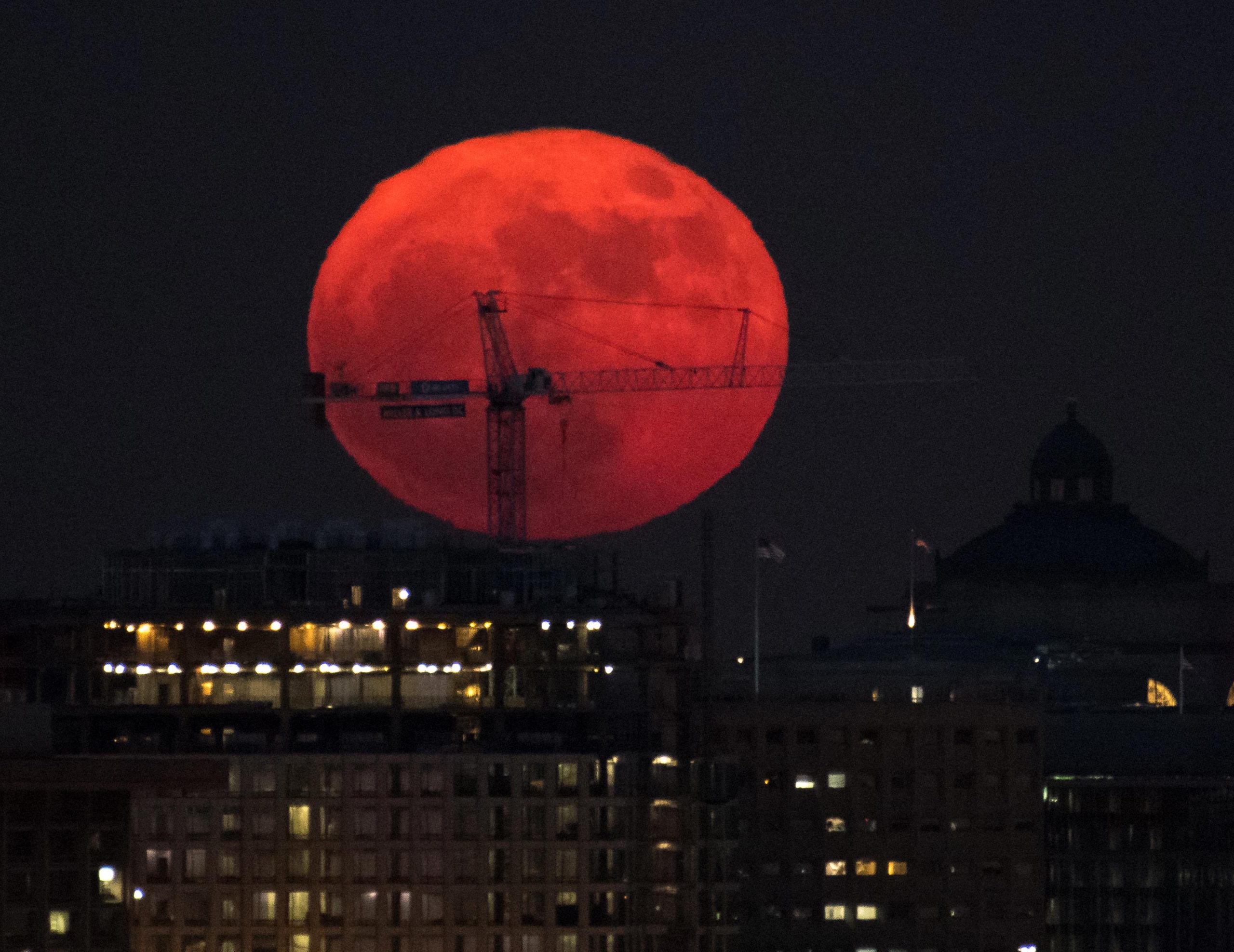
The Moon DOES Look More Yellow Near the Horizon
There’s one notable way in which the Moon’s appearance is actually different when it’s low in the sky. It tends to have a more yellow or orange hue, compared to when it’s high overhead. This happens because the Moon’s light travels a longer distance through the atmosphere. As it travels a longer path, more of the shorter, bluer wavelengths of light are scattered away, leaving more of the longer, redder wavelengths. (Dust or pollution can also deepen the reddish color.)
The Ongoing Mystery of the Moon Illusion
Brace yourself: we don’t really know. Well, not really. Depending on your mindset, this news might be unsatisfying, or it could be a reason to marvel at our mysterious brains. But despite the fact that people have been observing this illusion for thousands of years, we still don’t have a rock-solid scientific explanation for it.
In general, the proposed explanations have to do with a couple of key elements of how we visually perceive the world: how our brains perceive the size of objects that are nearer or farther away, and how far away we expect objects to be when they’re close to the horizon. It seems that our brains don’t know that the Moon’s distance doesn’t change that much no matter where it is in the sky on a given night.
There’s also some thinking that objects in the foreground of your lunar view play a role. Perhaps trees, mountains, and buildings help to trick your brain into thinking the Moon is both closer and bigger than it is? There’s an effect discovered a century ago called the Ponzo illusion that describes how this works. In the illusion, you have a scene where two lines are converging, like railroad tracks stretching away into the distance. On top of these lines are drawn two horizontal bars of equal length. Surprisingly, the horizontal bars appear to be different sizes, because your brain’s hard-wired sense of how distance works forces you to perceive it this way. This effect is related to how forced perspective works in paintings.
But this isn’t a perfect explanation, either. NASA astronauts in orbit also see the Moon illusion, and they have no foreground objects to act as distance clues. So, there’s likely more going on.
Maybe Just Enjoy the Spectacle?
In the absence of a complete explanation for why we see it like that, we can still agree that – real or illusion – a giant Moon is a beautiful sight. So, until someone puzzles out exactly what our brains are up to, it’s probably best to just enjoy the Moon illusion, and the moody, atmospheric, and sometimes downright haunting vistas it creates.
Never miss a breakthrough: Join the SciTechDaily newsletter.
Follow us on Google and Google News.
3 Comments
I figured this out (to my own satisfaction) years ago. Yes, it’s an illusion and yes it’s in the brain but it’s been the same for millions of years and it’s not just the moon. So does this make sense? We live in a horizontal world not a perpendicular world and by that I mean everything we see normally is on the plane that is around us at the same distance above the ground. For example if you were on the top of a building a hundred metres high and you could observe two identical objects; one on another building a hundred metres away but horizontal to you and the same object on the ground a hundred metres below you, it would look smaller than the one on the same horizontal plane. There are many things that are burned into our brain over millions of years that we accept and live with and don’t think too much about. OK this may not be a technical explanation but it works for me.
The brain is still largely a mystery – we don’t know what it’s billions of cells are doing together, moment to moment. So, like so many things the brain does, this is an unknown function. Most of how vision works is as yet unknown, in fact – we’ve only got a sketchy and inaccurate understanding so far. And that’s fine. It’s much better, and more intelligent, to say “we don’t understand this” than to make up stories to explain it – because those are just stories, with no way to verify them.
We don’t have the tools yet, or the computing capacity, to figure out how the brain works at the cellular level – we’re many decades away from understanding it. We’ll get there eventually – but for now, we don’t know how it works, we’ve only figured out some of the productive questions to ask about it.
Is there also an Earth illusion on the Moon? Does the Earth loom larger near the horizon?