
Close Menu
    Facebook X (Twitter) Instagram
    SciTechDaily
    • Biology
    • Chemistry
    • Earth
    • Health
    • Physics
    • Science
    • Space
    • Technology
    Facebook X (Twitter) Pinterest YouTube RSS
    SciTechDaily
    Home»Science»Magnetic Imaging of Living Cells with Sub-Cellular Spatial Resolution
    Science

    Magnetic Imaging of Living Cells with Sub-Cellular Spatial Resolution

    By Harvard-Smithsonian Center for AstrophysicsApril 26, 2013No Comments2 Mins Read
    Facebook Twitter Pinterest Telegram LinkedIn WhatsApp Email Reddit
    Share
    Facebook Twitter LinkedIn Pinterest Telegram Email Reddit
    Method for Resolving the Magnetic Structure of Living Biological Specimens at a Sub Cellular Level
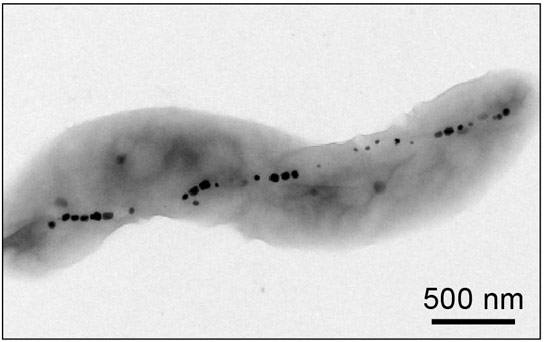
    A typical electron microscope image of a bacterium; magnetic nanoparticles inside the bacterium appear as black spots. A new technique has been developed that is capable of studying living cells at comparable spatial resolutions by taking advantage of the presence of these magnetic particles. Credit: Nature

    In a new study, researchers present a method for resolving the magnetic structure of living biological specimens at a sub-cellular level.

    Magnetic field measurement techniques have long enabled scientists to probe the internal structure of biological and material samples. For example, magnetic resonance imaging (MRI) provides information about the structure and function of tissue inside opaque biological specimens. A current limitation of such biologically compatible magnetic imaging techniques is that their resolution is insufficient to resolve the internal structure of cells, which are instead typically studied using optical or electron microscopes.

    In the current issue of the journal Nature, Harvard-Smithsonian Center for Astrophysics (CfA) scientists David Le Sage, David Glenn, and Ron Walsworth, together with their collaborators, present a method for resolving the magnetic structure of living biological specimens at a sub-cellular level. In their study, they use a particular variety of bacteria that naturally produces an internal chain of magnetic nanoparticles. They place these live bacteria onto a diamond surface that has been modified to contain crystal defects that interact with magnetic fields and light. By shining a laser beam onto the surface and measuring the pattern of the light emitted by the defects using an optical microscope, they are able to record images of the magnetic field pattern present at the diamond surface with a spatial resolution that is on the order of the wavelength of light. The technique is a spinoff from the group’s laser technology research on behalf of astronomical research, including exoplanet detection and radio interferometry.

    These first results demonstrate the promise of the technique to probe magnetically the internal structure of living cells. This technique could be used to shed new light on the properties and life cycles of these magnetic bacteria, and it points the way toward more sophisticated probes of a wide range of other biologically interesting systems.

    Reference: “Optical magnetic imaging of living cells” by D. Le Sage, K. Arai, D. R. Glenn, S. J. DeVience, L. M. Pham, L. Rahn-Lee, M. D. Lukin, A. Yacoby, A. Komeili and R. L. Walsworth, 24 April 2013, Nature.
    DOI: 10.1038/nature12072

    Never miss a breakthrough: Join the SciTechDaily newsletter.
    Follow us on Google and Google News.

    Harvard-Smithsonian Center for Astrophysics
    Share. Facebook Twitter Pinterest LinkedIn Email Reddit

    Related Articles

    Global SPHERE Network Promotes Research Opportunities for Students

    Next Generation SDSS-V Astronomical Survey to Map the Entire Sky

    Antarctic Site Dome A Promises to Open a New Window on the Cosmos

    Zipf’s Law from Scale-free Geometry – Like Galaxies, Like Cities

    Scientists Propose a New Method to Probe the Evolutionary History of the Universe

    CfA Astronomers Create First Realistic Virtual Universe

    Leave A Reply Cancel Reply

    • Facebook
    • Twitter
    • Pinterest
    • YouTube

    Don't Miss a Discovery

    Subscribe for the Latest in Science & Tech!

    Trending News

    Study Finds a Surprising Link Between Gut Microbes and Aging

    Frequent Cannabis Users Wake Up With More “Stress Hormone”

    Scientists Reveal Hidden DNA Traces in the Shroud of Turin

    Giant Alien World Found Hiding in Plain Sight for 11 Years

    Scientists Link Heavy TV Watching to Brain Changes Decades Later

    Did T. rex Leave These Mysterious Marks on Dinosaur Bones?

    Quantum Computers Could Freeze Like Ordinary PCs

    Scientists Reversed Autism-Like Symptoms in Adult Mice Within Two Hours

    Follow SciTechDaily
    • Facebook
    • Twitter
    • YouTube
    • Pinterest
    • Newsletter
    • RSS
    SciTech News
    • Biology News
    • Chemistry News
    • Earth News
    • Health News
    • Physics News
    • Science News
    • Space News
    • Technology News
    Recent Posts
    • Forgotten Autobiography Rewrites the Story of a War of 1812 Soldier
    • Ancient Egyptian Princesses Were Trained Warriors, Their Bones Reveal
    • Long-Lost Megalodon Fossils Found Hiding on a Museum Shelf
    • Two-Year Lifestyle Program Boosts Cognition 55% More in Older Adults
    • Speaking More Languages May Slow Brain Aging
    Copyright © 1998 - 2026 SciTechDaily. All Rights Reserved.
    • Science News
    • About
    • Contact
    • Editorial Board
    • Privacy Policy
    • Terms of Use

    Type above and press Enter to search. Press Esc to cancel.