
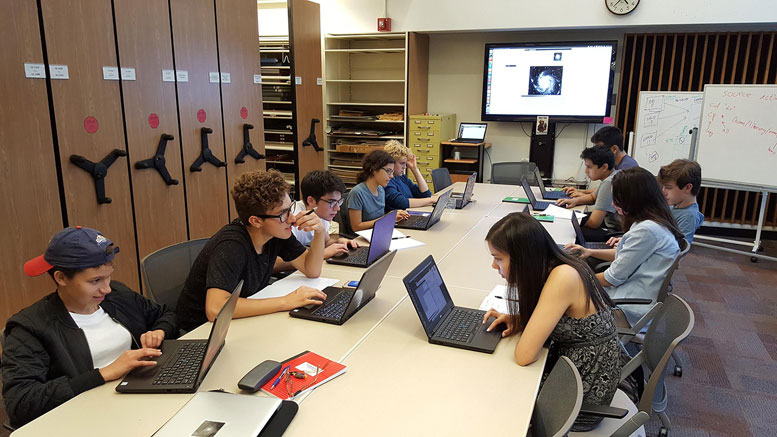
A coalition of U.S. educational institutions has launched an online database of opportunities around the world for high school students to get involved in research in the STEM fields (science, technology, engineering, and mathematics). The database is part of a global network of STEM programs and mentors for high school students.
By promoting “STEM Programs for High-Schoolers Engaging in Research Early” (SPHERE), the Global SPHERE Network aims to increase both the number of mentors (researchers who engage high school students in their research) and the number and diversity of high school students who participate in authentic STEM research.
Founding partners in the coalition include the University of California, Santa Cruz; the New York Academy of Sciences; the Bay Area Teen Science Program at UC Berkeley; American Museum of Natural History; RockEDU Science Outreach at the Rockefeller University; and the Harvard-Smithsonian Center for Astrophysics (CfA) in Cambridge, Mass. Since 2015, the Global SPHERE Network has connected with 120 organizations in 20 countries, said cofounder Puragra (Raja) GuhaThakurta.
“As a STEM researcher, I feel it is very important to mentor today’s youth and get them deeply immersed in authentic research so they can get a taste of how exciting it is to tackle some of the open-ended problems facing the world today,” said GuhaThakurta, a professor of astronomy and astrophysics at UC Santa Cruz and founder of the UCSC Science Internship Program (SIP). He and SIP partner liaison Emily Entress Clark cofounded the Global SPHERE Network.
The network’s new online database lists available opportunities across the world for high school students to engage in research. It also serves as a networking space for programs and mentors who are already offering research opportunities or are looking to do so. Member programs are encouraged to use the database on an ongoing basis to network with other programs, share resources, and engage with high school students.
The database will initially offer a few hundred research projects across a dozen established programs in a wide range of STEM disciplines. The goal is to grow the database to five to 10 times its current size over the next few years, GuhaThakurta said. High school science teachers and students interested in these projects can access the database through the student portal on the Global SPHERE Network website.
“Many students on a STEM track at school are keen to do research projects, not only for their school work, but to also enter some of the science competitions that offer college scholarships, but they often don’t know how to get started,” said Celina Morgan-Standard, senior vice president of global business development at the New York Academy of Sciences. “The Global SPHERE Network initiative will help to address this opportunity gap while providing a great resource to teachers who’d like to give their students STEM-related research projects.”
GuhaThakurta noted that most established programs find that they have to turn away many qualified students and generally have no systematic way to redirect them to alternate programs. Meanwhile, parents and students tend to be aware of only a small fraction of the available programs. The Global SPHERE Network provides valuable resources for programs and mentors as well as for students, parents, and teachers.
This year, the first cohort of Cambridge, Mass. high-school students began to attend the Science Research Mentoring Program at the CfA. The students are paired with astrophysicists, who advise them in year-long, independent research projects. The students get to work on some of the most cutting-edge subjects in astrophysics.
“Mentoring is a keyword in the programs available through the Global SPHERE Network,” says the CfA’s Dr. Or Graur, the program’s director. “It’s important for students to get to know real scientists with diverse backgrounds. This kind of mentoring makes it easier for students to see themselves as future scientists.”
The network will host the first in a series of webinars on Wednesday, November 29, 2017, to give an overview of the network and answer questions for organizations that are interested in joining. Free registration for this and subsequent webinars is available through the prospective partner questionnaire on the network’s website. Institutions, professionals, and educational groups are encouraged to register to receive invitations to webinars and find out ways they can benefit from the network.
Additional information about the Global SPHERE Network is available online at www.globalspherenetwork.org.
Never miss a breakthrough: Join the SciTechDaily newsletter.
Follow us on Google and Google News.
1 Comment
I would be interested to know more about this. Where did you get this information and where could I go with this?