
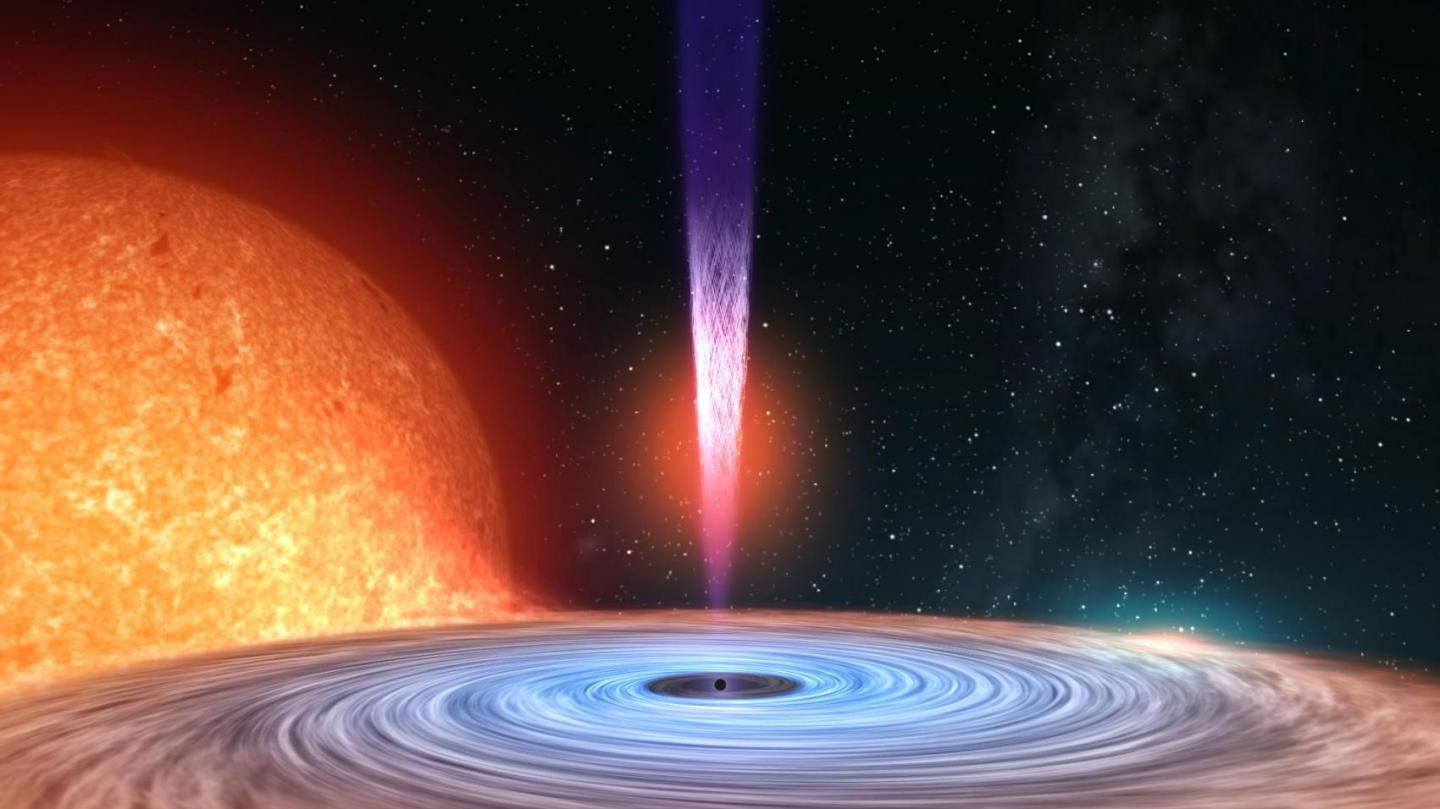
Nothing can emerge from a black hole. Yet, in nature, we find ultra-powerful jets of energy that shoot out from the immediate vicinities of growing black holes. How these jets form remains a puzzle but they consist of a hot plasma soup, which is somehow sped up to speeds approaching that of light. Along the way, this plasma begins to glow with radiation, forming two bright columns along the black hole’s axis of rotation. Scientists have long debated where and how this happens in the jet.
In a new study appearing in the journal Nature Astronomy today, in which the IAC has participated, astronomers announce that they have new clues to this mystery. They studied one of the famous black hole binaries in our galaxy -V404 Cygni- when it was undergoing a bright episode of growth activity during June 2015. Using the ULTRACAM fast imager mounted on the William Herschel Telescope (WHT), of the Isaac Newton Group of Telescopes (ING), at the Roque de los Muchachos Observatory (Garafía, La Palma), combined with NASA’s NuSTAR telescope in Earth orbit, a fleeting time delay of just 100 milliseconds (0.1 seconds) was found between X-rays and optical flashes of light.
V404 Cygni comprises a black hole weighing about 9 times our Sun, orbited by a companion star which supplies material to feed the black hole. The X-ray light detected by NuSTAR is emitted by this infalling material as it spirals inwards in the form of a disc. The optical flashes emerge from the outflowing plasma in the jet.
“The time delay between the X-rays and the optical thus tells us the size of the inner jet where the plasma undergoes strong acceleration,” said Dr. Poshak Gandhi, lead author from the University of Southampton, UK. “The nature of these optical flashes has been questioned. But V404 Cygni showed these delayed flashes while the jet emission was observed to be strengthening. This means that the fastest flashes originate in the jet.”
The time delay can be translated to the maximum distance that the plasma could have traveled in this duration. This distance is approximately 30,000 kilometers (18,600 miles) – a tiny distance in cosmic terms – representing the inner acceleration zone in the jet. Beyond this region, the jet plasma glows brightly, possibly because of shocks created by chunks of plasma colliding at very high speed.
“Probing these inner zones in jets is exciting because it allows us to constrain theories of extreme particle acceleration in nature,” said Dr. Gandhi. “Strong magnetic fields have been invoked to explain the launching of jet plasma but many uncertainties remain in matching up the theory with observations. Our new observations will certainly help in this regard.” The scientists are further excited because of evidence that jets in supermassive black holes weighing millions or times more than V404 Cygni could behave similarly.
Phil Charles, professor emeritus at Southampton and Oxford, placed these findings in context as follows. “Black holes in our Galaxy were only definitively confirmed with the measurement of the compact object mass in V404 Cygni almost 25 years ago – an absolute minimum of 6 times that of our Sun meant that it could not possibly be a neutron star. Thus began this field of “stellar-mass black holes.” As in this occasion, almost all the early ground-based observations were made with the WHT on La Palma. This discovery also involved the other finders of the first black hole of the Milky Way, the IAC researcher Jorge Casares, who has been hunting black holes during these years using the WHT and other optical telescopes. “The fact that we can now potentially unite the physics of jets in stellar and supermassive black holes is immensely satisfying,” explains this scientist.
Carrying out these measurements required several telescopes working together across the entire electromagnetic spectrum. “Simultaneous multiwavelength astronomy from telescopes around the Earth is not easy. Therefore, there are only a handful of observations like these which can study the behavior of black holes at high time resolution across the electromagnetic spectrum. But this is a glimpse of the other studies which will surely come in the future,” Jorge Casares said.
Reference: “An elevation of 0.1 light-seconds for the optical jet base in an accreting Galactic black hole system” by P. Gandhi, M. Bachetti, V. S. Dhillon, R. P. Fender, L. K. Hardy, F. A. Harrison, S. P. Littlefair, J. Malzac, S. Markoff, T. R. Marsh, K. Mooley, D. Stern, J. A. Tomsick, D. J. Walton, P. Casella, F. Vincentelli, D. Altamirano, J. Casares, C. Ceccobello, P. A. Charles, C. Ferrigno, R. I. Hynes, C. Knigge, E. Kuulkers, M. Pahari, F. Rahoui, D. M. Russell and A. W. Shaw, 30 October 2017, Nature Astronomy.
DOI: 10.1038/s41550-017-0273-3
Never miss a breakthrough: Join the SciTechDaily newsletter.
Follow us on Google and Google News.
1 Comment
interesting artilce