
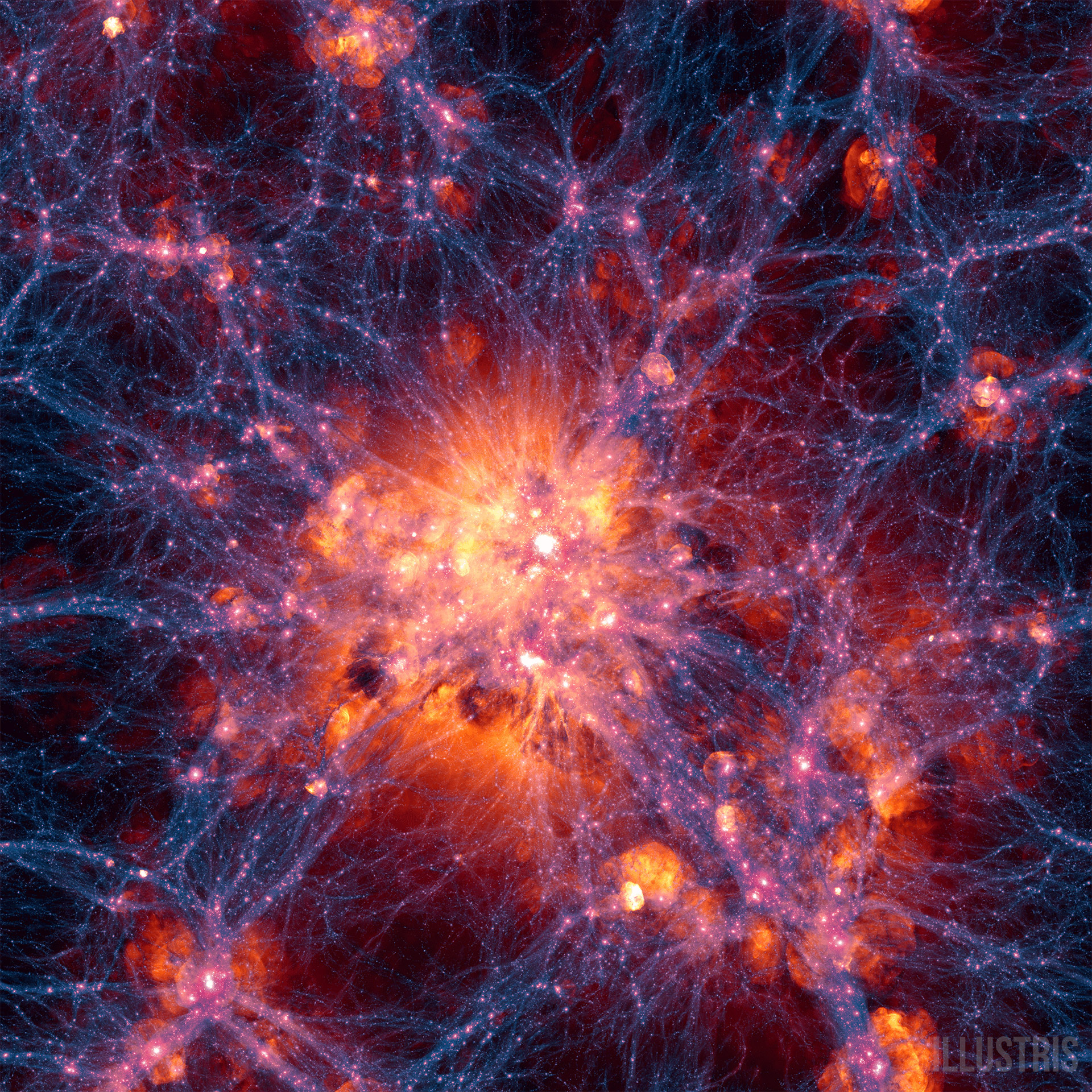
Using a computer simulation called Illustris, astronomers have created the first realistic virtual universe that starts 12 million years after the Big Bang and traces 13 billion years of cosmic evolution.
Move over, Matrix — astronomers have done you one better. They have created the first realistic virtual universe using a computer simulation called “Illustris.” Illustris can recreate 13 billion years of cosmic evolution in a cube 350 million light-years on a side with unprecedented resolution.
“Until now, no single simulation was able to reproduce the universe on both large and small scales simultaneously,” says lead author Mark Vogelsberger (MIT/Harvard-Smithsonian Center for Astrophysics), who conducted the work in collaboration with researchers at several institutions, including the Heidelberg Institute for Theoretical Studies in Germany.
These results are being reported in the May 8th issue of the journal Nature.
Previous attempts to simulate the universe were hampered by a lack of computing power and the complexities of the underlying physics. As a result, those programs either were limited in resolution, or forced to focus on a small portion of the universe. Earlier simulations also had trouble modeling complex feedback from star formation, supernova explosions, and supermassive black holes.
Illustris employs a sophisticated computer program to recreate the evolution of the universe in high fidelity. It includes both normal matter and dark matter using 12 billion 3-D “pixels,” or resolution elements.
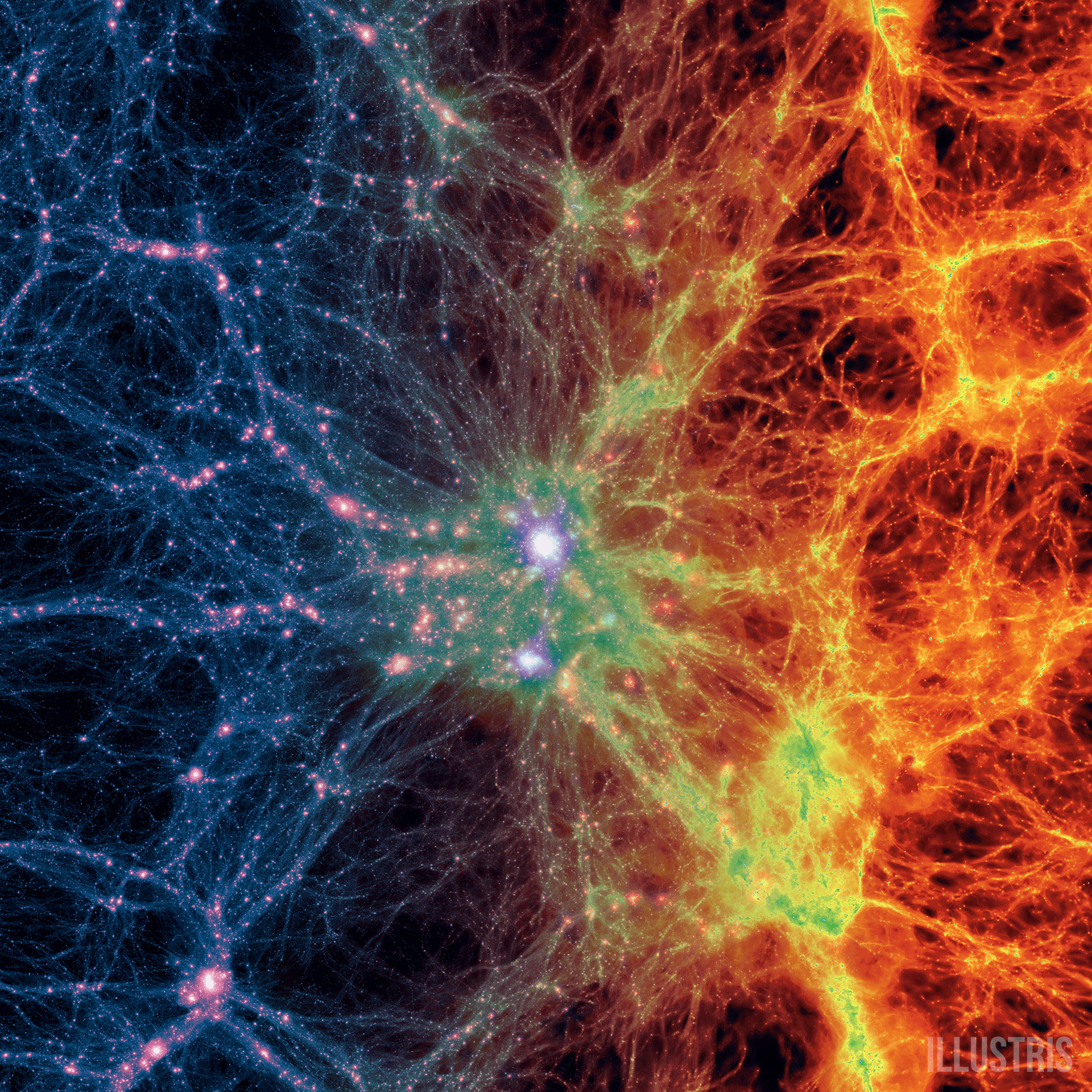
This video from the Illustris project simulates 13 billion years of the universe in just two minutes. It shows a close-up view on a volume of space 30 million light-years on a side, around which the “camera” rotates to show all sides. The total simulation volume is 1,000 times larger than this region. The simulation features several layers including dark matter, gas temperature, and the abundance of heavy elements. Although all layers are present throughout the simulation, the video shows only one layer at a time. The video begins by showing the density of dark matter (blue) – the mysterious stuff that forms the backbone of the cosmic web, holding galaxies and galaxy clusters together. Next the video shifts to a view of gas temperature, with red and white representing the highest temperatures. What appear to be explosions actually come from supermassive black holes blasting jets of material into intergalactic space, carving out huge bubbles. The view then morphs to show the abundance of heavy elements (purple) mixed into the gas, illustrating how dying stars have seeded space with chemicals like oxygen and iron. Finally, the video shifts back to dark matter before fading to a simulated view of the present-day universe teeming with galaxies.
The team dedicated five years to developing the Illustris program. The actual calculations took 3 months of “run time,” using a total of 8,000 CPUs running in parallel. If they had used an average desktop computer, the calculations would have taken more than 2,000 years to complete.
The computer simulation began a mere 12 million years after the Big Bang. When it reached the present day, astronomers counted more than 41,000 galaxies in the cube of simulated space. Importantly, Illustris yielded a realistic mix of spiral galaxies like the Milky Way and football-shaped elliptical galaxies. It also recreated large-scale structures like galaxy clusters and the bubbles and voids of the cosmic web. On the small scale, it accurately recreated the chemistries of individual galaxies.
Since light travels at a fixed speed, the farther away astronomers look, the farther back in time they can see. A galaxy one billion light-years away is seen as it was a billion years ago. Telescopes like Hubble can give us views of the early universe by looking to greater distances. However, astronomers can’t use Hubble to follow the evolution of a single galaxy over time.
“Illustris is like a time machine. We can go forward and backward in time. We can pause the simulation and zoom into a single galaxy or galaxy cluster to see what’s really going on,” says co-author Shy Genel of the CfA.
Headquartered in Cambridge, Massachusetts, the Harvard-Smithsonian Center for Astrophysics (CfA) is a joint collaboration between the Smithsonian Astrophysical Observatory and the Harvard College Observatory. CfA scientists, organized into six research divisions, study the origin, evolution, and ultimate fate of the universe.
Reference: “Properties of galaxies reproduced by a hydrodynamic simulation” by M. Vogelsberger, S. Genel, V. Springel, P. Torrey, D. Sijacki, D. Xu, G. Snyder, S. Bird, D. Nelson and L. Hernquist, 7 May 2014, Nature.
DOI: 10.1038/nature13316
arXiv: 1405.1418
Never miss a breakthrough: Join the SciTechDaily newsletter.
Follow us on Google and Google News.