
Close Menu
    Facebook X (Twitter) Instagram
    SciTechDaily
    • Biology
    • Chemistry
    • Earth
    • Health
    • Physics
    • Science
    • Space
    • Technology
    Facebook X (Twitter) Pinterest YouTube RSS
    SciTechDaily
    Home»Biology»Yale Research Shows How Renalase Protects Kidney and Heart from Injury
    Biology

    Yale Research Shows How Renalase Protects Kidney and Heart from Injury

    By Ziba Kashef, Yale UniversityMay 11, 2015No Comments2 Mins Read
    Facebook Twitter Pinterest Telegram LinkedIn WhatsApp Email Reddit
    Share
    Facebook Twitter LinkedIn Pinterest Telegram Email Reddit
    Study Details How Key Protein Protects Kidney and Heart from Injury
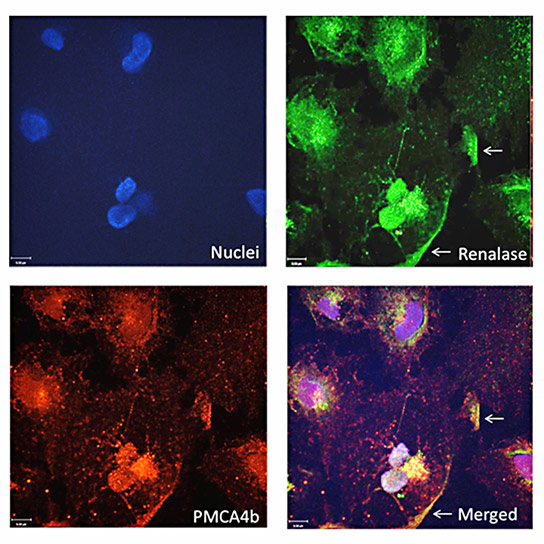
    Image of kidney cells in culture. The lower right panel shows how the protein renalase co-localizes with its receptor PMCA4b. Credit: Ling Wang

    A newly published study from Yale University details how the protein renalase protects cells from the type of severe injury that could result in a heart attack or kidney failure. The finding may lead to new treatments that protect against those conditions.

    Dr. Gary V. Desir, professor of medicine, and fellow researchers at Yale School of Medicine, focused their study on the mechanism of renalase, a critical protein that Desir’s lab first discovered in 2005. By re-engineering and observing a small piece of the protein in culture, they were able to identify its receptor, a molecule known as PMCA4b. Their work revealed that the interaction between renalase and PMCA4b promotes cell survival.

    Other studies have confirmed the role of renalase in protecting the heart. By identifying its receptor and underlying mechanism, the Yale researchers pinpointed a target for new therapies based on the protein or its receptor. “It could lead to the development of drugs that protect the kidney and the heart against ischemic or toxic injury,” said Desir.

    Future studies will investigate the role of renalase in cancer.

    The research was published April 23 in PLOS ONE.

    Reference: “Identification of a Receptor for Extracellular Renalase” by Ling Wang, Heino Velazquez, John Chang, Robert Safirstein and Gary V. Desir, 23 April 2015, PLOS One.
    DOI: 10.1371/journal.pone.0122932

    Never miss a breakthrough: Join the SciTechDaily newsletter.
    Follow us on Google and Google News.

    Medicine Protein Yale University
    Share. Facebook Twitter Pinterest LinkedIn Email Reddit

    Related Articles

    New Analysis of Longevity Protein Yields Important Therapeutic Insights

    A Closer Look at the Antifreeze Protein That Allows Siberian Beetles to Survive

    New Design Makes Previously Inaccessible Proteins Vulnerable to Drugs

    Chitinase 3-like-1, A Key to Fighting Pneumonia

    Evolution Helps Deduce the Shape of 18 Families of Transmembrane Proteins

    Crowding Causes Internal Cell Structure Alignment

    Complete Structure of the “Salvia Receptor” Revealed

    Examining Membrane Proteins by X-Ray Laser

    Zelboraf Nearly Doubles Median Survival Time for Patients with Metastatic Melanoma

    Leave A Reply Cancel Reply

    • Facebook
    • Twitter
    • Pinterest
    • YouTube

    Don't Miss a Discovery

    Subscribe for the Latest in Science & Tech!

    Trending News

    Bone-Strengthening Discovery Could Reverse Osteoporosis

    Scientists Uncover Hidden Trigger Behind Stem Cell Aging

    Scientists Find Way to Reverse Fatty Liver Disease Without Changing Diet

    Could Humans Regrow Limbs? New Study Reveals Promising Genetic Pathway

    Scientists Reveal Eating Fruits and Vegetables May Increase Your Risk of Lung Cancer

    Scientists Reverse Brain Aging With Simple Nasal Spray

    Scientists Uncover Potential Brain Risks of Popular Fish Oil Supplements

    Scientists Discover a Surprising Way To Make Bread Healthier and More Nutritious

    Follow SciTechDaily
    • Facebook
    • Twitter
    • YouTube
    • Pinterest
    • Newsletter
    • RSS
    SciTech News
    • Biology News
    • Chemistry News
    • Earth News
    • Health News
    • Physics News
    • Science News
    • Space News
    • Technology News
    Recent Posts
    • Scientists Create “Neurobots” – Living Machines With Their Own Nervous Systems
    • Europe’s Most Active Volcano Just Got Stranger – Here’s Why Scientists Are Rethinking It
    • Why Are Giant Ants Letting Tiny Ants Crawl All Over Them?
    • Revolutionary Technique Sends Healthy Mitochondria Exactly Where They’re Needed
    • This Student Recreated the Universe in a Bottle. What She Discovered Could Help Reveal How Life Started on Earth
    Copyright © 1998 - 2026 SciTechDaily. All Rights Reserved.
    • Science News
    • About
    • Contact
    • Editorial Board
    • Privacy Policy
    • Terms of Use

    Type above and press Enter to search. Press Esc to cancel.