
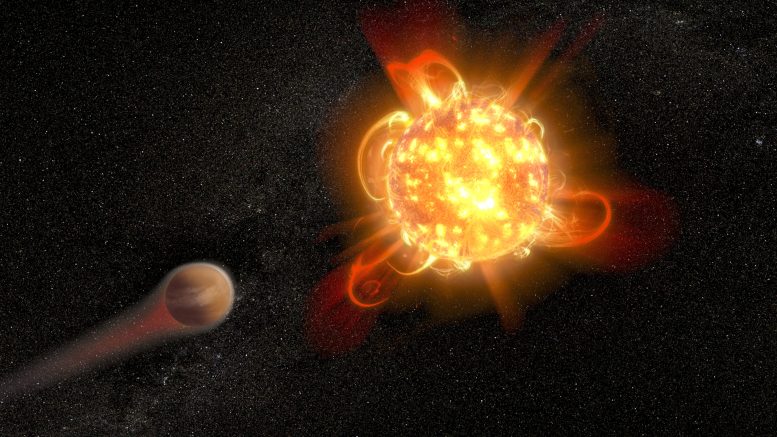
A recent discovery suggests that an Earth-like planet orbiting an M dwarf, the most common star type in the universe, lacks an atmosphere.
This finding, detailed in The Astrophysical Journal Letters, highlights the inhospitable conditions on GJ 1252b, which orbits its star twice daily and reaches extreme temperatures that could melt metals like gold and silver. The planet’s proximity to its star and the intense radiation pressure likely strip away any potential atmosphere, posing challenges for the possibility of life on similar planets around M dwarfs. This research could influence future astronomical studies, including those conducted by the James Webb Space Telescope.
An Earth-like planet orbiting an M dwarf — the most abundant type of star in the universe — appears to have no atmosphere at all. This dramatic discovery could cause a major shift in the search for life on other planets.
Because M-dwarfs are so common, this discovery means that a large number of planets orbiting these stars may also lack atmospheres and therefore are unlikely to harbor living things.
The work that led to the revelations about the no-atmosphere exoplanet, named GJ 1252b, is detailed in a paper that was recently published in The Astrophysical Journal Letters.
Extreme Conditions on GJ 1252b
This planet orbits its star twice during the course of a single day on Earth and is slightly larger than Earth. It is also much closer to its star than Earth is to the sun, making GJ 1252b intensely hot as well as inhospitable.
“The pressure from the star’s radiation is immense, enough to blow a planet’s atmosphere away,” said Michelle Hill, UC Riverside astrophysicist and study co-author.
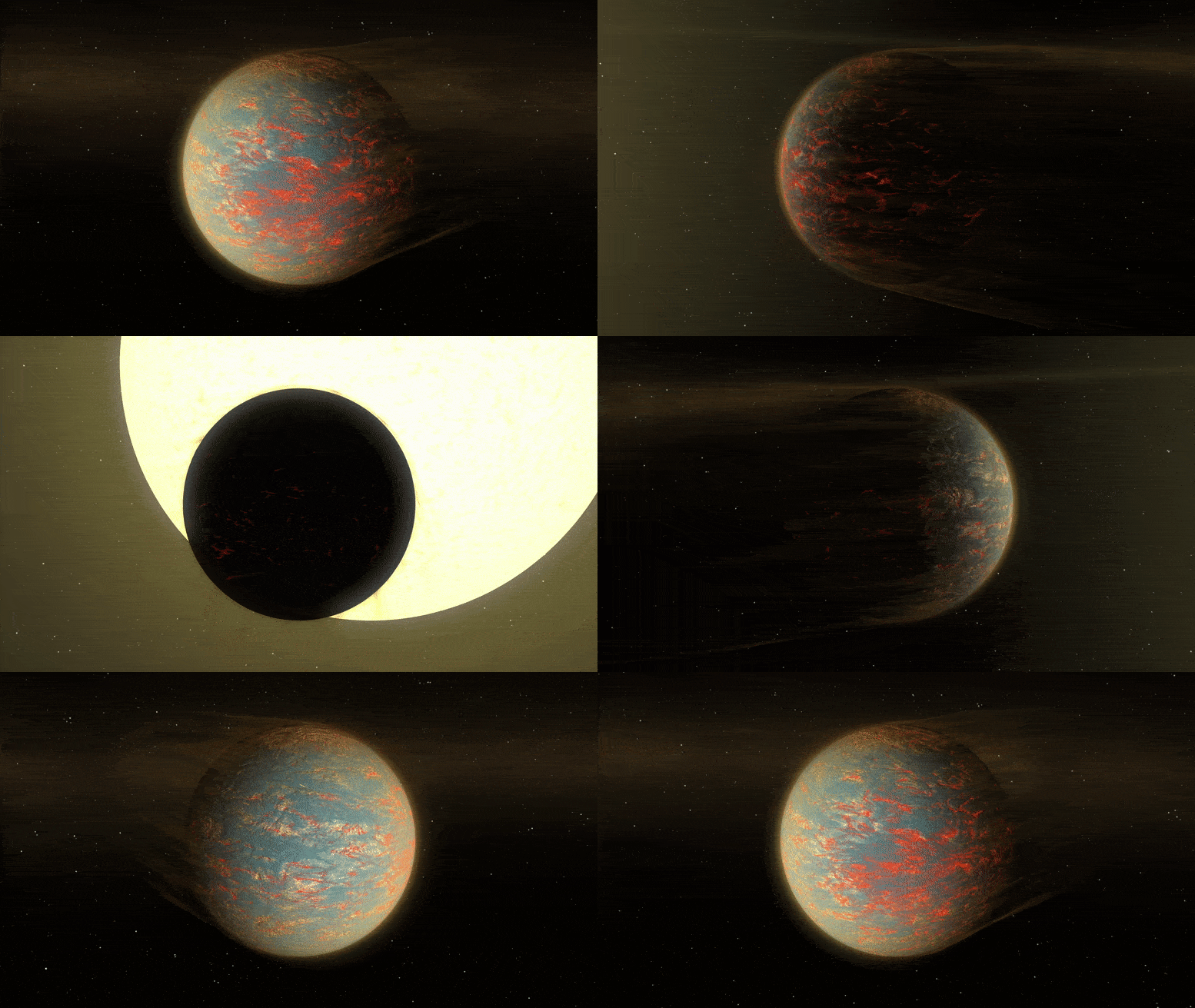
Earth also loses some of its atmosphere over time because of the sun, but volcanic emissions and other carbon cycling processes make the loss barely noticeable by helping replenish what is lost. However, in greater proximity to a star, a planet cannot keep replenishing the amount being lost.
In our solar system, this is the fate of Mercury. It does have an atmosphere, but one that is extremely thin, made up of atoms blasted off its surface by the sun. The extreme heat of the planet causes these atoms to escape into space.
Investigative Techniques and Findings
To determine that GJ 1252b lacks an atmosphere, astronomers measured infrared radiation from the planet as its light was obscured during a secondary eclipse. This type of eclipse occurs when a planet passes behind a star and the planet’s light, as well as light reflected from its star, is blocked.
The radiation revealed the planet’s scorching daytime temperatures, estimated to reach 2,242 degrees Fahrenheit (1,228 degrees Celsius) — so hot that gold, silver, and copper would all melt on the planet. The heat, coupled with assumed low surface pressure, led the investigators to conclude that there’s no atmosphere.
Even with a tremendous amount of carbon dioxide, which traps heat, the researchers concluded GJ 1252b would still not be able to hold on to an atmosphere. “The planet could have 700 times more carbon than Earth has, and it still wouldn’t have an atmosphere. It would build up initially, but then taper off and erode away,” said Stephen Kane, UCR astrophysicist, and study co-author.
Implications for Life on Other Planets
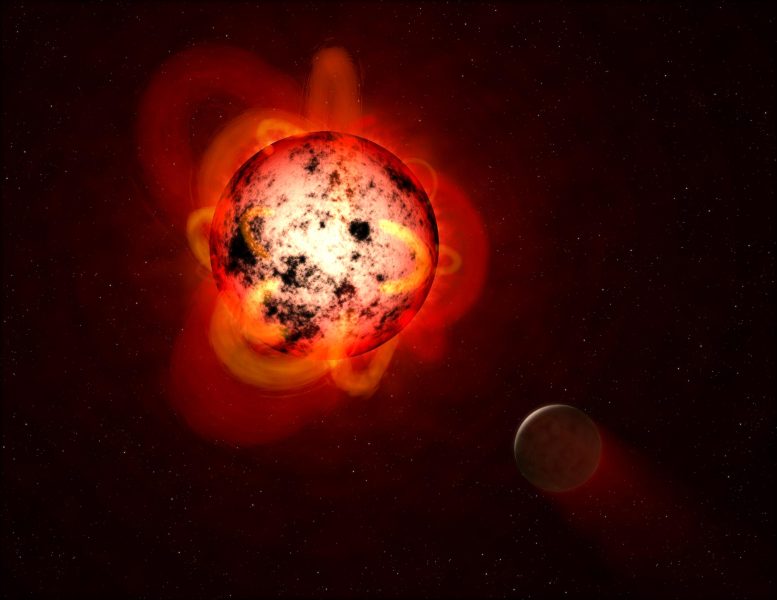
M dwarf stars tend to have more flares and activity than the sun, further reducing the likelihood that planets closely surrounding them could hold on to their atmospheres.
“It’s possible this planet’s condition could be a bad sign for planets even further away from this type of star,” Hill said. “This is something we’ll learn from the James Webb Space Telescope, which will be looking at planets like these.”
There are 5,000 stars in Earth’s solar neighborhood, most of them M dwarfs. Even if planets orbiting them can be ruled out entirely, there are still roughly 1,000 stars similar to the sun that could be habitable.
“If a planet is far enough away from an M dwarf, it could potentially retain an atmosphere. We cannot conclude yet that all rocky planets around these stars get reduced to Mercury’s fate,” Hill said. “I remain optimistic.”
Reference: “GJ 1252b: A Hot Terrestrial Super-Earth with No Atmosphere” by Ian J. M. Crossfield, Matej Malik, Michelle L. Hill, Stephen R. Kane, Bradford Foley, Alex S. Polanski, David Coria, Jonathan Brande, Yanzhe Zhang, Katherine Wienke, Laura Kreidberg, Nicolas B. Cowan, Diana Dragomir, Varoujan Gorjian, Thomas Mikal-Evans, Björn Benneke, Jessie L. Christiansen, Drake Deming and Farisa Y. Morales, 23 September 2022, The Astrophysical Journal Letters.
DOI: 10.3847/2041-8213/ac886b
The research was led by Ian Crossfield at the University of Kansas. It included scientists from UC Riverside as well as NASA’s Jet Propulsion Laboratory (JPL), California Institute of Technology (Caltech), University of Maryland, Carnegie Institution for Science, Max Planck Institute for Astronomy, McGill University, University of New Mexico, and the University of Montreal.
Hill’s work on this project was supported by a grant from the Future Investigators in NASA Earth and Space Science and Technology program.
Never miss a breakthrough: Join the SciTechDaily newsletter.
Follow us on Google and Google News.
8 Comments
“Discovery Could Dramatically Speed Up the Search for Extraterrestrial Life”
Who writes these headlines? Better–
“Discovery Could Dramatically Reduce Chances for Extraterrestrial Life”
Which constraint speeds up the search.
The chances of extraterrestrial life are already pretty low. This makes them even lower. Habitability has to include protection from solar UV radiation to the planetary surfaces.
Chances are high under habitable conditions due to the short time and high diversity which life evolved here.
UV protection is afforded by atmospheres, clouds, one meter of water or a few millimeters of soil.
And why would you expect life on a planet that is too close to its sun to begin with? Mercury and Venus is too close to our sun to support life. Why would it be any different elsewhere? That is why you always look at planets within a suns goldilocks zone. That is if your looking for carbon based life such as us.
If vulcanic activity was a primary reason that earth has still atmosphere, CO2 emition is not so bad at all.
Should we try to increase CO2 emition to save our planet in the long run?
Not at the problem and cost increasing rate that we are doing it today. At normal rates, 1/1000 of today’s crises causing man made global warming, it would be feasible – the climate has changed *that* way before.
there are still roughly 1,000 stars similar to the sun that could be habitable, SO by Celestia star program there are 23,017 G type stars around the sun, BUT, only 4,996 are G0, 704 G1, 1068 G2, 1184 G3, 36 G4, 6911 G5, 636 G6, 17 G7V, 1527 G8, 31 G9, are on the Main Sequence. And of all the G type there are 464 within 100 light-years of Sol, 95 G0V, 6 G0IV, 1 G0III, 22 G1V, 2 G1IV, 1 G1III, 36 G2V, 5 G2IV, 1 G2III, 1 G2VI, 28 G3V, 7 G3IV, 9 G4V, 2G4IV, 131 G5V, 19 G5IV, 1G5III, 1 G5VI, 18 G6V, 3 G6IV, 4 G7V, 52, G8V, 8 G8IV, 2 G8III, 6 G9V, 3G9IV.
I have HD, HIP, and SAO numbers for almost all of them…