
Close Menu
    Facebook X (Twitter) Instagram
    SciTechDaily
    • Biology
    • Chemistry
    • Earth
    • Health
    • Physics
    • Science
    • Space
    • Technology
    Facebook X (Twitter) Pinterest YouTube RSS
    SciTechDaily
    Home»Science»Can Stress Influence Your Appetite? A Johns Hopkins Study Reveals That It’s All in Your Head
    Science

    Can Stress Influence Your Appetite? A Johns Hopkins Study Reveals That It’s All in Your Head

    By Johns Hopkins MedicineNovember 21, 2022No Comments3 Mins Read
    Facebook Twitter Pinterest Telegram LinkedIn WhatsApp Email Reddit
    Share
    Facebook Twitter LinkedIn Pinterest Telegram Email Reddit
    Hamburger Unhealthy Junk Food Obesity
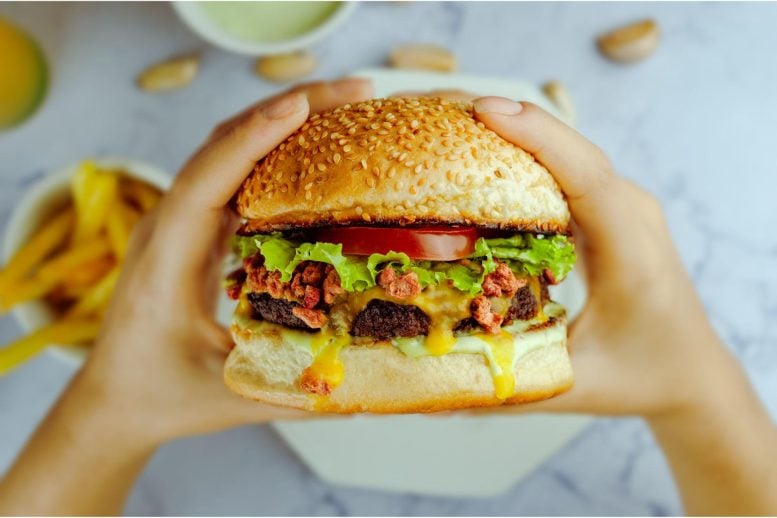
    The research also revealed that obese and lean individuals had somewhat different brain responses to food phrases, with obese adults displaying less activation of cognitive control regions to high-calorie items like grilled cheese.

    New Research Reveals the Relationship Between Stress, Obesity, and Appetite

    Researchers from Johns Hopkins Medicine investigated whether stress may increase appetite in obese and lean adults in a series of experiments using functional magnetic resonance imaging (fMRI), a technique for monitoring brain activity across networks in the brain. The results showed that stress affects how the brain responds to food and that both lean and obese people respond to food cues in reward- and cognitive-control-related brain regions.

    The findings of the study were recently published in the journal PLOS ONE.

    Data from 29 adults—16 women and 13 men—were evaluated for the study, of whom 17 were obese and 12 were lean. Participants underwent two fMRI scans, one following a social and physiological stress test.

    During both scans, participants underwent a food word reactivity test. This test involved observing how people’s brains responded to food words, such as menu items written on a blackboard. The researchers asked participants to picture each food’s appearance, smell, and taste, as well as how it would feel to consume it right then and there, in order to maximize the brain’s appetitive response. They were also asked how much they desired each dish and whether they thought they shouldn’t eat it to evaluate how they viewed food-related decision-making.

    “The experiments showed that obese and lean adults differ somewhat in their brain responses, with obese adults showing less activation of cognitive control regions to food words, especially to high-calorie foods, like for example, grilled cheese,” says lead researcher Susan Carnell, Ph.D., associate professor of psychiatry and behavioral sciences at the Johns Hopkins University School of Medicine.

    The study also showed that stress impacts brain responses to food. For example, obese individuals showed greater activation of the orbitofrontal cortex, a brain reward region, after the stress test. “We also found evidence for links between the subjective stress experienced and brain responses in both groups. For example, lean individuals who reported higher stress following the test showed lower activation of the dorsolateral prefrontal cortex, a key brain area for cognitive control,” says Carnell.

    Reference: “Obesity and acute stress modulate appetite and neural responses in food word reactivity task” by Susan Carnell, Leora Benson, Afroditi Papantoni, Liuyi Chen, Yuankai Huo, Zhishun Wang, Bradley S. Peterson and Allan Geliebter, 28 September 2022, PLOS ONE.
    DOI: 10.1371/journal.pone.0271915

    Never miss a breakthrough: Join the SciTechDaily newsletter.
    Follow us on Google and Google News.

    Brain Johns Hopkins Medicine Obesity Popular Psychiatry Stress
    Share. Facebook Twitter Pinterest LinkedIn Email Reddit

    Related Articles

    Unlocking the Brain’s Secret Defense Against Stress

    Harvard Psychiatrist Says Mental Illness Starts in Your Cells

    Obesity Breakthrough: Scientists Discover Brain’s “Stop Eating” Switch

    In the Amygdala, Clues to Anxiety’s Origins — and a Potential Cure

    Intermittent Fasting vs. USDA Diet: Johns Hopkins Scientists Uncover Surprising Brain Health Benefits

    Revealing the Brain’s Secret Weapon Against Stress: Natural Cannabinoid Substances

    New Study Reveals That a Four-Day Work Week Can Improve Health

    How the Brain Changes During Depression Treatment

    How Touching Is Perceived in the Brain – Investigated With Two-Person MRI Scans on Couples

    Leave A Reply Cancel Reply

    • Facebook
    • Twitter
    • Pinterest
    • YouTube

    Don't Miss a Discovery

    Subscribe for the Latest in Science & Tech!

    Trending News

    Scientists Warn That This Common Pet Fish Can Wreck Entire Ecosystems

    Scientists Make Breakthrough in Turning Plastic Trash Into Clean Fuel Using Sunlight

    This Popular Supplement May Interfere With Cancer Treatment, Scientists Warn

    Scientists Finally Solved One of Water’s Biggest Mysteries

    Could This New Weight-Loss Pill Disrupt the Entire Market? Here’s What You Should Know About Orforglipron

    Earth’s Crust Is Tearing Open in Africa, and It Could Form a New Ocean

    Breakthrough Bowel Cancer Trial Leaves Patients Cancer-Free for Nearly 3 Years

    Natural Compound Shows Powerful Potential Against Rheumatoid Arthritis

    Follow SciTechDaily
    • Facebook
    • Twitter
    • YouTube
    • Pinterest
    • Newsletter
    • RSS
    SciTech News
    • Biology News
    • Chemistry News
    • Earth News
    • Health News
    • Physics News
    • Science News
    • Space News
    • Technology News
    Recent Posts
    • Ancient Roman Ship Coating Reveals Secrets Hidden for 2,200 Years
    • Enormous Prehistoric Insects Puzzle Scientists
    • College Student Identifies Bizarre New Carnivorous Dinosaur Three Times Older Than T. rex
    • The Most Effective Knee Arthritis Treatments Aren’t What You Expect
    • Scientists Develop Bioengineered Chewing Gum That Could Help Fight Oral Cancer
    Copyright © 1998 - 2026 SciTechDaily. All Rights Reserved.
    • Science News
    • About
    • Contact
    • Editorial Board
    • Privacy Policy
    • Terms of Use

    Type above and press Enter to search. Press Esc to cancel.