

The research is the first to look into the link between oxygen, temperature, and the metabolic needs of vertical migrators.
Brad Seibel still recalls headlines from 20 years ago that sounded like they were taken from a B-rated science fiction film, such as “Invasion of the jumbo squid in Monterey Bay.” At the time, he was a postdoctoral researcher at MBARI (Monterey Bay Aquarium Research Institute).
It was definitely not fiction. To the dismay of local fishermen, the voracious eaters—which typically inhabit more tropical latitudes—arrived off central California in record numbers and filled their stomachs with important commercial species like hake and rockfish. Although the specifics were hazy, scientists believed that a combination of overfishing and climate change was to blame for their appearance.

Seibel, who is now a professor and an expert in marine physiology at the University of South Florida College of Marine Science, recently published a paper in Nature Climate Change that sheds light on those old headlines. It ties all the information he’s gathered on animal metabolism over the course of 20 years and seven research cruises in the Gulf of California, Mexico, and it opens up a new chapter in the tale of how certain creatures may adapt to the warming waters.
“The basic narrative in recent years has been that as the ocean warms and loses oxygen, animals in it will be chased out of their native habitat and move into cooler waters in more northern latitudes,” Seibel said. “But this is an oversimplification.”
Not all marine animals will react to changing conditions in the same way.
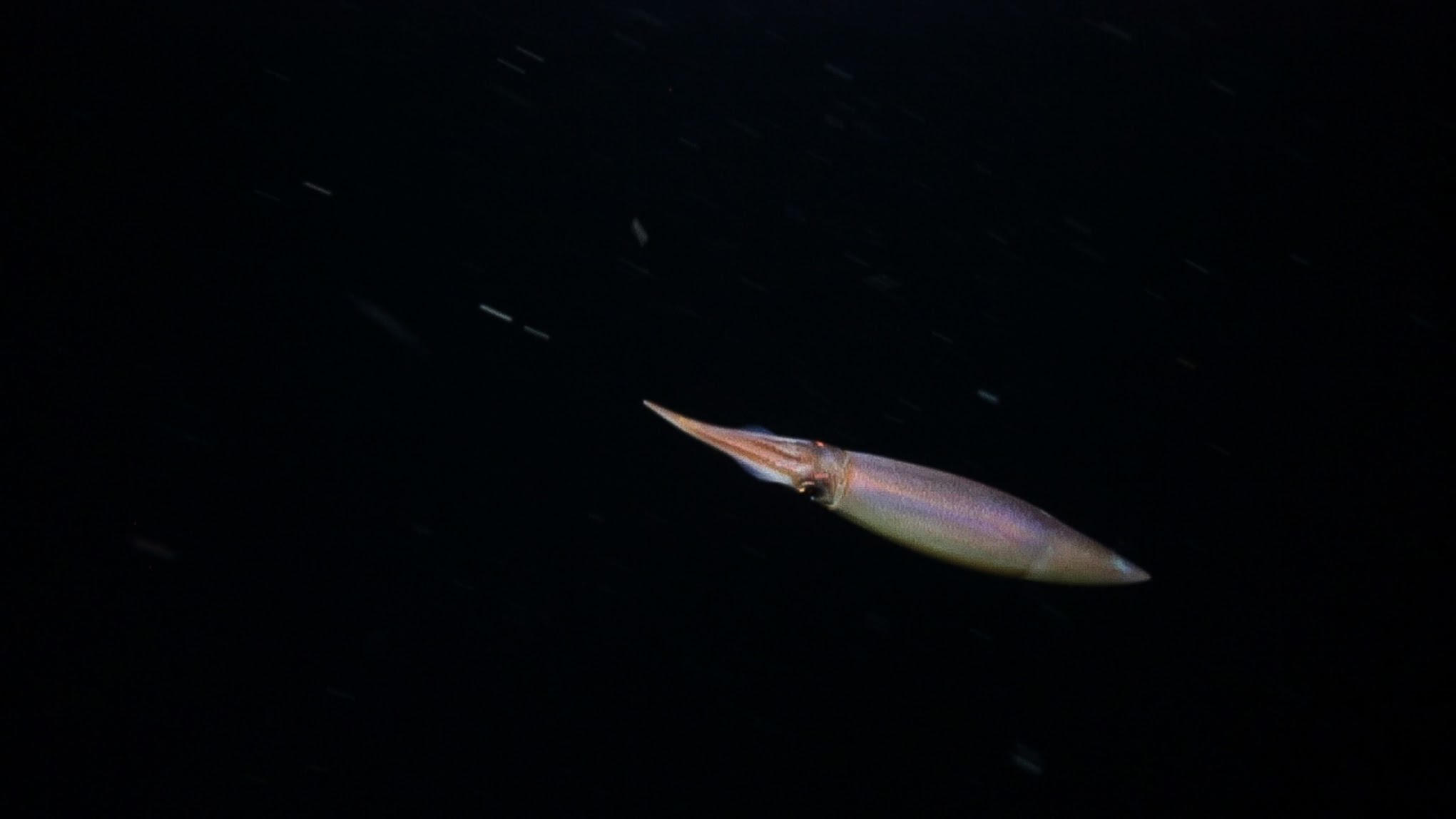
Brad Seibel diving with the jumbo squid (Dosidicus gigas). (These are smaller in size.) If you turn up the volume, you can hear one of the squids run into him on the dive. The squid is momentarily stunned before swimming off again. Credit: Stephani Gordon, Open Boat Films.
Seibel co-authored the publication with his former graduate student, Matt Birk, now a professor at Saint Francis University in Pennsylvania. The study is the first to drill down into the relationship between oxygen, temperature, and the metabolic requirements of vertical migrators, which include billions of marine animals from tiny crustaceans called krill to the six-foot-long jumbo squid. Seibel and Birk used modeling to understand how six species of krill and the jumbo squid would respond metabolically to the varying parameters approximating day and night habitats.
“Vertical migrators buck the basic narrative, which is based largely on studies of coastal animals,” Seibel said.
As the oceans warm squid and other vertical migrators living in tropical zones are likely to expand their habitat northward – but not necessarily leave their native tropical zones.
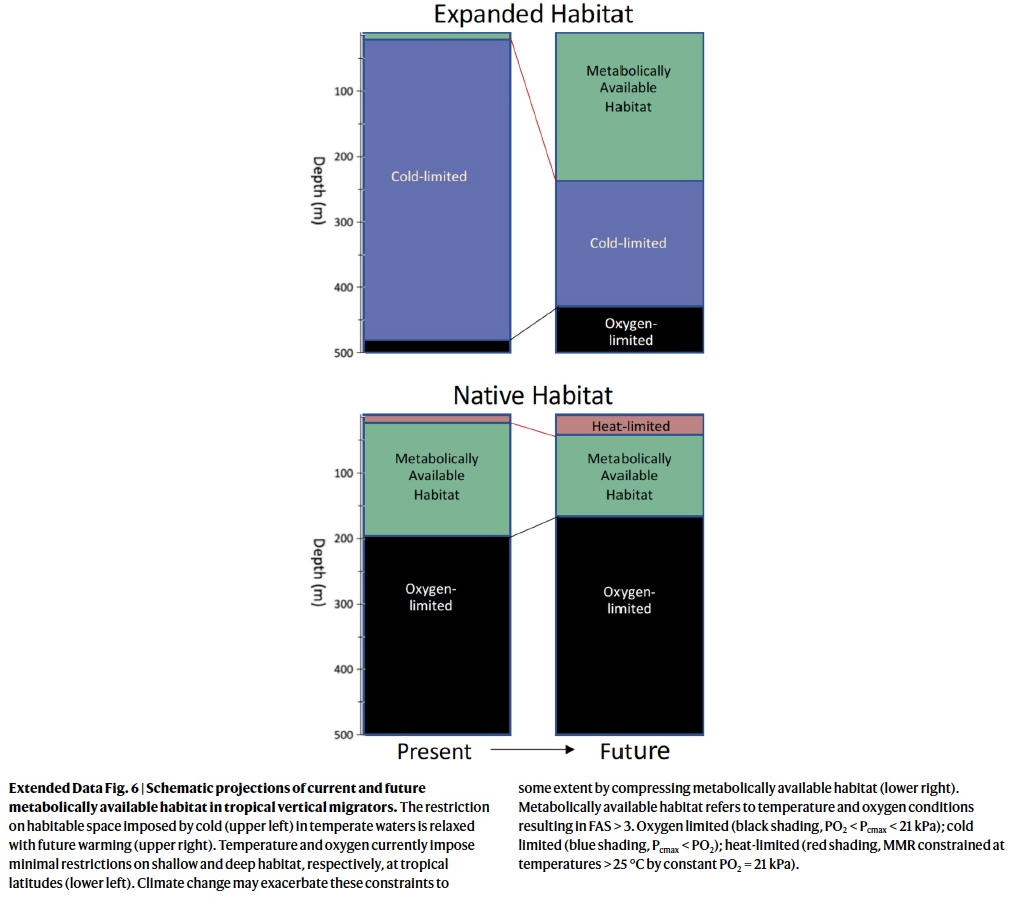
That’s what likely happened 20 years ago in Monterey, Seibel said. An El Nino event temporarily brought warmer water to the coast. (Think of it as a relatively short-lived model of climate change.) The warmer water allowed the squid to expand their range northward, where they took advantage of new food sources – heavily impacting the local fisheries — even though food was plentiful back in the more tropical latitudes.
“It wasn’t that they didn’t have enough oxygen or that it was too hot for them further south; before the El Nino event it was too cold for them up north” – a nuance related to their metabolic requirements that matters, Seibel said.
How Temperature Impacts Metabolism in the Deep Ocean
Vertical migrators live very different lives than coastal species, which experience a fairly consistent supply of oxygen in waters well mixed with the atmosphere. Migrators live at depth during the day, where it’s cold and dark and there’s less oxygen, and they travel hundreds of meters toward the relatively warm ocean surface at night to eat, where oxygen is plentiful and when it’s safer to forage.
“This study is a good example of the fact that the conclusions we often draw from well-studied — and easy to catch — organisms may not hold true for the greater diversity of species and lifestyles found in the oceans,” Birk said.
It turns out that the effect of temperature on the metabolic rates of vertical migrators is 4-5 times greater than for most coastal species. When at depth, the squid, for example, don’t do much at all. When migrating to shallower waters for a meal, their metabolic rate skyrockets, said Seibel.
Modeling that incorporates heightened effects of temperature on the metabolic rate of vertical migrators suggests that climate change will expand the available habitat for vertical migrators to the north and south by as much as 10-20 degrees of latitude by the end of the century, Seibel said.
“We really need to drill down into animal physiology and better understand the ways that various species evolve and adapt to environmental conditions,” said Seibel.
Reference: “Unique thermal sensitivity imposes a cold-water energetic barrier for vertical migrators” by Brad A. Seibel, and Matthew A. Birk, 10 October 2022, Nature Climate Change.
DOI: 10.1038/s41558-022-01491-6
The study was funded by the National Science Foundation and the National Oceanic and Atmospheric Administration.
Never miss a breakthrough: Join the SciTechDaily newsletter.
Follow us on Google and Google News.