
Close Menu
    Facebook X (Twitter) Instagram
    SciTechDaily
    • Biology
    • Chemistry
    • Earth
    • Health
    • Physics
    • Science
    • Space
    • Technology
    Facebook X (Twitter) Pinterest YouTube RSS
    SciTechDaily
    Home»Earth»Soon the North Pole Will Be Ice Free in Summer
    Earth

    Soon the North Pole Will Be Ice Free in Summer

    By University of HamburgApril 21, 2020No Comments3 Mins Read
    Facebook Twitter Pinterest Telegram LinkedIn WhatsApp Email Reddit
    Share
    Facebook Twitter LinkedIn Pinterest Telegram Email Reddit
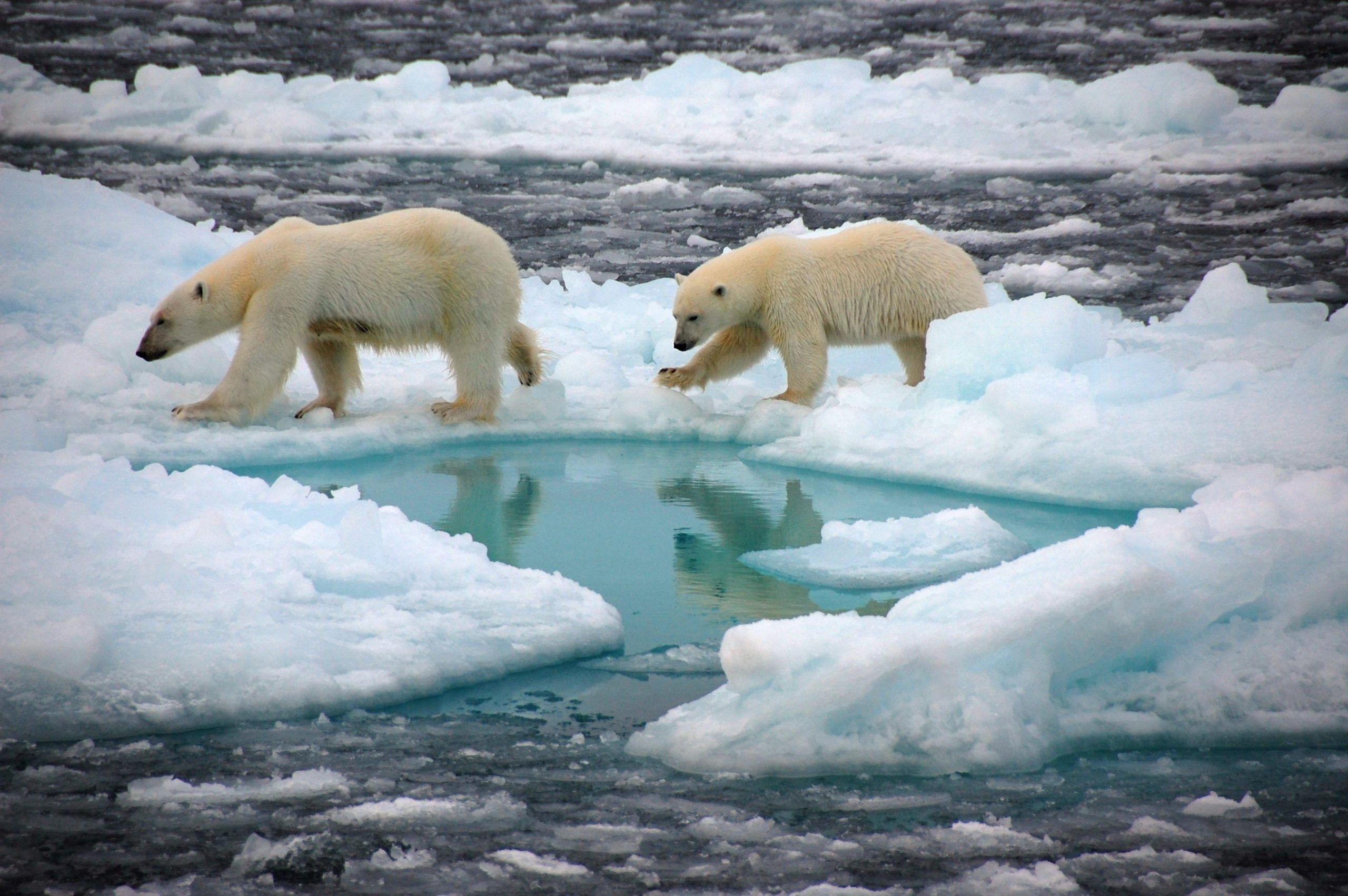
    Polar Bears on Arctic Sea Ice
    Polar bears on Arctic sea ice. Credit: Dirk Notz

    The Arctic Ocean in summer will very likely be ice-free before 2050, at least temporally. The efficacy of climate-protection measures will determine how often and for how long. These are the results of a new research study involving 21 research institutes from around the world, coordinated by Dirk Notz from the University of Hamburg, Germany.

    The research team has analyzed recent results from 40 different climate models. Using these models, the researchers considered the future evolution of Arctic sea-ice cover in a scenario with high future CO2 emissions and little climate protection. As expected, Arctic sea ice disappeared quickly in summer in these simulations. However, the new study finds that Arctic summer sea ice also disappears occasionally if CO2 emissions are rapidly reduced.

    “If we reduce global emissions rapidly and substantially, and thus keep global warming below 2 °C relative to preindustrial levels, Arctic sea ice will nevertheless likely disappear occasionally in summer even before 2050. This really surprised us” said Dirk Notz, who leads the sea-ice research group at University of Hamburg, Germany.

    Currently, the North Pole is covered by sea ice year-round. Each summer, the area of the sea ice cover decreases, and in winter it grows again. In response to ongoing global warming, the overall area of the Arctic Ocean that is covered by sea ice has rapidly been reduced over the past few decades. This substantially affects the Arctic ecosystem and climate: The sea-ice cover is a hunting ground and habitat for polar bears and seals, and keeps the Arctic cool by reflecting sunlight.

    How often the Arctic will lose its sea-ice cover in the future critically depends on future CO2 emissions, the study shows. If emissions are reduced rapidly, ice-free years only occur occasionally. With higher emissions, the Arctic Ocean will become ice free in most years. Hence, humans still have an impact on how often the Arctic loses its year-round sea-ice cover.

    Reference: “Arctic Sea Ice in CMIP6” by Dirk Notz, Jakob Dörr, David A. Bailey, Ed Blockley, Mitchell Bushuk, Jens Boldingh Debernard, Evelien Dekker, Patricia DeRepentigny, David Docquier, Neven S. Fuckar, John C. Fyfe, Alexandra Jahn, Marika Holland, Elizabeth Hunke, Doroteaciro Iovino, Narges Khosravi, Francois Massonnet, Gurvan Madec, Siobhan O’Farrell, Alek Petty, Arun Rana, Lettie Roach, Erica Rosenblum, Clement Rousset, Tido Semmler, Julienne Stroeve, Bruno Tremblay, Takahiro Toyoda, Hiroyuki Tsujino and Martin Vancoppenolle, 17 April 2020, Geophysical Research Letters.
    DOI: 10.1029/2019GL086749

    Technical Details: The simulations used in this study are based on so-called SSP Scenarios (shared socio-economic pathways), which will also be used for the next IPCC report. Scenarios SSP1-1.9 and SSP1-2.6 are used to simulate a rapid reduction of future CO2 emissions, while scenario SSP5-8.5 is used to simulate largely unchanged future CO2 emissions. The study is based on simulations from the most recent generation of climate models, collected within the Coupled Model Intercomparison Project Phase 6 (CMIP6).

    Never miss a breakthrough: Join the SciTechDaily newsletter.
    Follow us on Google and Google News.

    Arctic Climate Change Global Warming Oceanography University of Hamburg
    Share. Facebook Twitter Pinterest LinkedIn Email Reddit

    Related Articles

    Frequent Arctic Ocean Heatwaves Set to Become the New Climate Reality

    Flawed Climate Models? Arctic Ocean Started Getting Warmer Decades Earlier Than We Thought

    Russian Arctic Losing Billions of Tons of Ice Each Year As Climate Warms

    Melting Arctic Ice May Lead to Severe Weather Changes

    Changes in Ocean Salinity and the Water Cycle Could Affect Food Supplies

    Increased Methane Gas Levels Found Over Cracks in Arctic Sea Ice

    Fossil Fuel Emissions, Organic Carbon and Alaska’s Glaciers

    NASA Study Reveals Multi-Year Ice Declining Faster than Perennial Ice that Surrounds It

    New Research Shows Southern Ocean as a Powerful Influence on Climate Change

    Leave A Reply Cancel Reply

    • Facebook
    • Twitter
    • Pinterest
    • YouTube

    Don't Miss a Discovery

    Subscribe for the Latest in Science & Tech!

    Trending News

    Artificial Sweeteners May Harm Future Generations, Study Suggests

    Splashdown! NASA Artemis II Returns From Record-Breaking Moon Mission

    What If Consciousness Exists Beyond Your Brain

    Scientists Finally Crack the 100-Million-Year Evolutionary Mystery of Squid and Cuttlefish

    Beyond “Safe Levels”: Study Challenges What We Know About Pesticides and Cancer

    Researchers Have Found a Dietary Compound That Increases Longevity

    Scientists Baffled by Bizarre “Living Fossil” From 275 Million Years Ago

    Your IQ at 23 Could Predict Your Wealth at 27, Study Finds

    Follow SciTechDaily
    • Facebook
    • Twitter
    • YouTube
    • Pinterest
    • Newsletter
    • RSS
    SciTech News
    • Biology News
    • Chemistry News
    • Earth News
    • Health News
    • Physics News
    • Science News
    • Space News
    • Technology News
    Recent Posts
    • 20x Difference: Study Reveals True Source of Airborne Microplastics
    • Scientists Uncover Hidden Force Powering Yellowstone’s Supervolcano
    • This Metal Melts in Your Hand – and Scientists Just Discovered Something Strange
    • Why Losing Too Much Fat Can Be Just As Dangerous as Obesity
    • Beef vs. Chicken: Surprising Results From New Prediabetes Study
    Copyright © 1998 - 2026 SciTechDaily. All Rights Reserved.
    • Science News
    • About
    • Contact
    • Editorial Board
    • Privacy Policy
    • Terms of Use

    Type above and press Enter to search. Press Esc to cancel.