
Close Menu
    Facebook X (Twitter) Instagram
    SciTechDaily
    • Biology
    • Chemistry
    • Earth
    • Health
    • Physics
    • Science
    • Space
    • Technology
    Facebook X (Twitter) Pinterest YouTube RSS
    SciTechDaily
    Home»Science»Spitzer Reveals That Asteroid Don Quixote is a Comet
    Science

    Spitzer Reveals That Asteroid Don Quixote is a Comet

    By Whitney Clavin, Jet Propulsion Laboratory; Northern Arizona UniversitySeptember 12, 2013No Comments3 Mins Read
    Facebook Twitter Pinterest Telegram LinkedIn WhatsApp Email Reddit
    Share
    Facebook Twitter LinkedIn Pinterest Telegram Email Reddit
    Spitzer Reveals that Don Quixote is Comet
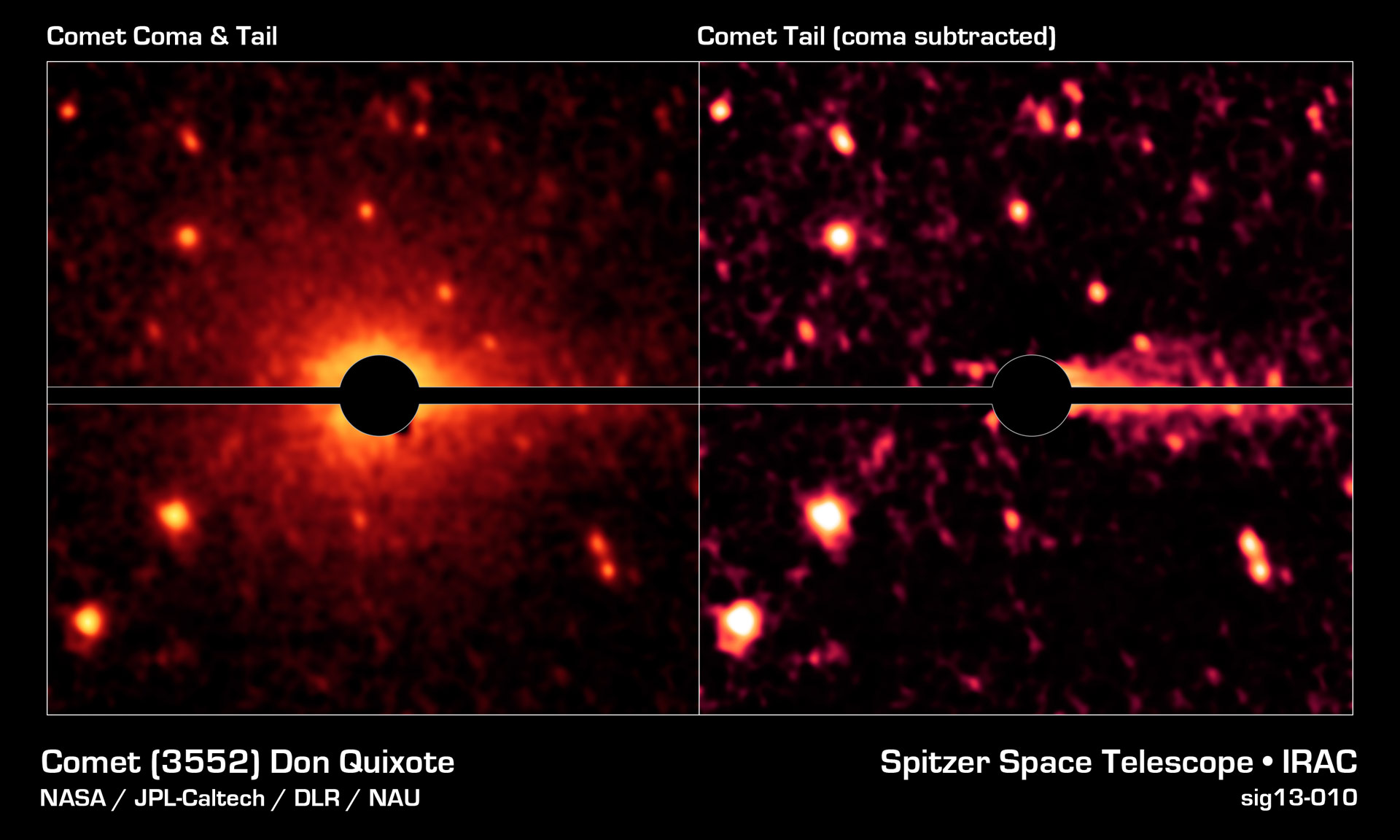
    The left image shows Don Quixote’s coma and tail — features of comets — as revealed in infrared light by Spitzer. The coma appears as a faint glow around the center of the body, caused by dust and gas. The tail, which appears more clearly in the right image, points towards the right-hand side of Don Quixote, into the direction opposite of the sun. The right image represents a more elaborate image processing step, in which the glow of the coma has been removed based on a model comet coma. Bright speckles around Don Quixote are background stars; the horizontal bar covers image artifacts caused by the image processing. Credit: NASA/JPL-Caltech/DLR/NAU

    Data from NASA’s Spitzer Space Telescope helped astronomers discover that the large asteroid called Don Quixote is in fact a comet.

    For 30 years, a large near-Earth asteroid wandered its lone, intrepid path, passing before the scrutinizing eyes of scientists armed with telescopes while keeping something to itself. The object, known as Don Quixote, whose journey stretches to the orbit of Jupiter, now appears to be a comet.

    The discovery resulted from an ongoing project coordinated by researchers at Northern Arizona University, Flagstaff, Arizona, using NASA’s Spitzer Space Telescope. Through a lot of focused attention and a little luck, they found evidence of comet activity, which had evaded detection for three decades.

    The results show that Don Quixote is not, in fact, a dead comet, as previously believed, but it has a faint coma and tail. In fact, this object, the third-biggest near-Earth asteroid known, skirts Earth with an erratic, extended orbit and is “sopping wet,” said David Trilling of Northern Arizona University, with large deposits of carbon dioxide and presumably water ice. Don Quixote is about 11 miles (18 kilometers) long.

    “This discovery of carbon dioxide emission from Don Quixote required the sensitivity and infrared wavelengths of the Spitzer telescope and would not have been possible using telescopes on the ground,” said Michael Mommert, who conducted the research at the German Aerospace Center, Berlin, before moving to Northern Arizona University. This discovery implies that carbon dioxide and water ice might be present on other near-Earth asteroids, as well.
    Astronomers Reveal that Don Quixote is a Comet
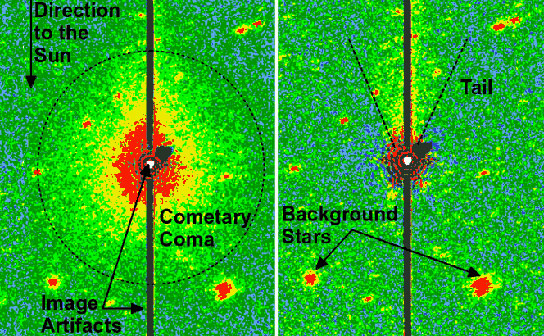
    Don Quixote’s coma and tail (left) as seen in infrared light by NASA’s Spitzer Space Telescope. After image processing (right), the tail is more apparent. Image courtesy NASA/JPL-Caltech/DLR/NAU

    The implications have less to do with a potential impact, which is extremely unlikely in this case, and more with “the origins of water on Earth,” Trilling said. Impacts with comets like Don Quixote over geological time may be the source of at least some of it, and the amount on Don Quixote represents about 100 billion tons of water — roughly the same amount that can be found in Lake Tahoe, California.

    Mommert presented the results at the European Planetary Space Conference in London on September 10.

    NASA’s Jet Propulsion Laboratory, Pasadena, California, manages the Spitzer mission for NASA’s Science Mission Directorate, Washington. Science operations are conducted at the Spitzer Science Center at the California Institute of Technology in Pasadena. Data are archived at the Infrared Science Archive housed at the Infrared Processing and Analysis Center at Caltech. Caltech manages JPL for NASA. For more information about Spitzer, visit http://spitzer.caltech.edu and http://www.nasa.gov/spitzer.

    Never miss a breakthrough: Join the SciTechDaily newsletter.
    Follow us on Google and Google News.

    Asteroid Astronomy Comet JPL NASA Northern Arizona University Spitzer Space Telescope
    Share. Facebook Twitter Pinterest LinkedIn Email Reddit

    Related Articles

    NASA Spots Gigantic Debris Cloud Created by Clashing Celestial Bodies

    NASA Comet Hitchhiker Would Take Tour of Small Asteroids and Comets

    NASA’s Near-Earth Object Observations Program Discovers Ten Thousandth NEO

    NASA Telescopes Spot Ultra-Distant Galaxy, MACS 1149-JD

    Smaller Than Earth, Exoplanet Candidate UCF-1.01 Is Just 33 Light-Years Away

    Patterns of Light Appear to be From the First Stars and Galaxies

    Sombrero Galaxy Exhibits Dual Characteristics

    Searching for “Bubbles” in the Milky Way

    NASA’s Spitzer Space Telescope Finds Solid Buckyballs in Space

    Leave A Reply Cancel Reply

    • Facebook
    • Twitter
    • Pinterest
    • YouTube

    Don't Miss a Discovery

    Subscribe for the Latest in Science & Tech!

    Trending News

    Once-in-a-Century Impact: NASA Just Found a Massive New Crater on the Moon

    Anak Krakatau Just Blasted Ash 50,000 Feet Into the Sky

    NASA’s Chandra Reveals Galaxies Being Torn Apart, Blasted by Black Holes, and Reborn in Stars

    Ozempic’s Active Ingredient Shows Surprising Anti-Aging Effects

    Scientists Discover Canada’s First Dinosaur Tracks From a Rarely Documented Cretaceous Age

    Astronomers Just Caught a Giant Planet in the Act of Forming

    Two Dead Stars Are Racing Around Each Other Every 6.2 Minutes

    Natural Compound May Help Protect the Brain and Heart From Excess Salt

    Follow SciTechDaily
    • Facebook
    • Twitter
    • YouTube
    • Pinterest
    • Newsletter
    • RSS
    SciTech News
    • Biology News
    • Chemistry News
    • Earth News
    • Health News
    • Physics News
    • Science News
    • Space News
    • Technology News
    Recent Posts
    • Autism Study Reveals Two Opposing Molecular Patterns in the Brain
    • Scientists Reveal What Workout Recovery Techniques Actually Work
    • Scientists Put Anti-Aging Treatments to the Test – These Ones Actually Changed Biological Age
    • A Quantum Prediction From 1931 Has Finally Come to Life
    • Scientists Just Watched a Single Quantum of Sound Vanish for the First Time
    Copyright © 1998 - 2026 SciTechDaily. All Rights Reserved.
    • Science News
    • About
    • Contact
    • Editorial Board
    • Privacy Policy
    • Terms of Use

    Type above and press Enter to search. Press Esc to cancel.