
Close Menu
    Facebook X (Twitter) Instagram
    SciTechDaily
    • Biology
    • Chemistry
    • Earth
    • Health
    • Physics
    • Science
    • Space
    • Technology
    Facebook X (Twitter) Pinterest YouTube RSS
    SciTechDaily
    Home»Space»Introducing “Dinkinesh” – First Asteroid Target for NASA’s Lucy Mission Gets a Name
    Space

    Introducing “Dinkinesh” – First Asteroid Target for NASA’s Lucy Mission Gets a Name

    By Katherine Kretke, Southwest Research InstituteMarch 1, 2023No Comments4 Mins Read
    Facebook Twitter Pinterest Telegram LinkedIn WhatsApp Email Reddit
    Share
    Facebook Twitter LinkedIn Pinterest Telegram Email Reddit
    Lucy Trojan Asteroid Mission
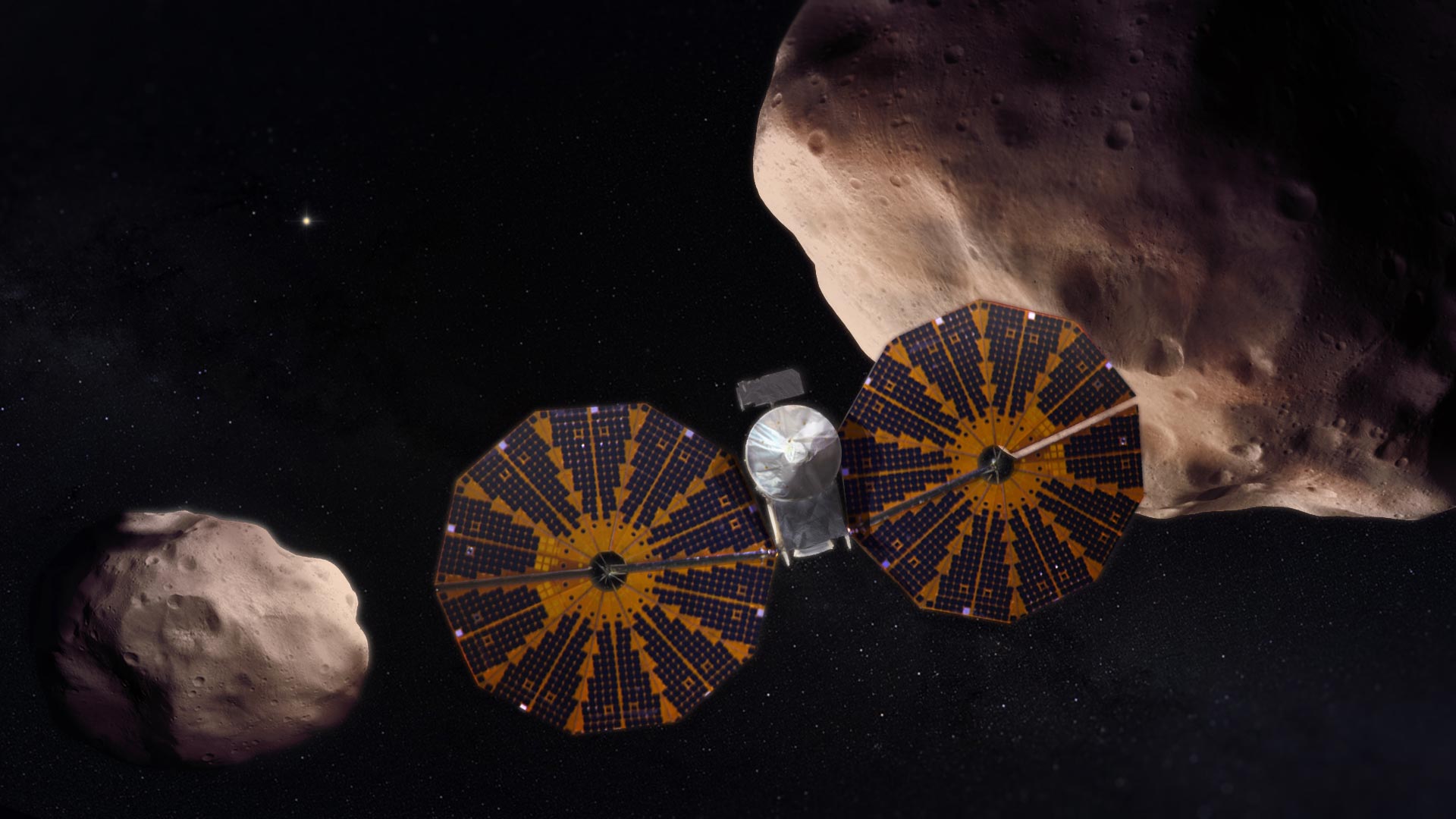
    Lucy will explore the Jupiter Trojan asteroids – thought to be “fossils of planet formation.” Credit: NASA’s Goddard Space Flight Center

    Naming the First Lucy Mission Asteroid

    The first asteroid to be visited by NASA’s Lucy mission now has a name. The International Astronomical Union has approved the name (152830) Dinkinesh for the tiny main belt asteroid that the Lucy spacecraft will encounter on November 1, 2023. “Dinkinesh,” or ድንቅነሽ in Amharic, is the Ethiopian name for the human-ancestor fossil, also known as Lucy, which was found in that country and currently curated there. Dinkinesh means “you are marvelous” in Amharic.

    “This is really a tiny little asteroid. Some of the team affectionately refer to it as ‘Dinky.’ But, for a small asteroid, we expect it to be a big help for the Lucy mission.” Hal Levison, Lucy principal investigator

    In 1999, when the asteroid Dinkinesh was first discovered, it was given the provisional designation 1999 VD57. It earned an official number, (152830), several years later when its orbit was sufficiently well determined. But, like most of the millions of small asteroids in the main asteroid belt, it was left unnamed. However, once the Lucy team identified this asteroid as a target, the team proposed this new name, inspired by Lucy’s mission to explore remnants of the early solar system.

    “This mission was named for Lucy because just as that fossil revolutionized our understanding of human evolution, we expect this mission to revolutionize our understanding of the origin and evolution of our solar system,” said Keith Noll, Lucy project scientist, from NASA’s Goddard Space Flight Center in Greenbelt, Maryland. “We are excited to have another opportunity to honor that connection.”

    The main reason the team has added Dinkinesh to Lucy’s already-packed tour (10 asteroids, including the newly discovered satellites) is to test the innovative terminal tracking system, which is critical for precise imaging during these high-speed encounters. While the asteroid is less than half a mile (less than a km) in diameter, it is an excellent opportunity to test out Lucy’s systems prior to the main scientific activities of the mission: learning about the never-before-explored Jupiter Trojan asteroids, which are in many ways fossils of our early solar system.
    Dinkinesh Asteroid Size Comparison
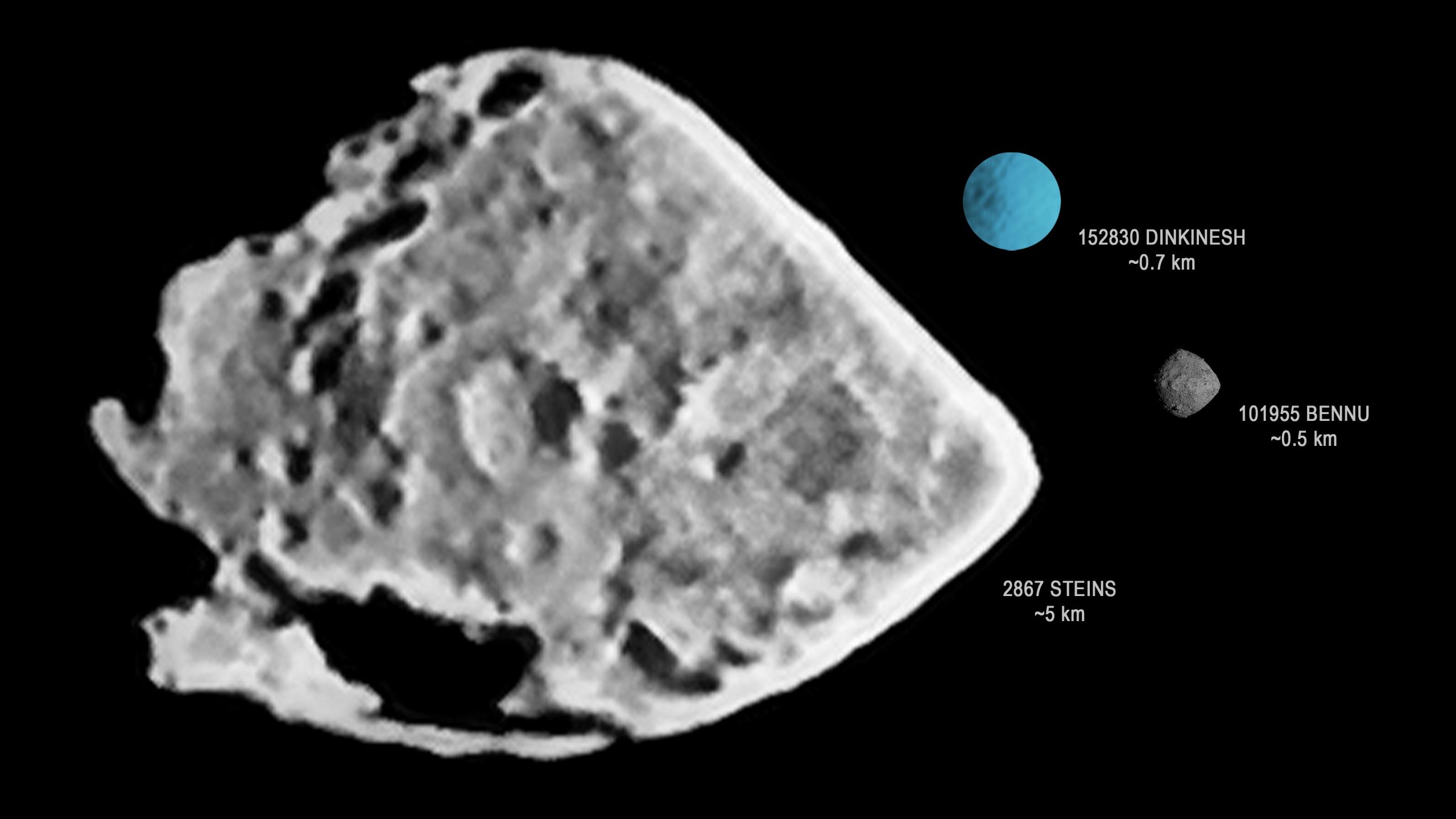
    A size comparison of (152830) Dinkinesh (shown in blue in the artist concept) to the main belt asteroid (2867) Steins and the near-Earth asteroid (101955) Bennu. Steins is currently the smallest, independently-orbiting main belt asteroid whose surface has been well imaged by a spacecraft (ESA Rosetta). The near-Earth asteroid Bennu was recently explored by NASA’s OSIRIS-REx spacecraft with a sample return expected this September. As a tiny main belt asteroid, Dinkinesh will serve as a link between these two populations. Credit: Montage by NASA Goddard, Image of Steins: ESA/OSIRIS team, Image of Bennu: NASA/Goddard/University of Arizona

    “This is really a tiny little asteroid,” said Hal Levison, Lucy principal investigator, from Southwest Research Institute’s (SwRI) Boulder office. “Some of the team affectionately refer to it as ‘Dinky.’ But, for a small asteroid, we expect it to be a big help for the Lucy mission.”

    While the main purpose of this encounter is as an engineering test, mission scientists are also excited for what this tiny asteroid might teach us. This will be the smallest main belt asteroid ever explored, and it is much closer in size to near-Earth asteroids that were recently studied by spacecraft than the main belt asteroids previously visited by other missions.

    Insights into Small Main Belt Asteroids

    “At closest approach, if all goes smoothly, we expect Dinkinesh to be 100s of pixels across as seen from Lucy’s sharpest imager,” says Simone Marchi, deputy principal investigator, also from SwRI. “While we won’t be able to see all the details of the surface, even the general shape may indicate whether near-Earth asteroids – which originate in the main belt – change significantly once they enter near-Earth space.”

    Dinkinesh may reveal yet another aspect of the evolutionary history of our solar system.

    Lucy’s principal investigator is based out of the Boulder, Colorado branch of Southwest Research Institute, headquartered in San Antonio, Texas. NASA’s Goddard Space Flight Center in Greenbelt, Maryland, provides overall mission management, systems engineering, and safety and mission assurance. Lockheed Martin Space in Littleton, Colorado, built the spacecraft. Lucy is the 13th mission in NASA’s Discovery Program. NASA’s Marshall Space Flight Center in Huntsville, Alabama, manages the Discovery Program for the Science Mission Directorate at NASA Headquarters in Washington.

    Never miss a breakthrough: Join the SciTechDaily newsletter.
    Follow us on Google and Google News.

    Asteroid Lucy Mission NASA NASA Goddard Space Flight Center Southwest Research Institute
    Share. Facebook Twitter Pinterest LinkedIn Email Reddit

    Related Articles

    NASA’s Lucy Uncovers Ancient Water Clues on a Weirdly Wobbling Asteroid

    NASA’s Lucy Captures Ice Cream Cone–Shaped Asteroid That Defies Expectations

    Another Surprise From NASA’s Lucy Asteroid Encounter: “We Never Suspected Anything So Bizarre!”

    NASA’s Lucy Spacecraft Snaps First Images of Asteroid Dinkinesh on Its 12-Year Voyage of Discovery

    Lucy in the Sky With Asteroids: NASA’s Mission Reveals First Images of Jupiter’s Trojans

    NASA’s Record-Breaking Lucy Spacecraft Has a New Asteroid Target

    Moon Discovered Around Asteroid Polymele by NASA’s Lucy Team

    The Fascinating Story of How the Trojan Asteroids – Target of NASA’s Lucy Mission – Were Discovered and Named

    NASA’s Mission to Jupiter’s Trojan Asteroids Confirms Discovery of “Bonus” Exploration Opportunity

    Leave A Reply Cancel Reply

    • Facebook
    • Twitter
    • Pinterest
    • YouTube

    Don't Miss a Discovery

    Subscribe for the Latest in Science & Tech!

    Trending News

    1.4-Million-Year-Old Footprints Reveal a Giant Human Relative

    Astronomers May Have Found the First Moon Beyond Our Solar System

    Underwater Cameras Expose the Secret Lives of Whale Sharks

    Why Dreaming Leaves the Brain Running Low on Energy

    CERN Experiments Detect Signs of the Universe’s Primordial Matter

    Study Finds a Surprising Link Between Gut Microbes and Aging

    Frequent Cannabis Users Wake Up With More “Stress Hormone”

    Scientists Reveal Hidden DNA Traces in the Shroud of Turin

    Follow SciTechDaily
    • Facebook
    • Twitter
    • YouTube
    • Pinterest
    • Newsletter
    • RSS
    SciTech News
    • Biology News
    • Chemistry News
    • Earth News
    • Health News
    • Physics News
    • Science News
    • Space News
    • Technology News
    Recent Posts
    • Scientists Discover What Makes Hydrogen Go Quantum
    • Scientists Discover Extreme Acceleration Inside a Nuclear Fireball
    • Giant Plasma Waves May Be Stripping Away Mars’ Atmosphere
    • A Daily Multivitamin May Help Older Adults Stay Active
    • Blood Test May Reveal Alzheimer’s Risk Years Before Symptoms
    Copyright © 1998 - 2026 SciTechDaily. All Rights Reserved.
    • Science News
    • About
    • Contact
    • Editorial Board
    • Privacy Policy
    • Terms of Use

    Type above and press Enter to search. Press Esc to cancel.