
Deep learning techniques uncovered previously unnoticed signals of interest in analyzed datasets.
The search for technologically advanced extraterrestrial life raises the question, “where are they?” The answer often lies in the vastness of the galaxy and the limited scope of our search. Additionally, outdated algorithms from the early days of computing may not be efficient in processing today’s massive petabyte-scale datasets.”
Now, a recent study published in Nature Astronomy, led by University of Toronto undergraduate student Peter Ma and researchers from the SETI Institute, Breakthrough Listen, and other scientific institutions, utilized deep learning to analyze a previously studied dataset of nearby stars. This new approach uncovered eight previously undiscovered signals of interest.
“In total, we had searched through 150 TB of data of 820 nearby stars, on a dataset that had previously been searched through in 2017 by classical techniques but labeled as devoid of interesting signals,” said Peter Ma, lead author. “We’re scaling this search effort to 1 million stars today with the MeerKAT telescope and beyond. We believe that work like this will help accelerate the rate we’re able to make discoveries in our grand effort to answer the question ‘are we alone in the universe?’”
Technosignatures and the Role of Radio Signals
The search for extraterrestrial intelligence (SETI) looks for evidence of extraterrestrial intelligence originating beyond Earth by trying to detect technosignatures, or evidence of technology, that alien civilizations could have developed. The most common technique is to search for radio signals. Radio is a great way to send information over the incredible distances between the stars; it quickly passes through the dust and gas that permeate space, and it does so at the speed of light (about 20,000 times faster than our best rockets). Many SETI efforts use antennas to eavesdrop on any radio signals aliens might be transmitting.
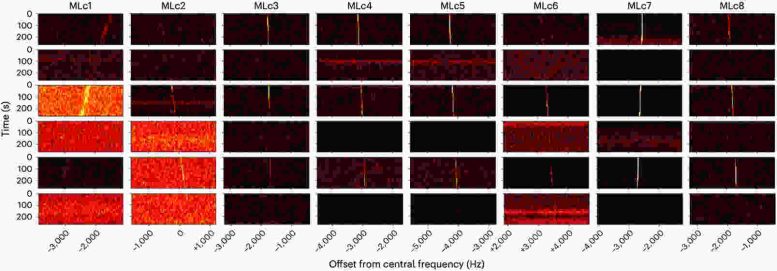
This study re-examined data taken with the Green Bank Telescope in West Virginia as part of a Breakthrough Listen campaign that initially indicated no targets of interest. The goal was to apply new deep learning techniques to a classical search algorithm to yield faster, more accurate results. After running the new algorithm and manually re-examining the data to confirm the results, newly detected signals had several key characteristics:
- The signals were narrow band, meaning they had narrow spectral width, on the order of just a few Hz. Signals caused by natural phenomena tend to be broadband.
- The signals had non-zero drift rates, which means the signals had a slope. Such slopes could indicate a signal’s origin had some relative acceleration with our receivers, hence not local to the radio observatory.
- The signals appeared in ON-source observations and not in OFF-source observations. If a signal originates from a specific celestial source, it appears when we point our telescope toward the target and disappears when we look away. Human radio interference usually occurs in ON and OFF observations due to the source being close by.
Transforming SETI Research with Modern Techniques
Cherry Ng, another of Ma’s research advisors and an astronomer at both the SETI Institute and the French National Center for Scientific Research said, “These results dramatically illustrate the power of applying modern machine learning and computer vision methods to data challenges in astronomy, resulting in both new detections and higher performance. Application of these techniques at scale will be transformational for radio technosignature science.”
While re-examinations of these new targets of interest have yet to result in re-detections of these signals, this new approach to analyzing data can enable researchers to more effectively understand the data they collect and act quickly to re-examine targets. Ma and his advisor Dr. Cherry Ng are looking forward to deploying extensions of this algorithm on the SETI Institute’s COSMIC system.
Since SETI experiments began in 1960 with Frank Drake’s Project Ozma at the Greenbank Observatory, a site now home to the telescope used in this latest work, technological advances have enabled researchers to collect more data than ever. This massive volume of data requires new computational tools to process and analyze that data quickly to identify anomalies that could be evidence of extraterrestrial intelligence. This new machine learning approach is breaking new ground in the quest to answer the question, “are we alone?”
Reference: “A deep-learning search for technosignatures from 820 nearby stars” by Peter Xiangyuan Ma, Cherry Ng, Leandro Rizk, Steve Croft, Andrew P. V. Siemion, Bryan Brzycki, Daniel Czech, Jamie Drew, Vishal Gajjar, John Hoang, Howard Isaacson, Matt Lebofsky, David H. E. MacMahon, Imke de Pater, Danny C. Price, Sofia Z. Sheikh and S. Pete Worden, 30 January 2023, Nature Astronomy.
DOI: 10.1038/s41550-022-01872-z
Never miss a breakthrough: Join the SciTechDaily newsletter.
Follow us on Google and Google News.
2 Comments
… who would willfully send the signals around it self? Perhaps, … well! Even if aliens do exist, in which I don’t believe, there would be no chance to spot them with our level of civilization…
I am writing this on behalf of a life form or forms I have encountered here on earth .which I reached out to seti in mountain view with no avail.i have pictures of real life alien forms. But have came to a roadblock of walls which no one would. Here me .I am here seeing these life forms of aliens which. I now see in the skiies all over space.i have all pictures of these alien pictures here with me that. We see in space.so if anyone would. Just contact me you’ll see I have all faces and / or bodies. Of these interesting alien pictures due to it only illusion pictures as it seems. But ythis is real stuff .I am trying to report it at the same time trying to find a person of interest to purchase all my work that is hours of documentation So I come to you and ask maybe you can take a minute of your time and look into this it’s amazing discovery and there is no such thing as what produces these illusiosthat are. Real life. Documentaries.