
Close Menu
    Facebook X (Twitter) Instagram
    SciTechDaily
    • Biology
    • Chemistry
    • Earth
    • Health
    • Physics
    • Science
    • Space
    • Technology
    Facebook X (Twitter) Pinterest YouTube RSS
    SciTechDaily
    Home»Space»Active Galactic Nuclei Core Ignition Triggered by Galaxy Mergers
    Space

    Active Galactic Nuclei Core Ignition Triggered by Galaxy Mergers

    By SciTechDailyMay 28, 2020No Comments3 Mins Read
    Facebook Twitter Pinterest Telegram LinkedIn WhatsApp Email Reddit
    Share
    Facebook Twitter LinkedIn Pinterest Telegram Email Reddit
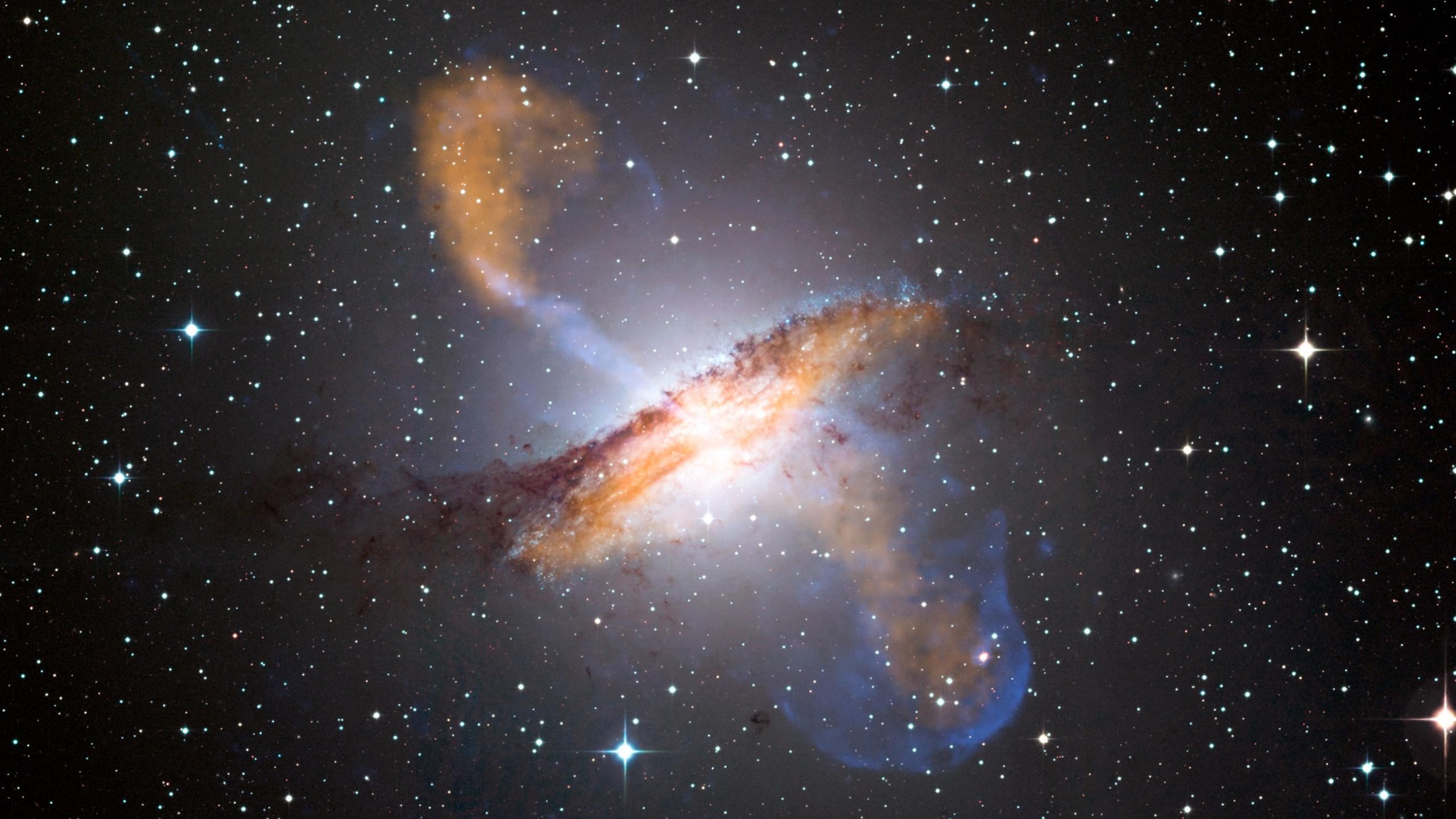
    Galaxy With an Active Galactic Nucleus
    This is an image of a galaxy with an active galactic nucleus. Credit: ESO/WFI (Optical); MPIfR/ESO/APEX/A.Weiss et al. (Submillimeter); NASA/CXC/CfA/R.Kraft et al. (X-ray)

    Active galactic nuclei (AGNs) play a major role in galaxy evolution. Astronomers from the University of Groningen and Netherlands Institute for Space Research have now used a record-sized sample of galaxies to confirm that galaxy mergers have a positive effect on igniting AGNs. They were able to compile about ten times more images of merging galaxies than previous studies by using a machine-learning algorithm. The results were published on 27 May in the journal Astronomy & Astrophysics.

    One of the bigger questions in astronomy is how galaxies evolve from clouds of gas and dust to the beautiful spiral structures we see in our Galactic neighborhood. So-called active galactic nuclei (AGNs) form interesting research objects to answer part of this question, because there appears to be co-evolution between AGNs and galaxies. AGNs harbor supermassive black holes that emit huge amounts of energy after accreting gas from their surroundings. Some have large enough magnetic or gravitational fields to spit out jets from their poles, stretching thousands of lightyears.

    Seeds for stars

    Co-evolution is a two-way street. On the one hand, the evolution stage of a galaxy affects AGN activity. AGNs seem to thrive at a certain stage in a galaxy’s evolution, because we see AGN activity peaking in galaxies at a particular distance, and therefore at a particular time in the past. On the other hand, AGN activity affects a galaxy’s star formation. This could go either way. An AGN’s jet pushes gas away as it propagates through the galaxy, forcing the gas to collide with other gas and thus creating clumps–seeds for new stars. But AGNs also emit energy, heating up the gas and thus preventing it to cool down and condense into clumps.

    Astronomers from the University of Groningen and SRON Netherlands Institute for Space Research have now compiled a sample with a record number of galaxies to study one of the factors that allegedly has a positive effect on igniting AGNs: mergers between galaxies. And they found a correlation, counting both ways. There are about 1.4 times more AGNs in mergers than in non-mergers. And the other way around, the researchers find about 1.3 times more mergers in samples of galaxies with an AGN compared to samples of galaxies without an AGN.

    Large sample

    The research team used a machine-learning algorithm to identify mergers. It gave them a sample that is about one order of magnitude larger than those in previous studies, making the correlation much more reliable. ‘We have built a network to train the system to recognize mergers in a lot of pictures,’ says first author Fangyou Gao. ‘This enables us to use a large sample of two telescope surveys with tens of thousands of galaxies. AGNs are relatively easy to recognize, based on their spectrum. But mergers must be classified from images, which is typically a human’s job. With machine learning, we can now have computers do this for us.’

    Reference: “Mergers trigger active galactic nuclei out to z ∼ 0.6” by F. Gao, L. Wang, W. J. Pearson, Y. A. Gordon, B. W. Holwerda, A. M. Hopkins, M. J. I. Brown, J. Bland-Hawthorn and M. S. Owers, 27 May 2020, Astronomy & Astrophysics.
    DOI: 10.1051/0004-6361/201937178

    Never miss a breakthrough: Join the SciTechDaily newsletter.
    Follow us on Google and Google News.

    Astronomy Astrophysics Machine Learning Popular University of Groningen
    Share. Facebook Twitter Pinterest LinkedIn Email Reddit

    Related Articles

    Peering Into the Abyss: Machine Learning Enhances M87 Black Hole Image

    Artificial Intelligence Helps Resolve Long-Running Astrophysics Debate on Supermassive Black Holes

    Dark Matter: Is It “Real Stuff” or Gravity Misunderstood?

    AI Detects Incredible Stream of Stars That Extends Thousands of Light-Years Across the Milky Way

    AI “Magic” Just Removed One of the Biggest Roadblocks in Astrophysics

    Seeing Quadruple: Artificial Intelligence Leads to Discovery That Can Help Solve Cosmological Puzzles

    Astronomers Discover Evidence for Substance on Liquid-Gas Boundary on Exoplanet WASP-31b

    Surprisingly Recent Galaxy Discovered Using Machine Learning – May Be the Last Generation Galaxy in the Long Cosmic History

    Map to the Stars – Astronomers Trace Most Common Molecule in the Universe

    Leave A Reply Cancel Reply

    • Facebook
    • Twitter
    • Pinterest
    • YouTube

    Don't Miss a Discovery

    Subscribe for the Latest in Science & Tech!

    Trending News

    Scientists Warn That This Common Pet Fish Can Wreck Entire Ecosystems

    Scientists Make Breakthrough in Turning Plastic Trash Into Clean Fuel Using Sunlight

    This Popular Supplement May Interfere With Cancer Treatment, Scientists Warn

    Scientists Finally Solved One of Water’s Biggest Mysteries

    Could This New Weight-Loss Pill Disrupt the Entire Market? Here’s What You Should Know About Orforglipron

    Earth’s Crust Is Tearing Open in Africa, and It Could Form a New Ocean

    Breakthrough Bowel Cancer Trial Leaves Patients Cancer-Free for Nearly 3 Years

    Natural Compound Shows Powerful Potential Against Rheumatoid Arthritis

    Follow SciTechDaily
    • Facebook
    • Twitter
    • YouTube
    • Pinterest
    • Newsletter
    • RSS
    SciTech News
    • Biology News
    • Chemistry News
    • Earth News
    • Health News
    • Physics News
    • Science News
    • Space News
    • Technology News
    Recent Posts
    • Scientists Uncover Fatal Weakness in “Zombie Cells” Linked to Cancer
    • World-First Study Reveals Human Hearts Can Regenerate After a Heart Attack
    • Why Your Dreams Feel So Real Sometimes and So Strange Other Times
    • Scientists Debunk 100-Year-Old Belief About Brain Cells, Rewriting Textbooks
    • This Simple Home Device May Boost Brain Power in Adults Over 40
    Copyright © 1998 - 2026 SciTechDaily. All Rights Reserved.
    • Science News
    • About
    • Contact
    • Editorial Board
    • Privacy Policy
    • Terms of Use

    Type above and press Enter to search. Press Esc to cancel.