
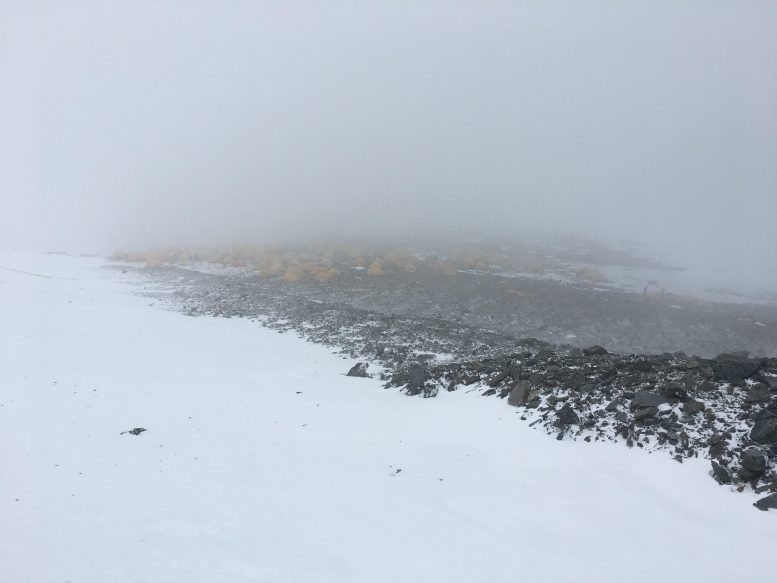
Human activity leaves a microbial footprint at Everest’s South Col. Resilient microbes highlight life’s adaptability and raise concerns about contamination during future space exploration.
Located nearly 5 miles (8 kilometers) above sea level in the Himalayas, the barren, wind-swept depression between Mount Everest and its neighboring summit, Lhotse, remains devoid of snow. At the South Col, hundreds of thrill-seekers set up their final camp annually, preparing to ascend the world’s highest mountain from the southeast flank.
New research led by the University of Colorado Boulder indicates that these adventurers are inadvertently leaving behind a frozen signature of resilient microbes. These microorganisms can endure extreme conditions at high altitudes and remain dormant in the soil for decades, or potentially even centuries.
The research not only highlights an invisible impact of tourism on the world’s highest mountain, but could also lead to a better understanding of environmental limits to life on Earth, as well as where life may exist on other planets or cold moons. The findings were published last month in Arctic, Antarctic, and Alpine Research, a journal published on behalf of the Institute of Arctic and Alpine Research (INSTAAR) at CU Boulder.
“There is a human signature frozen in the microbiome of Everest, even at that elevation,” said Steve Schmidt, senior author on the paper and professor of ecology and evolutionary biology.
In decades past, scientists have been unable to conclusively identify human-associated microbes in samples collected above 26,000 feet (8,000 meters). This study marks the first time that next-generation gene sequencing technology has been used to analyze soil from such a high elevation on Mount Everest, enabling researchers to gain new insight into almost everything and anything that’s in them.
The researchers weren’t surprised to find microorganisms left by humans. Microbes are everywhere, even in the air, and can easily blow around and land some distance away from nearby camps or trails.
“If somebody even blew their nose or coughed, that’s the kind of thing that might show up,” said Schmidt.
What they were impressed by, however, was that certain microbes which have evolved to thrive in warm and wet environments like our noses and mouths were resilient enough to survive in a dormant state in such harsh conditions.
Life in the Cryosphere
This team of CU Boulder scientists—including Schmidt, lead author Nicholas Dragone and Adam Solon, both graduate students in the Department of Ecology and Evolutionary Biology and the Cooperative Institute for Research in Environmental Science (CIRES)—study the cryobiosphere: Earth’s cold regions and the limits to life in them. They have sampled soils everywhere from Antarctica and the Andes to the Himalayas and the high Arctic. Usually, human-associated microbes don’t show up in these places to the extent they appeared in the recent Everest samples.
Schmidt’s work over the years connected him with researchers who were headed to Everest’s South Col in May of 2019 to set up the planet’s highest weather station, established by the National Geographic and Rolex Perpetual Planet Everest Expedition.
He asked his colleagues: Would you mind collecting some soil samples while you’re already there?
So Baker Perry, co-author, professor of geography at Appalachian State University, and a National Geographic Explorer, hiked as far away from the South Col camp as possible to scoop up some soil samples to send back to Schmidt.
Extremes on Earth, and Elsewhere
Dragone and Solon then analyzed the soil in several labs at CU Boulder. Using next-generation gene sequencing technology and more traditional culturing techniques, they were able to identify the DNA of almost any living or dead microbes in the soils. They then carried out extensive bioinformatics analyses of the DNA sequences to determine the diversity of organisms, rather than their abundances.
Most of the microbial DNA sequences they found were similar to hardy, or “extremophilic” organisms previously detected in other high-elevation sites in the Andes and Antarctica. The most abundant organism they found using both old and new methods was a fungus in the genus Naganishia that can withstand extreme levels of cold and UV radiation.
But they also found microbial DNA for some organisms heavily associated with humans, including Staphylococcus, one of the most common skin and nose bacteria, and Streptococcus, a dominant genus in the human mouth.
At high elevations, microbes are often killed by ultraviolet light, cold temperatures, and low water availability. Only the hardiest critters survive. Most—like the microbes carried up great heights by humans—go dormant or die, but there is a chance that organisms like Naganishia may grow briefly when water and the perfect ray of sunlight provides enough heat to help them momentarily prosper. But even for the toughest of microbes, Mount Everest is a Hotel California: “You can check out any time you like/ But you can never leave.”
The researchers don’t expect this microscopic impact on Everest to significantly affect the broader environment. But this work does carry implications for the potential for life far beyond Earth, if one day humans step foot on Mars or beyond.
“We might find life on other planets and cold moons,” said Schmidt. “We’ll have to be careful to make sure we’re not contaminating them with our own.”
Reference: “Genetic analysis of the frozen microbiome at 7900 m a.s.l., on the South Col of Sagarmatha (Mount Everest)” by Nicholas B. Dragone, L. Baker Perry, Adam J. Solon, Anton Seimon, Tracie A. Seimon and Steven K. Schmidt, 16 February 2023, Arctic, Antarctic, and Alpine Research.
DOI: 10.1080/15230430.2023.2164999
The study was funded by the National Geographic and Rolex Perpetual Planet Everest Expedition, the Department of Ecology and Evolutionary Biology, and the University of Colorado Boulder Libraries Open Access Fund
Never miss a breakthrough: Join the SciTechDaily newsletter.
Follow us on Google and Google News.