
New research from the University of Illinois reveals that contaminated bubbles coated with a thin oil layer create smaller droplets ejected at higher velocities than clean bubbles, increasing the potential for pathogen spread and pollution.
A cold sparkling water. Waves crashing on the beach. The crackle of a bonfire. Steam from a kettle.
These factors not only contribute to a relaxing weekend but also add to the aerosols in our environment. While some aerosol sources may not cause significant harm, others, such as those originating from industrial facilities or even natural sources like sea spray and dust, can have a more significant impact on both the environment and public health.
An aerosol refers to tiny droplets of liquid or fine solid particles that are suspended in the air. Although aerosols can be created through various means, one of the most significant sources is the bursting of bubbles at the boundary between a liquid and air. Despite contaminated interfaces being more common, prior research has primarily focused on “clean” bubbles.
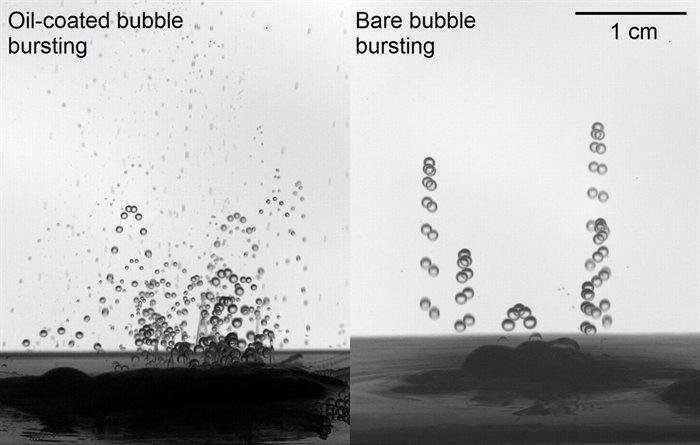
New research from the University of Illinois Urbana-Champaign Mechanical Science and Engineering assistant professor Jie Feng and graduate student Zhengyu Yang has shown that bursting bubbles coated by a thin oil layer produce drops with smaller sizes, the greater overall number of drops, and are ejected at a higher velocity, compared to bubbles generated in clean water. The research was recently published in Nature Physics.
Aerosols are quite ubiquitous in our environment, and they can be natural or anthropogenic in nature. Bubble-bursting aerosols play a key role in the transfer of mass across liquid interfaces. Sea spray aerosols, for example, are primarily generated by bubble bursting at the ocean surface. The drops that are produced from bubble bursting can impact air pollution, global climate, and even the transmission of infectious diseases. One important parameter of these droplets is their size since that is indicative of residence time and transport in the atmosphere- small drops are more easily lifted by winds and can travel much further.
Feng says, “We have contaminated water everywhere. When the bubble rises from deeper water to the surface, it will collect contaminants and form an organic layer around it. We call this a contaminated bubble. When it reaches the surface and bursts, it can actually aerosolize these contaminants into small droplets.”
How Contaminated Bubbles Create Smaller, Faster Droplets
Feng and Yang investigated the impact a thin layer of oil has on bursting bubbles, as a model system for contaminated bubbles. The bursting of a millimeter-sized bare bubble at an aqueous surface produces drops with a typical size of around 100 micrometers (µm) (a typical human hair is around 100-200 µm). In this work, they found that drops can be as small as a few µm when the bursting bubble is coated by a thin layer of oil. Additionally, bare bubble bursting produces drops with a typical ejection velocity of 1 meter per second (m/s), whereas oil-coated bubble bursting produces drops with an ejection velocity as large as 10 m/s. Feng summarizes, “The main conclusion of our work is that we found, for these contaminated bubbles, they can quite effectively aerosolize the contaminants into micron-size droplets.”
In an industrial setting like a wastewater treatment plant, smaller contaminated drops can pose a significant risk to those that work in the plant. Bubble bursting in these settings may generate acidic mists and bioaerosols. Understanding the effect of contaminated bubbles on size distribution and ejection speeds is crucial to designing effective personal protective equipment and implementing additional guidelines on air and water quality near such facilities.
On a broader scale, aerosols have an effect on weather, climate, and even human health.
“These droplets can transport pathogens, bacteria, and viruses,” Yang said. “When you have these small aerosols, and they can be ejected higher, the small size and higher ejection speed can help them stay in the atmosphere for a longer time.” Understanding size and composition of aerosols is important to improve global modeling efforts. Furthermore, these contaminated drops can pose a greater risk of pollutant spread as well as infection since smaller aerosols are able to penetrate further in the respiratory tract than larger aerosols.
Reference: “Enhanced singular jet formation in oil-coated bubble bursting” by Zhengyu Yang, Bingqiang Ji, Jesse T. Ault and Jie Feng, 23 February 2023, Nature Physics.
DOI: 10.1038/s41567-023-01958-z
Never miss a breakthrough: Join the SciTechDaily newsletter.
Follow us on Google and Google News.