
Close Menu
    Facebook X (Twitter) Instagram
    SciTechDaily
    • Biology
    • Chemistry
    • Earth
    • Health
    • Physics
    • Science
    • Space
    • Technology
    Facebook X (Twitter) Pinterest YouTube RSS
    SciTechDaily
    Home»Science»How Mosquitoes Manage to Fly in the Rain
    Science

    How Mosquitoes Manage to Fly in the Rain

    By SciTechDailyJanuary 14, 2012No Comments2 Mins Read
    Facebook Twitter Pinterest Telegram LinkedIn WhatsApp Email Reddit
    Share
    Facebook Twitter LinkedIn Pinterest Telegram Email Reddit
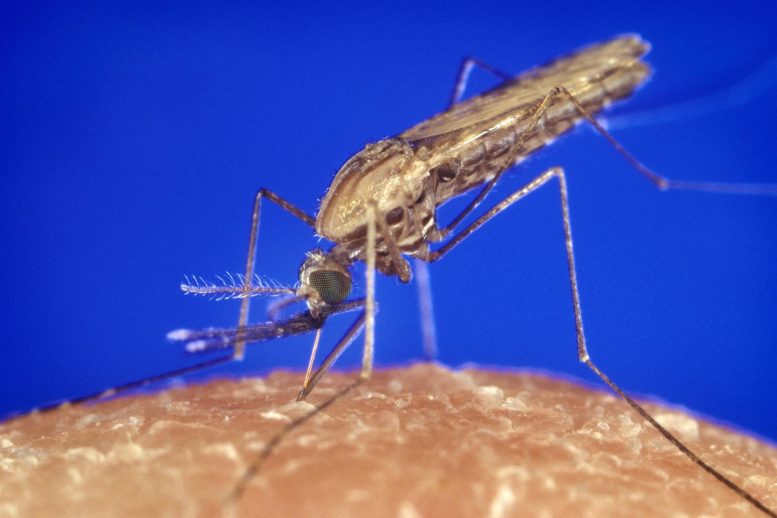
    Mosquito Feeding
    Scientists uncover how mosquitoes navigate through rain.

    Mosquitoes are able to fly adeptly during a rainstorm as well as under clear skies, but how do they manage that feat? Since mosquitoes weigh 50 times less than raindrops, shouldn’t they be crushed by the rain? David Hu has discovered otherwise.

    Hu is an assistant professor of mechanical engineering and biology at the Georgia Institute of Technology, and in tandem with his graduate research assistant Andrew Dickerson, they have discovered that while mosquitoes do get hit by raindrops, they aren’t crushed. The researchers measured the impact forces of raindrops on both regular mosquitoes and mosquito duplicates, which were made out of small Styrofoam spheres. Ultra-high-speed cameras captured the images of the resulting action.

    Mosquitoes fly too slowly to be able to detect and avoid colliding with raindrops, and while frontal impacts are infrequent, transverse impacts on the body and wings are a common occurrence. Instead of being crushed, their bodies get rotated around. Mosquitoes have low speed, mass, and inertia, so they aren’t damaged at all by the raindrops. The raindrops push the mosquitoes to the side. The drops might even bounce off completely, depending on the angle they hit.

    Never miss a breakthrough: Join the SciTechDaily newsletter.
    Follow us on Google and Google News.

    Flight Fluid Dynamics Mechanical Engineering Mosquito Popular Rain Storm
    Share. Facebook Twitter Pinterest LinkedIn Email Reddit

    Related Articles

    New Research Shows Masks and Ventilation Stop COVID Spread Better Than Social Distancing

    More Efficient Thermal Cooling Method Bioinspired by Plants

    What Exactly Makes One Knot Better Than Another Has Not Been Well-Understood – Until Now

    Carbon Fiber Artificial Muscles Lift 12,600 Times Their Weight

    MIT Engineers Show How Hairy Tongues Help Bats Drink

    Engineers Design Microfluidic Device That Generates Passive Hydraulic Power

    Ocean Eddies Are Mathematically Equivalent to Black Holes

    MIT Researchers Study Theoretical Speed Limit of Flight

    China to Create 10% More Rain by 2015

    Leave A Reply Cancel Reply

    • Facebook
    • Twitter
    • Pinterest
    • YouTube

    Don't Miss a Discovery

    Subscribe for the Latest in Science & Tech!

    Trending News

    The Strange “Spacetime Crystal” That Can Suddenly Turn Into a Black Hole

    The Surprising Way Asteroids May Have Helped Life Begin on Earth

    Vast Hidden Structure Discovered Under Miles of Ice in East Antarctica

    A Surprising Discovery Suggests Autism Is Not One Condition

    New Alzheimer’s Discovery Could Change How Scientists Fight the Disease

    Yale Discovery Overturns Long-Held “Evolutionary Dead End” Theory

    UCLA Scientists Uncover a “Hidden Weakness” in Some of the World’s Deadliest Cancers

    Humpback Whale Stuns Scientists With 15,000 Kilometer Journey Across Oceans

    Follow SciTechDaily
    • Facebook
    • Twitter
    • YouTube
    • Pinterest
    • Newsletter
    • RSS
    SciTech News
    • Biology News
    • Chemistry News
    • Earth News
    • Health News
    • Physics News
    • Science News
    • Space News
    • Technology News
    Recent Posts
    • Meet the Artemis III Astronauts Preparing for NASA’s Boldest Moon Mission Yet
    • Scientists Develop a New Way To Measure Gravitational Waves in the Expanding Universe
    • MIT’s New Dual-Mode Rocket System Could Send Tiny Satellites to Mars
    • Scientists Discover a Biological Clock Unlike Anything Seen Before
    • This “Zombie” Sea Creature Keeps Growing After Being Cut Apart
    Copyright © 1998 - 2026 SciTechDaily. All Rights Reserved.
    • Science News
    • About
    • Contact
    • Editorial Board
    • Privacy Policy
    • Terms of Use

    Type above and press Enter to search. Press Esc to cancel.