
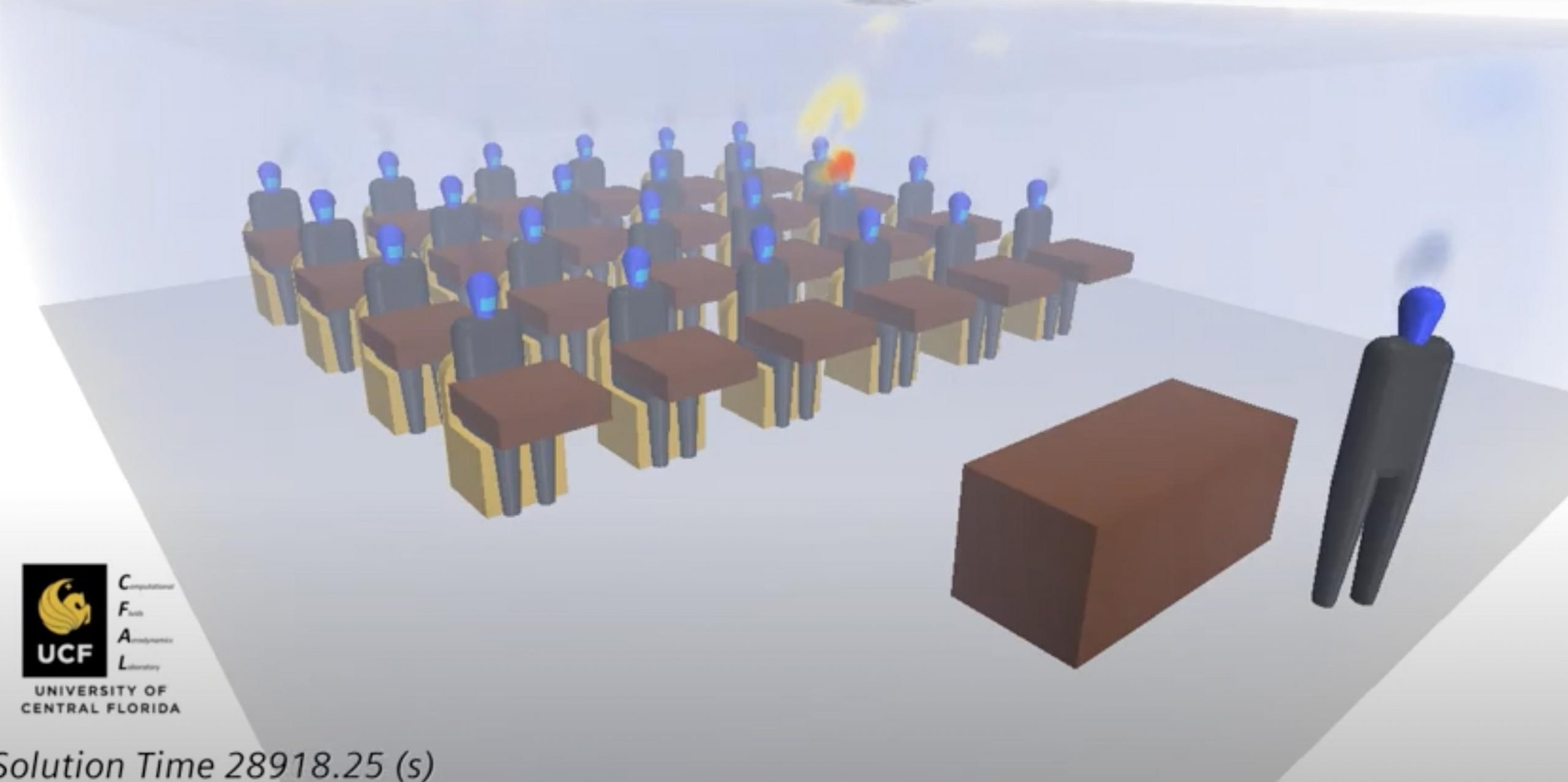
The results indicate masks and proper ventilation may be key to allowing more capacity in schools, businesses, and other indoor areas.
A new study from the University of Central Florida suggests that masks and a good ventilation system are more important than social distancing for reducing the airborne spread of COVID-19 in classrooms.
The research, published recently in the journal Physics of Fluids, comes at a critical time when schools and universities are considering returning to more in-person classes in the fall.
“The research is important as it provides guidance on how we are understanding safety in indoor environments,” says Michael Kinzel, an assistant professor in UCF’s Department of Mechanical and Aerospace Engineering and study co-author.
“The study finds that aerosol transmission routes do not display a need for six feet social distancing when masks are mandated,” he says. “These results highlight that with masks, transmission probability does not decrease with increased physical distancing, which emphasizes how mask mandates may be key to increasing capacity in schools and other places.”
“The results suggest exactly what the CDC is doing, that ventilation systems and mask usage are most important for preventing transmission and that social distancing would be the first thing to relax.”
In the study, the researchers created a computer model of a classroom with students and a teacher, then modeled airflow and disease transmission, and calculated airborne-driven transmission risk.
The classroom model was 709 square feet (66 square meters) with 9-foot-tall (2.7-meter-tall) ceilings, similar to a smaller-size, university classroom, Kinzel says. The model had masked students — any one of whom could be infected— and a masked teacher at the front of the classroom.
Ventilation Significantly Reduces Risk
The researchers examined the classroom using two scenarios — a ventilated classroom and an unventilated one — and using two models, Wells-Riley and Computational Fluid Dynamics. Wells-Riley is commonly used to assess indoor transmission probability and Computational Fluid Dynamics is often used to understand the aerodynamics of cars, aircraft, and the underwater movement of submarines.
Masks were shown to be beneficial by preventing direct exposure of aerosols, as the masks provide a weak puff of warm air that causes aerosols to move vertically, thus preventing them from reaching adjacent students, Kinzel says.
Additionally, a ventilation system in combination with a good air filter reduced the infection risk by 40 to 50% compared to a classroom with no ventilation. This is because the ventilation system creates a steady current of airflow that circulates many of the aerosols into a filter that removes a portion of the aerosols compared to the no-ventilation scenario where the aerosols congregate above the people in the room.
These results corroborate recent guidelines from the U.S. Centers for Disease Control and Prevention that recommend reducing social distancing in elementary schools from six to three feet (1.8 to 0.9 meters) when mask use is universal, Kinzel says.
“If we compare infection probabilities when wearing masks, three feet of social distancing did not indicate an increase in infection probability with respect to six feet, which may provide evidence for schools and other businesses to safely operate through the rest of the pandemic,” Kinzel says.
CDC Guidelines Supported by Findings
“The results suggest exactly what the CDC is doing, that ventilation systems and mask usage are most important for preventing transmission and that social distancing would be the first thing to relax,” the researcher says.
When comparing the two models, the researchers found that Wells-Riley and Computational Fluid Dynamics generated similar results, especially in the non-ventilated scenario, but that Wells-Riley underpredicted infection probability by about 29 percent in the ventilated scenario.
As a result, they recommend some of the additional complex effects captured in Computational Fluid Dynamics be applied to Wells-Riley to develop a more complete understanding of risk of infection in a space, says Aaron Foster, a doctoral student in UCF’s Department of Mechanical and Aerospace Engineering and the study’s lead author.
“While the detailed Computational Fluid Dynamics results provided new insights into the risk variation and distance relationships, they also validated the more commonly used Wells-Riley models as capturing the majority of the benefit of ventilation with reasonable accuracy,” Foster says. “This is important since these are publicly available tools that anyone can use to reduce risk.”
Reference: “Estimating COVID-19 exposure in a classroom setting: A comparison between mathematical and numerical models” by Aaron Foster and Michael Kinzel, 24 February 2021, Physics of Fluids.
DOI: 10.1063/5.0040755
The research is part of a larger overall effort to control airborne disease transmission and better understand factors related to being a super-spreader. The researchers are also testing the effects of masks on aerosol and droplet transmission distance. The work is funded in part by the National Science Foundation.
Kinzel received his doctorate in aerospace engineering from Pennsylvania State University and joined UCF in 2018. In addition to being a member of UCF’s Department of Mechanical and Aerospace Engineering, a part of UCF’s College of Engineering and Computer Science, he also works with UCF’s Center for Advanced Turbomachinery and Energy Research.
Never miss a breakthrough: Join the SciTechDaily newsletter.
Follow us on Google and Google News.
3 Comments
LOL… When I see a computer wearing a mask, I’ll find this study credible. Just shows to go yuh that statistical/computer modeling can be “jiggied” to indicate just about anything; just as “researchers” can likewise be “compelled” to “adjust” their findings to win the next research grant. The magical COVID/SARS virus: small enough to be propelled 6+ feet, but large enough to avoid desiccation in-transit, and be trapped by a cloth or paper-filter mask. The “official” size of the COVID/SARS organism varies from 50nm, to a dubious140nm. Paper/fabric “pores” are considerable larger than 50nm. One epidemiologist I spoke with compared the size differential to that of a grain of salt passing through a spaghetti colander. One alternate explanation I’ve heard, relevant to masks: To hide the facial features of ALIENS circulating among the Human population, with the POSSIBLE exception of those who inhabit the apex of the socio-economic pyramid. They are rarely pictured wearing a mask, if they are pictured at all. In the absence of reliable “Science” it’s anybody’s guess… I GUESS… 🤔👽… RELAX, have a cookie 🍪. Ten minutes from now, you won’t remember what it was that was bothering you… Welcome to the MATRIX.👤 LOL 🍥 🦋
To Alexiev. We actually do live in a Matrix. A Matrix of lies and deception. And psychological operations. To program the masses. To divide and conquer. Jesus Christ is the only way to save your soul from what these people have planned for the world.
Wow. Looks like any idiot can comment here and debunk the study with baseless comments that add nothing to the discussion.