

Close Menu
    Facebook X (Twitter) Instagram
    SciTechDaily
    • Biology
    • Chemistry
    • Earth
    • Health
    • Physics
    • Science
    • Space
    • Technology
    Facebook X (Twitter) Pinterest YouTube RSS
    SciTechDaily
    Home»Health»Simply Talking While Infected Can Spread COVID-19 – Even While Wearing Masks
    Health

    Simply Talking While Infected Can Spread COVID-19 – Even While Wearing Masks

    By American Institute of PhysicsFebruary 23, 2021No Comments3 Mins Read
    Facebook Twitter Pinterest Telegram LinkedIn WhatsApp Email Reddit
    Share
    Facebook Twitter LinkedIn Pinterest Telegram Email Reddit
    Airflow Patterns While Speaking
    Airflow patterns while speaking.

    Airflow patterns around two people conversing in typical situations, such as hair salons, medical exam rooms, and long-term care facilities.

    COVID-19 can spread from asymptomatic but infected people through small aerosol droplets in their exhaled breath. Most studies of the flow of exhaled air have focused on coughing or sneezing, which can send aerosols flying long distances.

    However, speaking while near one another is also risky since the virus can be ejected by merely talking.

    In Physics of Fluids, by AIP Publishing, scientists in Japan use smoke and laser light to study the flow of expelled breath near and around two people conversing in various relative postures commonly found in the service industry, such as in hair salons, medical exam rooms, or long-term care facilities.
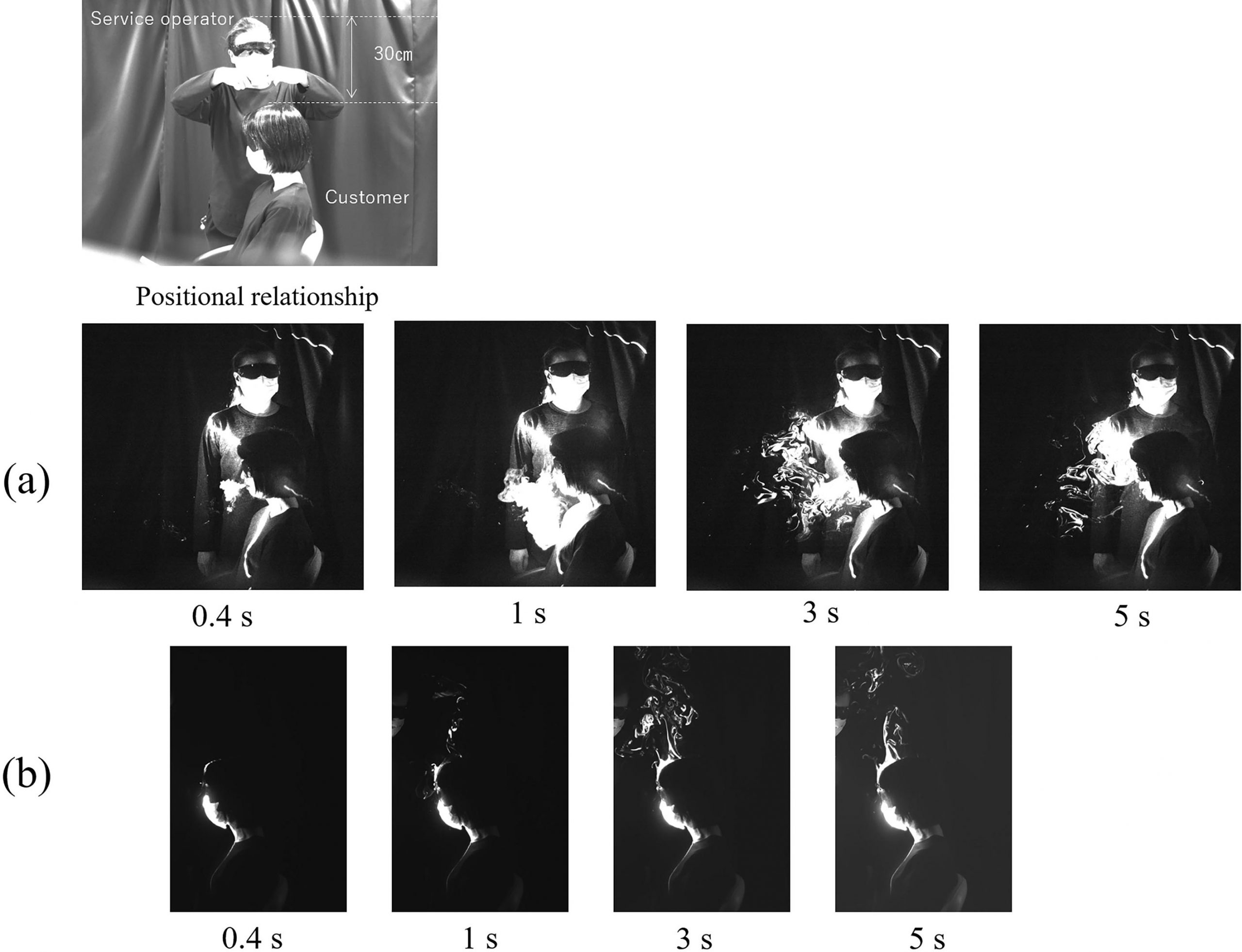
    Visualization of Airflow Patterns Service Technician and Client
    Visualization of airflow patterns between a service technician and a client. Conversation spreads droplets, even when both wear masks. Credit: Keiko Ishii

    In this study, electronic cigarettes were used to produce artificial smoke consisting of droplets about one-tenth micron in diameter, similar to the size of a virus particle. The liquid used in these vaping devices, a mixture of glycerin and propylene glycol, produces a cloud of tiny droplets that scatter light from a laser, allowing visualization of airflow patterns.

    “We analyzed the characteristics of exhalation diffusion with and without a mask when a person was standing, sitting, facing down, or lying face up,” said author Keiko Ishii.


    Visualization of airflow patterns while a client is reclining and a technician is standing above. Even when the technician is wearing a mask, droplets fall on the client below. Credit: Keiko Ishii

    To study the effect of speech on exhalation, the word “onegaishimasu,” a typical Japanese greeting in a business setting, was uttered repeatedly while filming the resulting vapor cloud. The experiments were carried out in a hair salon at the Yamano College of Aesthetics in Tokyo, with postures chosen to simulate typical customer service scenarios, including shampooing where a customer is lying back and the technician is standing and leaning over the customer.

    “A significant amount of similar face-to-face contact would occur not only in cosmetology but also in long-term and medical care,” said Ishii.


    When a technician uses a mask and a face shield, the shield prevents droplets that leak from the mask from falling on a client below. Credit: Keiko Ishii

    The experiments revealed the exhaled air from an unmasked person who is speaking tends to move downward under the influence of gravity. If a customer or patient is lying below, they could be infected.

    When a mask is worn while standing or sitting, the vapor cloud tends to attach to that person’s body, which is warmer than the surrounding air and flows upward along the body. If the technician is leaning over, however, the aerosol cloud tends to detach from that person’s body and fall onto the client below.

    The investigators also experimented with face shields and found it can prevent any aerosols that leak from around the technician’s mask from traveling down to the customer.

    “The face shield promoted the rise of the exhaled breath,” said Ishii. “Hence, it is more effective to wear both a mask and a face shield when providing services to customers.”

    Reference: “Relationship between human exhalation diffusion and posture in face-to-face scenario with utterance” by Keiko Ishii, Yoshiko Ohno, Maiko Oikawa and Noriko Onishi, 23 February 2021, Physics of Fluids.
    DOI: 10.1063/5.0038380

    Never miss a breakthrough: Join the SciTechDaily newsletter.
    Follow us on Google and Google News.

    American Institute of Physics Biophysics COVID-19 Fluid Mechanics Infectious Diseases Popular Public Health
    Share. Facebook Twitter Pinterest LinkedIn Email Reddit

    Related Articles

    Researchers Find Leakage of Airborne Droplets Escaping From COVID Masks – Even When Just Breathing

    Disposable Helmet Designed to Retain Cough Droplets, Minimize COVID-19 Transmission

    Some Masks Can Be Worse Than Not Wearing One at All: Physics of How Masks Affect Airflow and COVID-19 Protection

    Social Distancing Isn’t Enough to Prevent Infection – How to Detect COVID-19 Super-Spreaders

    COVID-19 Researchers Identify Features of a Virus Super-Spreader

    Breakthrough in Stopping the Spread of COVID-19: Plasma Treatments Quickly Kill Coronavirus on Surfaces

    Scientists Compare How COVID-19 Cough Clouds Travel With and Without Face Masks

    Visualization Shows How Face Shields (and Some N95 Masks) Fail to Stop the Spread of COVID-19

    COVID-19 Warning: Flushing Public Restroom Toilets Can Spew Clouds of Particles Carrying Viruses

    Leave A Reply Cancel Reply

    • Facebook
    • Twitter
    • Pinterest
    • YouTube

    Don't Miss a Discovery

    Subscribe for the Latest in Science & Tech!

    Trending News

    Artificial Sweeteners May Harm Future Generations, Study Suggests

    Splashdown! NASA Artemis II Returns From Record-Breaking Moon Mission

    What If Consciousness Exists Beyond Your Brain

    Scientists Finally Crack the 100-Million-Year Evolutionary Mystery of Squid and Cuttlefish

    Beyond “Safe Levels”: Study Challenges What We Know About Pesticides and Cancer

    Researchers Have Found a Dietary Compound That Increases Longevity

    Scientists Baffled by Bizarre “Living Fossil” From 275 Million Years Ago

    Your IQ at 23 Could Predict Your Wealth at 27, Study Finds

    Follow SciTechDaily
    • Facebook
    • Twitter
    • YouTube
    • Pinterest
    • Newsletter
    • RSS
    SciTech News
    • Biology News
    • Chemistry News
    • Earth News
    • Health News
    • Physics News
    • Science News
    • Space News
    • Technology News
    Recent Posts
    • What if Dark Matter Has Two Forms? Bold New Hypothesis Could Explain a Cosmic Mystery
    • Researchers Expose Hidden Chemistry of “Ore-Forming” Elements in Biology
    • Geologists Reveal the Americas Collided Earlier Than We Thought
    • 20x Difference: Study Reveals True Source of Airborne Microplastics
    • Scientists Uncover Hidden Force Powering Yellowstone’s Supervolcano
    Copyright © 1998 - 2026 SciTechDaily. All Rights Reserved.
    • Science News
    • About
    • Contact
    • Editorial Board
    • Privacy Policy
    • Terms of Use

    Type above and press Enter to search. Press Esc to cancel.