
Close Menu
    Facebook X (Twitter) Instagram
    SciTechDaily
    • Biology
    • Chemistry
    • Earth
    • Health
    • Physics
    • Science
    • Space
    • Technology
    Facebook X (Twitter) Pinterest YouTube RSS
    SciTechDaily
    Home»Space»New Hubble Image Shows a Handful of Galaxies in the Constellation of Eridanus
    Space

    New Hubble Image Shows a Handful of Galaxies in the Constellation of Eridanus

    By Hubble Space TelescopeDecember 9, 2013No Comments2 Mins Read
    Facebook Twitter Pinterest Telegram LinkedIn WhatsApp Email Reddit
    Share
    Facebook Twitter LinkedIn Pinterest Telegram Email Reddit
    New Hubble Image Shows a Handful of Galaxies in the Constellation of Eridanus
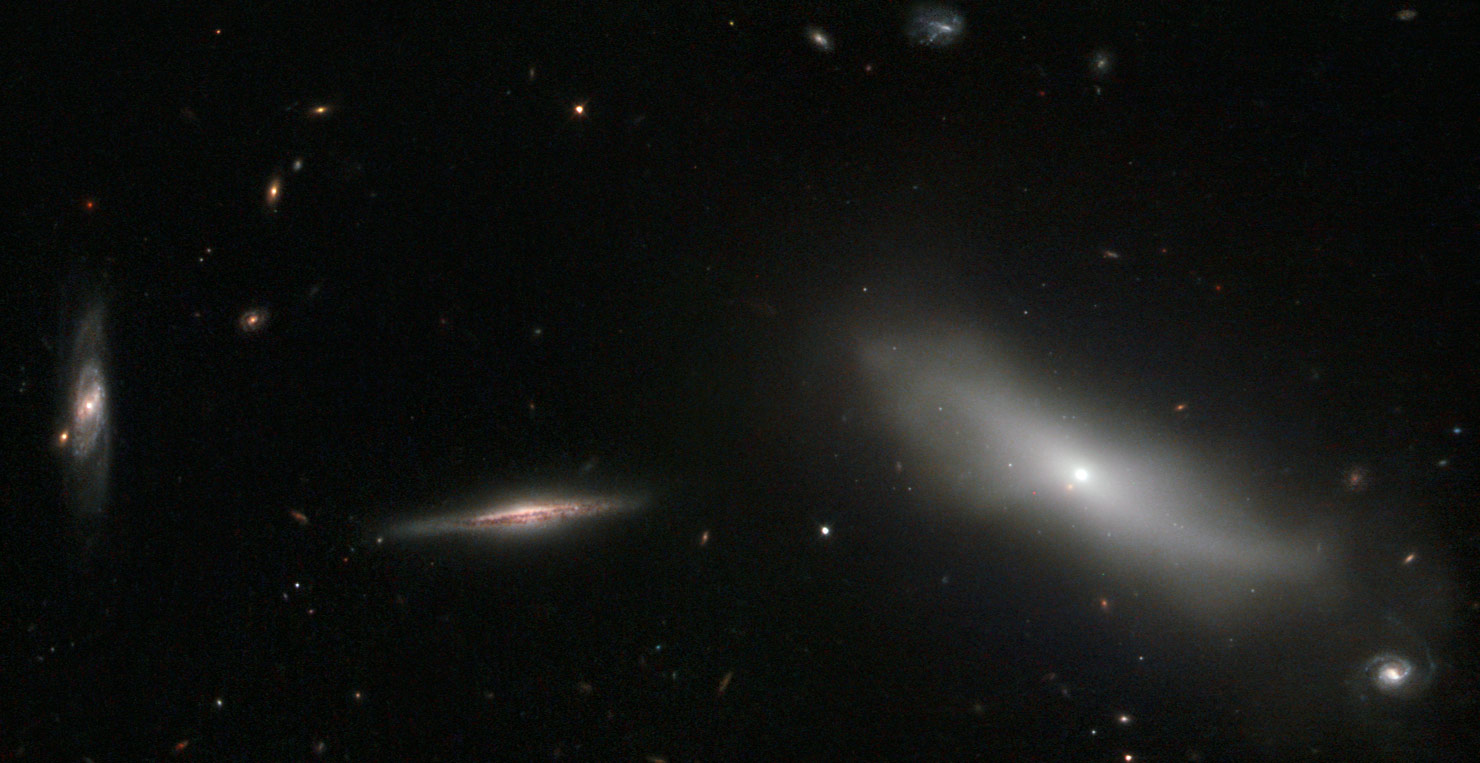
    Hubble Space Telescope image of several galaxies in the constellation of Eridanus (The River). Credit: ESA/Hubble & NASA, Acknowledgement: Luca Limatola

    This newly released Hubble image shows several galaxies in the constellation of Eridanus.

    This new Hubble image shows a handful of galaxies in the constellation of Eridanus (The River). NGC 1190, shown here on the right of the frame, stands apart from the rest; it belong to an exclusive club known as Hickson Compact Group 22 (HCG 22).

    There are four other members of this group, all of which lie out of frame: NGC 1189, NGC 1191, NGC 1192, and NGC 1199. The other galaxies shown here are nearby galaxies 2MASS J03032308-1539079 (center), and dCAZ94 HCG 22-21 (left), both of which are not part of HCG 22.

    Hickson Compact Groups are incredibly tightly bound groups of galaxies. Their discoverer Paul Hickson observed only 100 of these objects, which he described in his HCG catalog in the 1980s. To earn the Hickson Compact Group label, there must be at least four members — each one fairly bright and compact. These short-lived groups are thought to end their lives as giant elliptical galaxies, but despite knowing much about their form and destiny, the role of compact galaxy groups in galactic formation and evolution is still unclear.

    These groups are interesting partly for their self-destructive tendencies. The group members interact, circling and pulling at one another until they eventually merge together, signaling the death of the group, and the birth of a large galaxy.

    A version of this image was entered into the Hubble’s Hidden Treasures image processing competition by contestant Luca Limatola.

    Never miss a breakthrough: Join the SciTechDaily newsletter.
    Follow us on Google and Google News.

    Astronomy Hubble Space Telescope
    Share. Facebook Twitter Pinterest LinkedIn Email Reddit

    Related Articles

    A Morphing Spiral Galaxy Amongst Friends

    Hubble Views Magnificent Lopsided Galaxy NGC 2276

    Hubble Captures Fantastic Detail of Eponymous Spiral Galaxy NGC 691

    Spectacular Image Captured by Hubble Shows a Strangely Contorted Spiral Galaxy

    A Distant Spiral in Virgo: Extraordinary Detail Seen in a Galaxy 150 Million Light-Years Away From Earth

    Magnetic Monsters: Hubble Tracks Down Location of Mysterious Radio Signals From Intergalactic Space

    A Menagerie of Galaxies: Hubble Captures a Cluster With Galaxies of All Shapes and Sizes

    How Habitable Are Planets That Orbit Red Dwarfs – The Most Common Type of Stars in the Galaxy?

    Cosmic Silver Lining: Hubble Spots V565 Surrounded by Four Prominent Diffraction Spikes

    Leave A Reply Cancel Reply

    • Facebook
    • Twitter
    • Pinterest
    • YouTube

    Don't Miss a Discovery

    Subscribe for the Latest in Science & Tech!

    Trending News

    125-Million-Year-Old Crocodile Fossil Reveals Astonishing New Secrets

    Scientists Discover an “Impossible” Way Muscle Filaments Can Grow

    A Star’s Spin Could Solve a Longstanding Black Hole Mystery

    NASA Finds Earth Microbes Could Hide in the Moon’s Deep Shadows

    New Study: Intermittent Fasting Lowers Blood Sugar in Type 1 Diabetes

    Alzheimer’s Brain Changes May Begin 7 Years Earlier Than Scientists Thought

    This New Molecule Could Transform How We Recover Gold From Electronic Waste

    A Billion Years Before the Grand Canyon, a Giant Cliff May Have Stretched Across America

    Follow SciTechDaily
    • Facebook
    • Twitter
    • YouTube
    • Pinterest
    • Newsletter
    • RSS
    SciTech News
    • Biology News
    • Chemistry News
    • Earth News
    • Health News
    • Physics News
    • Science News
    • Space News
    • Technology News
    Recent Posts
    • This Metallic Green Beetle Is Quietly Killing Ash Trees Across Texas
    • A 15-Day Window Could Decide the Fate of California’s Most Endangered Salmon
    • Red Meat Helped Build Humanity, Now It May Be Harming Us
    • Scientists Discover a Brain Signal Linked to Severe Suicidal Thoughts
    • A Tiny Wireless Device Could Transform How Chronic Pain Is Treated
    Copyright © 1998 - 2026 SciTechDaily. All Rights Reserved.
    • Science News
    • About
    • Contact
    • Editorial Board
    • Privacy Policy
    • Terms of Use

    Type above and press Enter to search. Press Esc to cancel.