
Close Menu
    Facebook X (Twitter) Instagram
    SciTechDaily
    • Biology
    • Chemistry
    • Earth
    • Health
    • Physics
    • Science
    • Space
    • Technology
    Facebook X (Twitter) Pinterest YouTube RSS
    SciTechDaily
    Home»Physics»Powering the Future: China’s Superionic Hydride Ion Conductor Breakthrough
    Physics

    Powering the Future: China’s Superionic Hydride Ion Conductor Breakthrough

    By Chinese Academy of SciencesApril 24, 2023No Comments3 Mins Read
    Facebook Twitter Pinterest Telegram LinkedIn WhatsApp Email Reddit
    Share
    Facebook Twitter LinkedIn Pinterest Telegram Email Reddit
    Superionic Hydride Ion Conductor
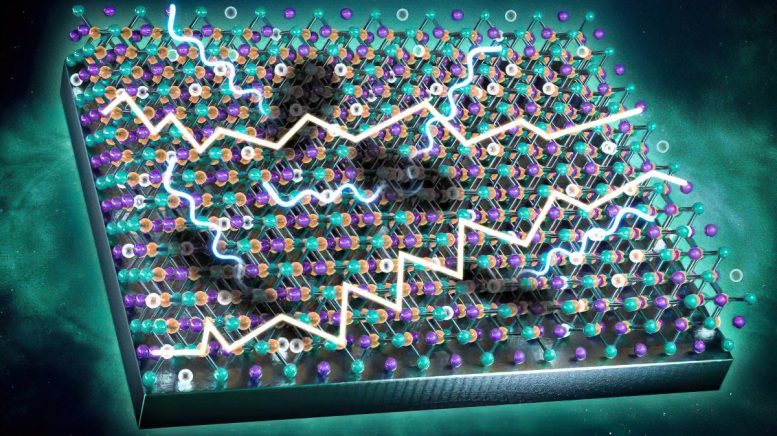
    Chinese scientists have developed the first superionic hydride ion conductor capable of operating at ambient conditions. By targeting the structure and morphology of trihydrides in rare earth elements and using a mechanical ball milling method, the researchers were able to suppress the electronic conductivity of lanthanum trihydride, transforming it into a superionic conductor with record-high conductivities. This breakthrough has potential applications in advanced clean energy storage and electrochemical conversion technologies. The team intends to further explore the physics behind the phenomenon and expand their method to other hydride materials. Credit: Chinese Academy of Sciences

    Chinese scientists have created the first ambient-temperature superionic hydride ion conductor, enabling advancements in clean energy storage and electrochemical conversion technologies.

    Chinese scientists have developed the first superionic hydride ion conductor at ambient conditions, according to the Dalian Institute of Chemical Physics under the Chinese Academy of Sciences.

    With strong reducibility and high redox potential, the hydride ion (H-) is a reactive hydrogen species and an energy carrier. Materials that conduct pure H- at ambient conditions will be enablers of advanced clean energy storage and electrochemical conversion technologies.

    Several H- conductors have already been developed in recent years, but none of the materials could achieve superionic conduction at ambient conditions.

    The research team targeted the structure and morphology of trihydrides — hydrides containing three atoms of hydrogen per molecule — of certain rare earth elements (REHx), including Lanthanum (La), according to a research paper published in the journal Nature.

    They innovatively adopted the mechanical ball milling method and deformed lanthanum trihydride (LaHx) through impact and shear force, according to the paper.

    Transforming Lanthanum Trihydride Properties

    By creating nanosized grains and defects in the LaHx lattice, the electronic conductivity of LaHx can be suppressed by more than five orders of magnitude. This transforms LaHx into a superionic conductor with record high conductivities at the ambient temperatures — minus 40 degrees Celsius to 80 degrees Celsius.

    The researchers plan to explore the physics underneath the phenomenon and extend the method developed in the study to other hydride materials to broaden the material scope for pure H- conductors.

    For more on this breakthrough, see A New Era of Superionic Hydride Conduction at Room Temperature.

    Reference: “Deforming lanthanum trihydride for superionic conduction” by Weijin Zhang, Jirong Cui, Shangshang Wang, Hujun Cao, Anan Wu, Yuanhua Xia, Qike Jiang, Jianping Guo, Teng He and Ping Chen, 5 April 2023, Nature.
    DOI: 10.1038/s41586-023-05815-0

    Never miss a breakthrough: Join the SciTechDaily newsletter.
    Follow us on Google and Google News.

    Chinese Academy of Sciences Conductivity Rare Earth Minerals
    Share. Facebook Twitter Pinterest LinkedIn Email Reddit

    Related Articles

    Quantum Breakthrough: Unmasking Hidden Magnetic Marvels in Kagome Lattices

    Chinese Scientists Synthesize Plutonium-227: The New Isotope Shaping the Future of Nuclear Physics

    Scientists Have Synthesized a Diamond-Like Nitrogen Structure That Could Redefine Energy Storage

    Scientists Capture Elusive Quantum Floquet States With Visible Light

    Chinese Scientists Have Developed an Electromagnetic Vortex Cannon

    Unmasking Antihyperhydrogen-4: The Heaviest Antimatter Hypernucleus Ever Discovered

    Unlocking Future Technologies With Magnetic Control of Rare Earth Elements

    Decoding Superconductivity: Quantum Simulator Unlocks Antiferromagnetic Mystery

    Charging Ahead: A New Era of Superionic Hydride Conduction at Room Temperature

    Leave A Reply Cancel Reply

    • Facebook
    • Twitter
    • Pinterest
    • YouTube

    Don't Miss a Discovery

    Subscribe for the Latest in Science & Tech!

    Trending News

    Mushroom Mystery: The Fungus That Makes People See Tiny Humans

    Popular Erectile Dysfunction Drug Linked to Vision-Threatening Eye Disease

    Scientists Find a Smarter Way To Turn Used Coffee Grounds Into Clean Fuel

    Did Cellular Life Begin Twice? New Study Points to Two Independent Origins

    Sitting Up Straight Could Actually Help You Make Better Decisions

    Never-Before-Seen Vortices Are Swirling Across the Sun

    This Common Amino Acid May Help the Body Fight Cancer and Viruses

    Low-Protein “Longevity Diet” Linked to Fat Loss, Muscle Preservation, and Healthy Aging

    Follow SciTechDaily
    • Facebook
    • Twitter
    • YouTube
    • Pinterest
    • Newsletter
    • RSS
    SciTech News
    • Biology News
    • Chemistry News
    • Earth News
    • Health News
    • Physics News
    • Science News
    • Space News
    • Technology News
    Recent Posts
    • Scientists Steer Infrared Light Through an “Invisible” Waveguide
    • Electrons Mysteriously Slow to a Crawl Inside This Magnetic Material
    • “Entirely Surprising” – Scientists Have Found a Martian Meteorite Unlike Any Known Before
    • Cancer Stem Cells Have an “Energy Addiction” – and Scientists Found a Way To Exploit It
    • Scientists Say This Simple Habit Could Lead to a Happier Marriage
    Copyright © 1998 - 2026 SciTechDaily. All Rights Reserved.
    • Science News
    • About
    • Contact
    • Editorial Board
    • Privacy Policy
    • Terms of Use

    Type above and press Enter to search. Press Esc to cancel.