
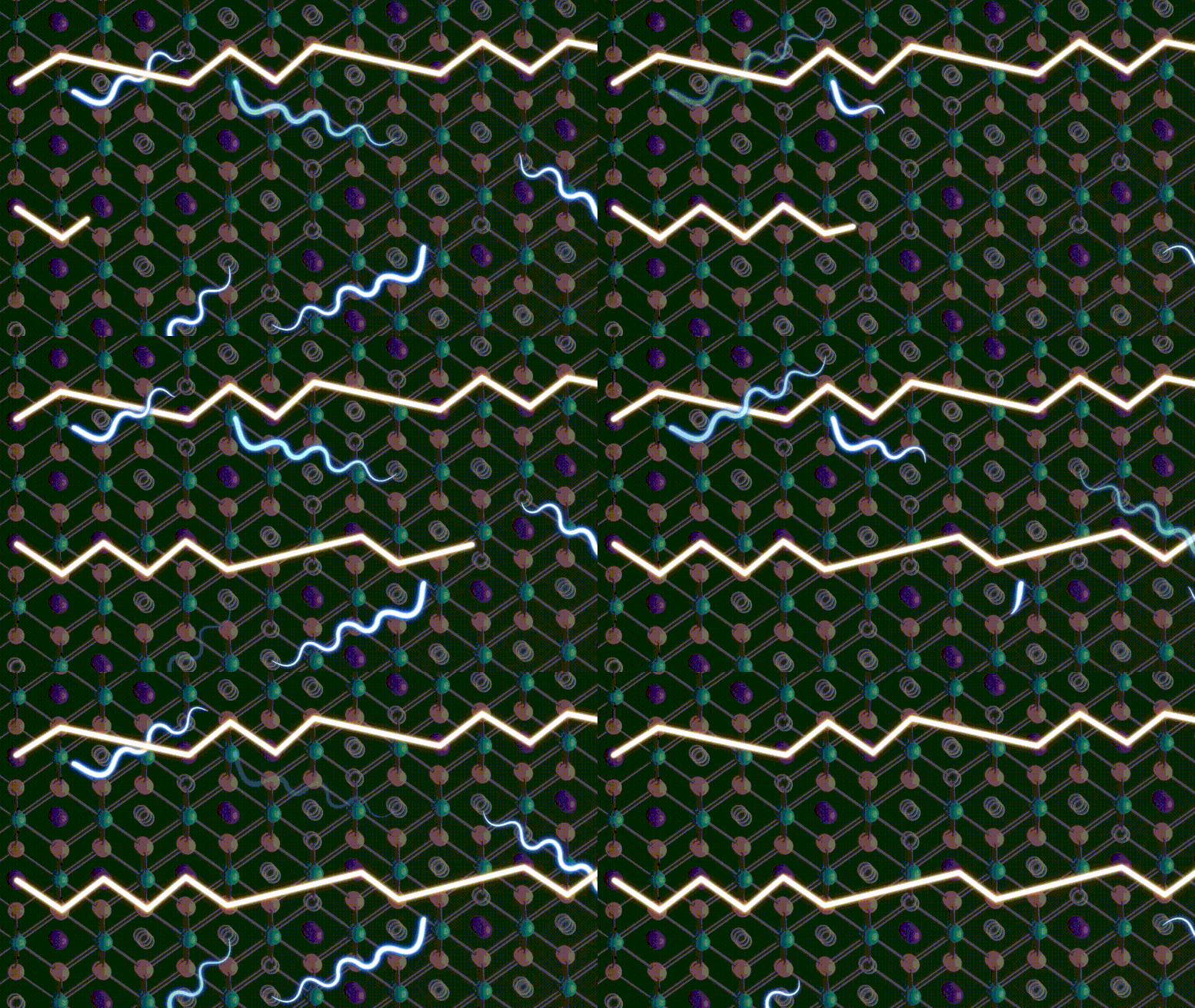
A research team has developed a technique for room-temperature all-solid-state hydride cells, which could enable advanced clean energy storage and conversion technologies. By introducing defects in the lattice structure of rare earth hydrides, the team suppressed electronic conductivity, creating pure hydride ion conductors with high conductivities in a wide temperature range.
Materials that can conduct negatively charged hydrogen atoms in ambient conditions would pave the way for advanced clean energy storage and electrochemical conversion technologies.
A research team from the Dalian Institute of Chemical Physics (DICP) of the Chinese Academy of Sciences (CAS) demonstrated a technique that enables a room-temperature all-solid-state hydride cell by introducing and exploiting defects in the lattice structure of rare earth hydrides.
Their study was published in the journal Nature on April 5.
Solid materials that conduct lithium, sodium and hydrogen cations have been used in batteries and fuel cells. Under certain conditions, some of the materials transition to superionic states where ions move as fast as they do in liquids by skipping through the rigid crystal structure. This phenomenon is advantageous for chemical and energy conversions as it allows ions to move without a liquid or soft membrane to separate the electrodes. However, few solid-state materials can reach this state under ambient conditions.
“Materials that exhibit superionic conduction at ambient conditions would provide huge opportunities for constructing brand new all-solid-state hydride batteries, fuel cells and electrochemical cells for the storage and conversion of clean energy,” said Prof. Ping Chen, study author from DICP.

With strong reducibility and high redox potential, hydride ion (H–) conductors have emerged as promising candidates for this technology. Several H– conductors have already been developed in recent years, including alkaline earth metal hydrides and oxyhydrides of alkaline earth and rare earth metals, which are known for fast hydrogen migration. But none of the materials developed could achieve superionic conduction at ambient conditions —until the DICP team took a new approach.
The DICP research team targeted the structure and morphology of trihydrides — hyrdrides containing three atoms of hydrogen per molecule — of certain rare earth elements (REHx), including Lanthanum (La).
Harnessing Lattice Defects for Enhanced Ion Conductivity
Strategies to enhance electronic conductivities typically seek to diminish crystallographic imperfections for applications like metallic nanowire interconnects and nanostructured photovoltaic semiconductors. In this study, however, the research team purposely created abundant discrete nanosized grains and lattice defects to disturb the path of electron transport in REHx and suppress the electronic conductivity. This is different from engineering conventional materials for ion conduction, which relies upon the consistent structure of high crystallinity.
The research team observed how H– ions diffused easily in REHx lattices by hopping between octahedral and tetrahedral sites in the crystal and across interfaces or grain boundaries. Electrons, on the other hand, encountered substantial scattering at grain boundaries, particle surfaces and other traps, which brought down the electronic conductivities by three to five orders of magnitude from those of their well-crystallized counterparts.
A New Era for All-Solid-State Hydride Batteries
“By creating nano-sized grains, defects and other crystalline mismatched zones in a known ionic-electronic mixed conductor, we demonstrated that the electronic conductivity of LaHx (x ≈ 2.94) can be largely suppressed by five orders of magnitude,” said Chen. “Engineering such a material could transform LaHx into a pure hydride ion conductor with record high conductivities in the temperature range of -40 to 80 ℃.”
The researchers effectively suppressed electron conduction of LaHx by decreasing the particle size and distorting the lattice via high-energy ball milling, which involves subjecting the material to high-energy collisions. With fast H– conduction and a high ion transfer number, the deformed LaHx material would enable a hydride ion battery to operate at room temperature or lower.
“This work demonstrates the effectiveness of lattice deformation in suppressing electron conduction in REHx,” said Chen.
The researchers plan to explore the physics underneath the phenomenon and extend the method developed in this study to other hydride materials to broaden the material scope for pure H– conductors.
“Our near-term goal is to demonstrate a brand new all-solid-state hydride ion battery that is of practical potential,” said Chen.
For more on this research, see China’s Superionic Hydride Ion Conductor Breakthrough.
Reference: “Deforming lanthanum trihydride for superionic conduction” by Weijin Zhang, Jirong Cui, Shangshang Wang, Hujun Cao, Anan Wu, Yuanhua Xia, Qike Jiang, Jianping Guo, Teng He and Ping Chen, 5 April 2023, Nature.
DOI: 10.1038/s41586-023-05815-0
This work was jointly supported by the National Key Research and Development Program of China, the National Natural Science Foundation of China, Youth Innovation Promotion Association CAS and the Liaoning Revitalization Talents Program.
Other contributors include ZHANG Weijin, CUI Jirong, WANG Shangshang, CAO Hujun, JIANG Qike, GUO Jianping and HE Teng from DICP; WU Anan from Xiamen University and XIA Yuanhua from the China Academy of Engineering Physics.
Never miss a breakthrough: Join the SciTechDaily newsletter.
Follow us on Google and Google News.
1 Comment
Blind worship of a certain journal will lead to academic corruption and pseudoscience.