
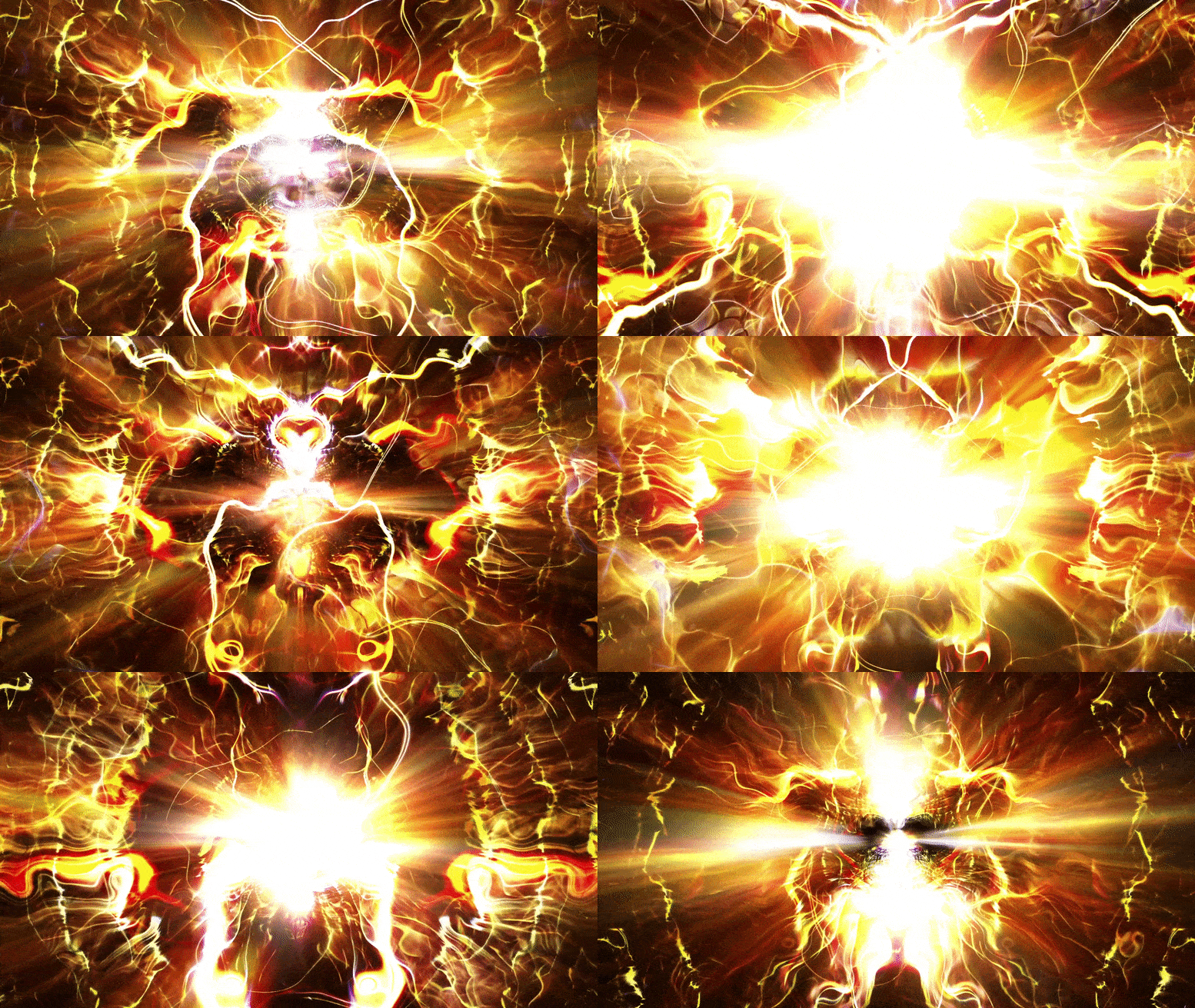
Researchers have not only raised the temperature, but also lowered the pressure required to achieve superconductivity.
In a historic achievement, University of Rochester researchers have created a superconducting material at both a temperature and pressure low enough for practical applications.
“With this material, the dawn of ambient superconductivity and applied technologies has arrived,” according to a team led by Ranga Dias, an assistant professor of mechanical engineering and of physics. In a paper published on March 8 in the journal Nature, the researchers describe a nitrogen-doped lutetium hydride (NDLH) that exhibits superconductivity at 69 degrees Fahrenheit and 10 kilobars (145,000 pounds per square inch, or psi) of pressure.
Although 145,000 psi might still seem extraordinarily high (pressure at sea level is about 15 psi), strain engineering techniques routinely used in chip manufacturing, for example, incorporate materials held together by internal chemical pressures that are even higher.
Researchers not only raised the temperature, but also lowered the pressure required to achieve superconductivity. Credit: University of Rochester / AJ Pow
Scientists have been pursuing this breakthrough in condensed matter physics for more than a century. Superconducting materials have two key properties: electrical resistance vanishes, and the magnetic fields that are expelled pass around the superconducting material. Such materials could enable:
- Power grids that transmit electricity without the loss of up to 200 million megawatt hours (MWh) of the energy that now occurs due to resistance in the wires
- Frictionless, levitating high-speed trains
- More affordable medical imaging and scanning techniques such as MRI and magnetocardiography
- Faster, more efficient electronics for digital logic and memory device technology
- Tokamak machines that use magnetic fields to confine plasmas to achieve fusion as a source of unlimited power
Previously, the Dias team reported creating two materials—carbonaceous sulfur hydride and yttrium superhydride—that are superconducting at 58 degrees Fahrenheit/39 million psi and 12 degrees Fahreneheit/26 million psi respectively, in papers in Nature and Physical Review Letters.
Given the importance of the new discovery, Dias and his team went to unusual lengths to document their research and head off criticism that developed in the wake of the previous Nature paper, which led to a retraction by the journal’s editors. That previous paper has been resubmitted to Nature with new data that validates the earlier work, according to Dias. The new data was collected outside the lab, at the Argonne and Brookhaven National Laboratories in front of an audience of scientists who saw the superconducting transition live. A similar approach has been taken with the new paper.
Five graduate students in Dias’s lab—Nathan Dasenbrock-Gammon, Elliot Snider, Raymond McBride, Hiranya Pasan, and Dylan Durkee—are listed as co-lead authors. “Everyone in the group was involved in doing the experiments,” Dias says. “It was truly a collective effort.”
‘Startling Visual Transformation’
Hydrides created by combining rare earth metals with hydrogen, then adding nitrogen or carbon, have provided researchers a tantalizing “working recipe” for creating superconducting materials in recent years. In technical terms, rare earth metal hydrides form clathrate-like cage structures, where the rare earth metal ions act as carrier donors, providing sufficient electrons that would enhance the dissociation of the H2 molecules. Nitrogen and carbon help stabilize materials. Bottom line: less pressure is required for superconductivity to occur.
In addition to yttrium, researchers have used other rare earth metals. However, the resulting compounds become superconductive at temperatures or pressures that are still not practical for applications.
So, this time, Dias looked elsewhere along the periodic table.
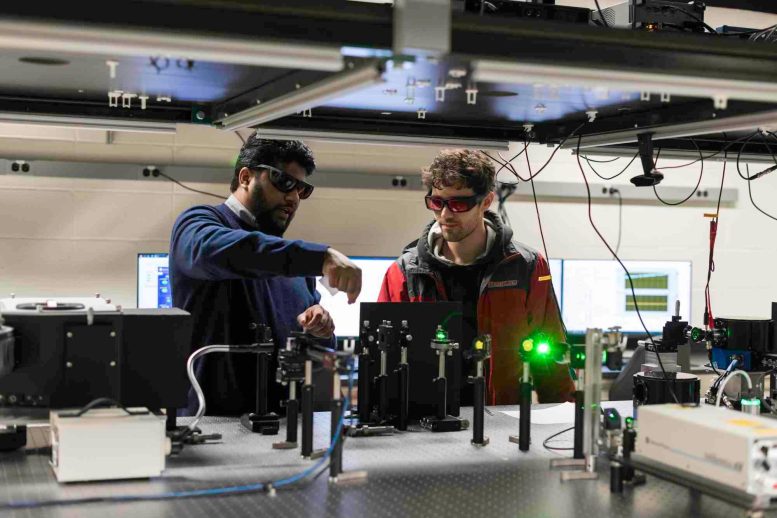
Lutetium looked like “a good candidate to try,” Dias says. It has highly localized fully-filled 14 electrons in its f orbital configuration that suppress the phonon softening and provide enhancement to the electron-phonon coupling needed for superconductivity to take place at ambient temperatures. “The key question was, how are we going to stabilize this to lower the required pressure? And that’s where nitrogen came into the picture.”
Nitrogen, like carbon, has a rigid atomic structure that can be used to create a more stable, cage-like lattice within a material and it hardens the low-frequency optical phonons, according to Dias. This structure provides the stability for superconductivity to occur at lower pressure.
Dias’s team created a gas mixture of 99 percent hydrogen and one percent nitrogen, placed it in a reaction chamber with a pure sample of lutetium, and let the components react for two to three days at 392 degrees Fahrenheit.

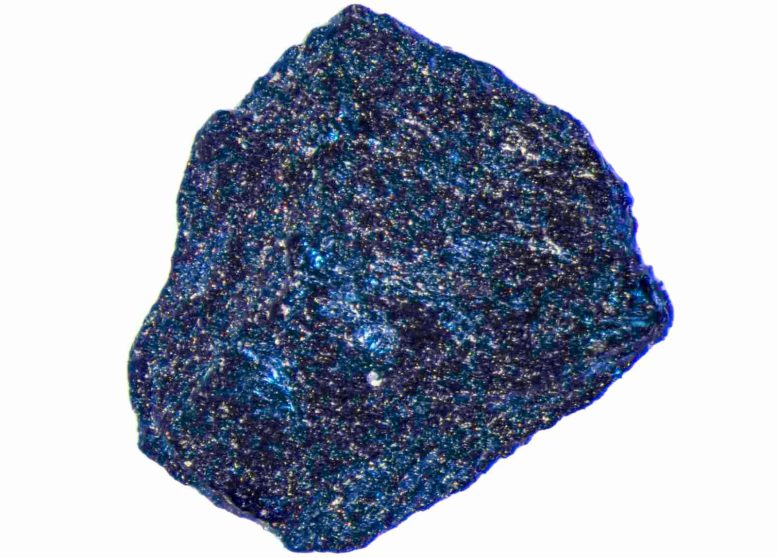
The resulting lutetium-nitrogen-hydrogen compound was initially a “lustrous bluish color,” the paper states. When the compound was then compressed in a diamond anvil cell, a “startling visual transformation” occurred: from blue to pink at the onset of superconductivity, and then to a bright red non-superconducting metallic state.
“It was a very bright red,” Dias says. “I was shocked to see colors of this intensity. We humorously suggested a code name for the material at this state—‘reddmatter’—after a material that Spock created in the popular 2009 Star Trek movie.” The code name stuck.
The 145,000 psi of pressure required to induce superconductivity is nearly two orders of magnitude lower than the previous low pressure created in Dias’s lab.
Predicting New Superconducting Materials With Machine Learning
With funding support from Dias’s National Science Foundation CAREER award and a grant from the US Department of Energy, his lab has now answered the question of whether superconducting material can exist at both ambient temperatures and pressures low enough for practical applications.
“A pathway to superconducting consumer electronics, energy transfer lines, transportation, and significant improvements of magnetic confinement for fusion are now a reality,” Dias says. “We believe we are now at the modern superconducting era.”
For example, Dias predicts that the nitrogen-doped lutetium hydride will greatly accelerate progress in developing tokamak machines to achieve fusion. Instead of using powerful, converging laser beams to implode a fuel pellet, tokamaks rely on strong magnetic fields emitted by a doughnut-shaped enclosure to trap, hold, and ignite super-heated plasmas. NDLH, which produces an “enormous magnetic field” at room temperatures, “will be a game-changer” for the emerging technology, Dias says.
Particularly exciting, according to Dias, is the possibility of training machine-learning algorithms with the accumulated data from superconducting experimentation in his lab to predict other possible superconducting materials—in effect, mixing and matching from thousands of possible combinations of rare earth metals, nitrogen, hydrogen, and carbon.
https://giphy.com/gifs/urochester-WBDR47kec9XiXAK7uo
“In day-to-day life we have many different metals we use for different applications, so we will also need different kinds of superconducting materials,” Dias says. “just like we use different metals for different applications, we need more ambient superconductors for different applications.”
Coauthor Keith Lawlor has already begun developing algorithms and making calculations using supercomputing resources available through the University of Rochester’s Center for Integrated Research Computing.
An Upstate New York Hub for Superconducting Materials?
Dias’s research group recently moved into a new, expanded lab on the third floor of Hopeman Hall on the River Campus. This is the first step in an ambitious plan to launch a degree-granting Center for Superconducting Innovation (CSI) at the University of Rochester, he says.
The center would create an ecosystem for drawing additional faculty and scientists to the University to advance the science of superconductivity. The trained students would broaden the pool of researchers in the field.
“Our hope is to make upstate New York the hub for superconducting technology,” Dias says.
Reference: “Evidence of near-ambient superconductivity in a N-doped lutetium hydride” by Nathan Dasenbrock-Gammon, Elliot Snider, Raymond McBride, Hiranya Pasan, Dylan Durkee, Nugzari Khalvashi-Sutter, Sasanka Munasinghe, Sachith E. Dissanayake, Keith V. Lawler, Ashkan Salamat and Ranga P. Dias. 8 March 2023. Nature.
DOI: 10.1038/s41586-023-05742-0
Funding: National Science Foundation, DOE/US Department of Energy, Unearthly Materials Inc
Never miss a breakthrough: Join the SciTechDaily newsletter.
Follow us on Google and Google News.
7 Comments
“Power grids that transmit electricity without the loss of up to 200 million megawatt hours (MWh) of the energy that now occurs due to resistance in the wires”
“MWh” is a unit of energy and doesn’t make sense in this context. Do the grids lose this amount of energy each year, day, hour, minute, or what? A unit of power belongs here. If it were simply megawatts (“MW”) then it would make sense.
Power lost is dreiectly effected by the amount of distance you are trying to transmit power, the longer the conductor the more your voltage drops, so while it was confusingly worded it is still accurate
So what? Significance?
“Dias’s team created a gas mixture of 99 percent hydrogen and one percent nitrogen, placed it in a reaction chamber with a pure sample of lutetium, and let the components react for two to three days at 392 degrees Fahrenheit.”
Could be two, could be three, the variation is not helpful but it seems to be part of an attempt to appear helpful.
The pink color maybe represents surface currents, maybe the resistance behaves like a surface coating of normal metal or maybe it disappears, it’s unclear and color appears to be superficial. If red means normal conductivity, pink could just be a superficial redness not representing superconductive surface currents.
Superconducting surface currents are the basis for internal field exclusion called the “Meissner effect,” I guess. Normal surface-dominated currents are apparently characteristic of metals that can only partly shield the interior bulk of the metal, due to a lack of surface superconduction.
Lutetium is apparently diamagnetic (a sort of natural metallic anti-magnetism, one could say), which is what I suspected. That just indicates the pink color may conceivably be natural diamagnetic surface currents in action.
I have been knowledging the appreciable information about the reddmatter.