
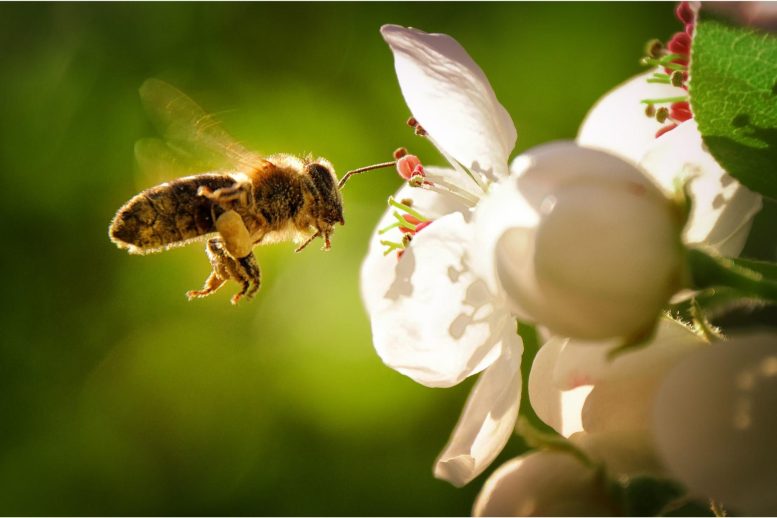
A recent investigation has revealed information about the subterranean microbreweries used by ground-nesting bees.
The microbiomes of cellophane bees, a species known for using cellophane-like materials to construct their subterranean nests and for their vital role as pollinators, have been found by researchers at the University of California, Irvine to be some of the most fermentative among insects. This remarkable discovery adds another layer of intrigue to these fascinating creatures.
According to a study published in Frontiers in Microbiology, cellophane bees “brew” a liquid food for their offspring, held in chambers called brood cells. The microbiome of these brood cells is dominated by lactobacilli bacteria. These bacteria are well-known for their ability to ferment foods such as sauerkraut, sourdough bread, and yogurt.
The researchers found that these bacteria are highly active in the food provisions of cellophane bees, where they likely play an important role as a source of nutrients for developing larvae.
“This discovery is quite remarkable,” said Tobin Hammer, assistant professor of ecology & evolutionary biology and lead author. “We know that lactobacilli are important for the fermentation of food, but finding wild bees that use them essentially the same way was really surprising. Most of the 20,000 species of bees get their nutrition from nectar and pollen, but for these cellophane bees, we suspect that lactobacilli are also really important. They have effectively evolved from herbivores into omnivores.”
The study also found that the food provisions of cellophane bees have much higher bacterial biomass compared to other bee species, matching the unusually fermentative smell that emanates from their brood cells. These uniquely rich, lactobacilli-dominated microbreweries of cellophane bees could have important implications for the health of the bees, as well as for the ecology of the ecosystems in which they live.
Spontaneous Fermentation: A Natural Strategy
“It was intriguing to find that cellophane bees use a strategy called ‘spontaneous fermentation,’ which is how certain fermented foods like sauerkraut are made. Rather than passing on starter cultures from generation to generation, they use wild strains of lactobacilli that are ubiquitous in flowers,” said Hammer. “It suggests that fermentation-based symbioses like this one can evolve without domestication. What makes these bees special is that they’ve figured out how to create a favorable environment in which lactobacilli can grow really well.”
This study highlights the importance of studying the microbiomes of insects, which are often overlooked in favor of more familiar animals like birds and mammals, despite playing an enormous role in ecosystems the world over. By understanding the complex interactions between microbes and their insect hosts, scientists can gain new insights into the biology of these important animals and the ecosystems that they inhabit.
Reference: “Bee breweries: The unusually fermentative, lactobacilli-dominated brood cell microbiomes of cellophane bees” by Tobin J. Hammer, Jordan Kueneman, Magda Argueta-Guzmán, Quinn S. McFrederick, Lady Grant, William Wcislo, Stephen Buchmann and Bryan N. Danforth, 5 April 2023, Frontiers in Microbiology.
DOI: 10.3389/fmicb.2023.1114849
This study was a collaboration between researchers at Cornell University, the Smithsonian Tropical Research Institute, UC Riverside, Colorado State University, and the University of Arizona. The study was funded by the National Science Foundation, the U.S. Department of Agriculture, and the Simons Foundation.
Never miss a breakthrough: Join the SciTechDaily newsletter.
Follow us on Google and Google News.