

We’ve long understood that hosts experience malfunctions in the absence of their microbiome, which can occur due to a lack of certain microbial species or a complete absence of microbes. This phenomenon is often attributed to the essential and beneficial functions that microbes perform. However, evolutionary ecologist Tobin Hammer from the University of California, Irvine, challenges this view.
Rethinking Microbial Benefits
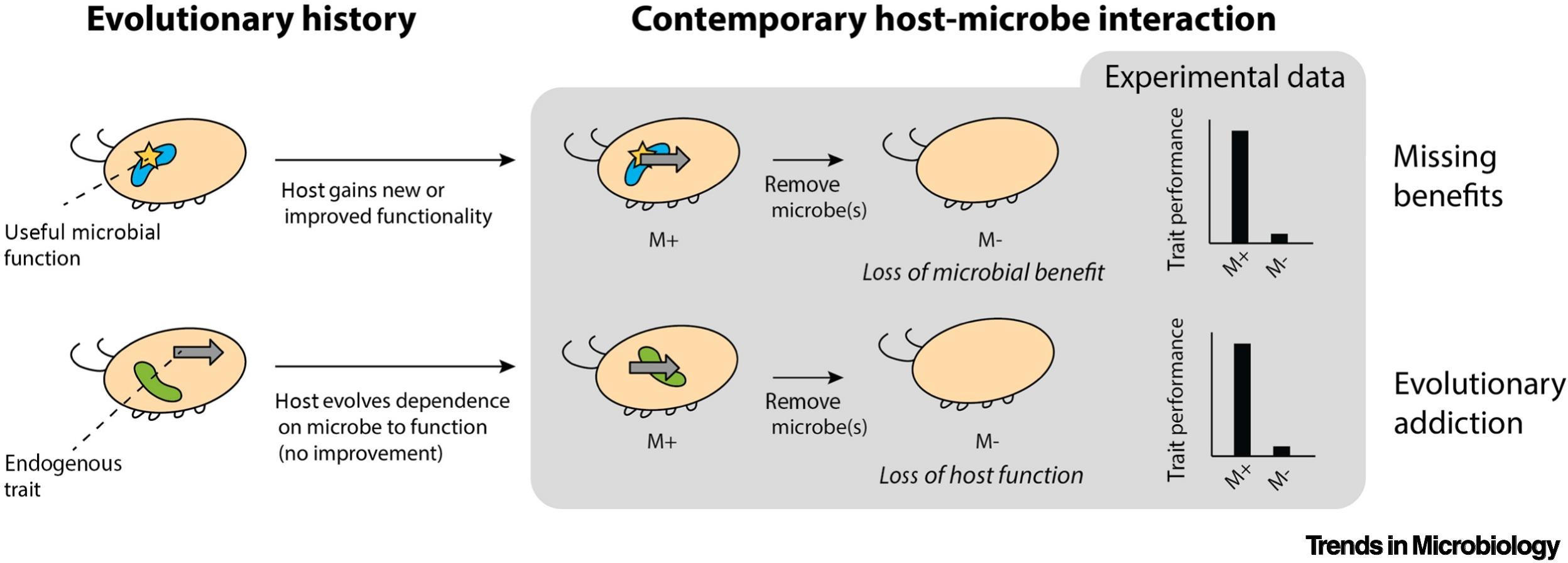
In a peer-reviewed opinion article recently published in the journal Trends in Microbiology, Hammer argues that, in some cases, microbes might not actually be helping their hosts; instead, microbe-free hosts might malfunction because they have evolved an addiction to their microbes. In this case, hosts are dependent on the microbes to function, but the microbes don’t actually provide any benefits in return.
Evolutionary addiction is also sometimes called “evolved dependence,” and it could occur in any host system— from the human gut, to plant roots, to microbes that host other microbes. Hammer compares it to his own dependence on coffee.
“I need coffee to perform basic functions, but I do not perform them any better now than before the addiction began; I need coffee just to get back to normal,” writes Hammer. “The same process can occur with host-microbe symbioses: a dependence evolves without an improvement in functionality.”
Microbial Dependence in Symbiotic Relationships
Though the concept of evolutionary addiction has been discussed in the context of other symbiotic relationships—for example, herbivores and plants as well as parasites and their hosts—it has rarely been considered in the context of the microbiome. Hammer argues that evolutionary addiction should be considered when interpreting microbe-removal experiments because it might have unique implications for the evolution and stability of host-microbe interactions.
“By largely ignoring evolutionary addiction, the microbiome field has missed a plausible and likely common evolutionary explanation for microbially dependent host traits,” writes Hammer. “The host organism is a complex, internally interconnected system, and the absence of a microbe that has been integrated into it, like a cog in a machine, will cause components to malfunction.”
Mechanisms of Evolutionary Addiction
There are several possible ways that a host could become evolutionarily addicted to a microbe. During one pathway, hosts adapt to accommodate and function in the presence of microbes and in the process become dependent on them. This pathway is one explanation for how mammalian immune systems came to be dependent on gut microbes: if, as well as receiving benefits, a host experiences inflammation during the early stages of a symbiotic relationship, it might be selected to have a less-sensitive immune response. In this way, our immune systems have been calibrated to function in the presence of microbes and so their absence causes immune malfunction.
Alternatively, host species could become addicted to microbes that perform a similar function to an existing host trait. In this case, there is less selection pressure on the host to retain that trait, and so the host eventually loses the trait and becomes dependent on the microbe. One such example of evolutionary addiction is the wasp Asobara tabida, which is chronically infected with the bacterial endosymbiont Wolbachia and requires the bacteria in order to produce eggs. Other Asobara species that are not chronically infected with Wolbachia do not need the bacteria to produce eggs, and A. tabida does not have an improved ability to produce eggs because of Wolbachia; having the bacteria simply brings it back to baseline functionality.
Coexistence of Addiction and Benefits
Hammer notes that evolutionary addiction and missing benefits are not mutually exclusive, and in the case of some host-microbe pairs, both mechanisms could be at play. “One process may engender the other,” Hammer writes. “A microbe providing an adaptive function can be expected to spread among hosts, facilitating the subsequent evolution of dependence.”
Knowing whether hosts benefit from their microbes or are evolutionary addicted to them could help us predict the consequences of microbial biodiversity loss. Evolutionary addiction might be reversible in some cases if hosts can adapt to regain the lost function, either through genetic variation within their population or via new mutations. In contrast, if microbe-free hosts malfunction due to missing benefits—for example, a plant host that depends on rhizobia to fix nitrogen, an essential nutrient—then the plant is very unlikely to be able to adapt to losing those microbes because no plant has ever been able to independently fix nitrogen. Hammer notes that more work is needed to test this hypothesis.
“Reversibility matters when we consider disruptions of long-associated microbial symbionts,” Hammer writes. “Which traits, in which hosts, will evolution be able to rescue in the microbes’ absence?”
Reference: “Why do hosts malfunction without microbes? Missing benefits versus evolutionary addiction” by Tobin J. Hammer, 29 August 2023, Trends in Microbiology.
DOI: 10.1016/j.tim.2023.07.012
Never miss a breakthrough: Join the SciTechDaily newsletter.
Follow us on Google and Google News.
1 Comment
I think that to answer the question, we need a careful, strict definition of “addiction,” and an answer to the nature of the evolutionary dependence.