

Close Menu
    Facebook X (Twitter) Instagram
    SciTechDaily
    • Biology
    • Chemistry
    • Earth
    • Health
    • Physics
    • Science
    • Space
    • Technology
    Facebook X (Twitter) Pinterest YouTube RSS
    SciTechDaily
    Home»Earth»Solar-Powered Balloons Detect Mysterious Sounds of Unknown Origins in Earth’s Stratosphere
    Earth

    Solar-Powered Balloons Detect Mysterious Sounds of Unknown Origins in Earth’s Stratosphere

    By Acoustical Society of AmericaMay 12, 20236 Comments3 Mins Read
    Facebook Twitter Pinterest Telegram LinkedIn WhatsApp Email Reddit
    Share
    Facebook Twitter LinkedIn Pinterest Telegram Email Reddit
    Painting Science Balloon Stratosphere
    Daniel Bowman of Sandia National Laboratories uses inexpensive solar-powered hot air balloons to detect unique sounds in the stratosphere, including mysterious infrasound signals with unknown origins. This technology could potentially be used to explore other planets.

    Inexpensive and easy to build, these data-collecting balloons capture low-frequency sound in the Earth’s atmosphere.

    Imagine if sending your science experiment 70,000 ft (21,000 m) in the air just took painter’s plastic, tape, a dash of charcoal dust, and plenty of sunlight.

    Daniel Bowman of Sandia National Laboratories presented his findings on using solar-powered hot air balloons to eavesdrop on stratospheric sounds at the 184th Meeting of the Acoustical Society of America.

    The stratosphere — the second layer of the atmosphere of Earth, located above the troposphere and below the mesosphere — is a relatively calm layer of Earth’s atmosphere. Rarely disturbed by planes or turbulence, microphones in the stratosphere pick up a variety of sounds unheard anywhere else. This includes natural sounds from colliding ocean waves and thunder, human-created sounds like wind turbines or explosions, and even sounds with unknown origins.
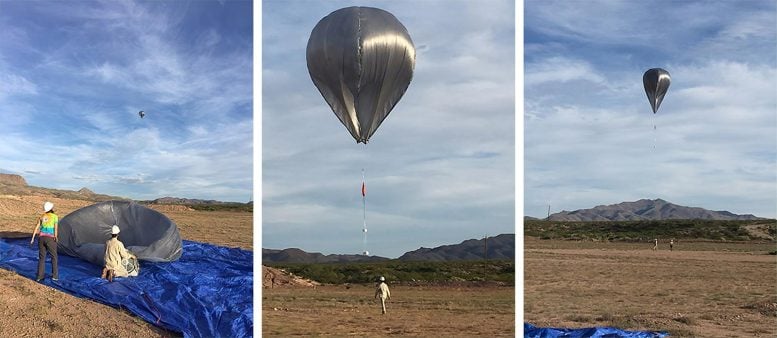
    Solar Hot Air Balloon With Infrasound Microbarometer Payload
    Inflating a solar hot air balloon with an infrasound microbarometer payload. Credit: Darielle Dexheimer, Sandia National Laboratories

    Innovative and Cost-Effective Balloon Design

    To reach the stratosphere, Bowman and his collaborators build balloons that span 6 to 7 meters (20 to 23 feet) across. Despite their large size and data collection capability, the balloons are relatively simple.

    “Our balloons are basically giant plastic bags with some charcoal dust on the inside to make them dark. We build them using painter’s plastic from the hardware store, shipping tape, and charcoal powder from pyrotechnic supply stores. When the sun shines on the dark balloons, the air inside heats up and becomes buoyant. This passive solar power is enough to bring the balloons from the surface to over 20 km (66,000 ft) in the sky,” said Bowman. “Each balloon only needs about $50 worth of materials and can be built in a basketball court.”

    The researchers collect data and detect low-frequency sound with microbarometers, which were originally designed to monitor volcanoes. After releasing the balloons, they track their routes using GPS – a necessary task since the balloons sometimes sail for hundreds of miles and land in hard-to-reach places. But, because the balloons are inexpensive and easy to construct and launch, they can release a lot of balloons and collect more data.

    Along with the expected human and environmental sounds, Bowman and his team detected something they are not able to identify.

    “[In the stratosphere,] there are mysterious infrasound signals that occur a few times per hour on some flights, but the source of these is completely unknown,” said Bowman.

    Solar-powered balloons could also help explore other planets, such as observing Venus’ seismic and volcanic activity through its thick atmosphere.

    Meeting: ASA 184th Meeting

    Never miss a breakthrough: Join the SciTechDaily newsletter.
    Follow us on Google and Google News.

    Acoustical Society of America Acoustics Atmospheric Science Popular
    Share. Facebook Twitter Pinterest LinkedIn Email Reddit

    Related Articles

    Massive Hunga Volcano Eruption Created an Atmospheric Pulse That Caused an Unusual Tsunami-Like Disturbance

    2.2 Billion-Year-Old Impact Crater in Australia – Asteroid Strike May Have Ended Snowball Earth

    Reports of Huge Reductions in This Potent Greenhouse Gas Are Wrong – Emissions Are Soaring

    Icebergs as a Source of Nutrients – Climate Change Could Lead to More Iron Fertilization

    Global Food Production at Risk From Large Atmospheric Waves in the Jet Stream

    Scientists Warn: Nine Climate Tipping Points Now ‘Active’ – Could Threaten the Existence of Human Civilization

    2017 Ozone Hole is the Smallest Since 1988

    Tropical Forests May Be Absorbing More Carbon Dioxide Than Previously Thought

    Melting Arctic Ice May Lead to Severe Weather Changes

    6 Comments

    1. Andreas on May 12, 2023 12:08 pm

      I think that the sound can came from the baloon.

      Reply
    2. Bob on May 12, 2023 12:32 pm

      the pyramids are using sound waves to not only transmit our location,but also as a power house to energize portals. Hmmmmm,how about that.The more they dig out the Bosnia pyramids the more energized they are becomming. Unfortunately this system is now obsolete,its a proven fact that sound waves can be modulated to travel faster the light speed

      Reply
      • CW on May 12, 2023 6:52 pm

        Bob, you are something special indeed

        Reply
    3. CW on May 12, 2023 6:53 pm

      Bob – you are something special indeed. I’m going to don my tinfoil hat ASAP.

      Reply
    4. Albert on May 13, 2023 6:50 pm

      It still sounds like sounds of movements of the materials of the balloon to me. Just because it’s in the low infrasonic range doesn’t mean it’s not coming from the balloon itself, just lower/slower movements of the material that are not in the human hearing range. I don’t know why that would be that big of a surprise given the winds moving the balloon around in the Stratosphere.

      Reply
    5. Konstantin ZIOUTAS on May 15, 2023 11:52 pm

      I would like to have the pdf file of the publication in
      J. amer. acoustical society
      THANKS in advance

      Reply
    Leave A Reply Cancel Reply

    • Facebook
    • Twitter
    • Pinterest
    • YouTube

    Don't Miss a Discovery

    Subscribe for the Latest in Science & Tech!

    Trending News

    Millions Take These IBS Drugs, But a New Study Finds Serious Risks

    Scientists Unlock Hidden Secrets of 2,300-Year-Old Mummies Using Cutting-Edge CT Scanner

    Bread Might Be Making You Gain Weight Even Without Eating More Calories

    Scientists Discover Massive Magma Reservoir Beneath Tuscany

    Europe’s Most Active Volcano Just Got Stranger – Here’s Why Scientists Are Rethinking It

    Alzheimer’s Symptoms May Start Outside the Brain, Study Finds

    Millions Take This Popular Supplement – Scientists Discover a Concerning Link to Heart Failure

    The Universe Is Expanding Too Fast and Scientists Can’t Explain Why

    Follow SciTechDaily
    • Facebook
    • Twitter
    • YouTube
    • Pinterest
    • Newsletter
    • RSS
    SciTech News
    • Biology News
    • Chemistry News
    • Earth News
    • Health News
    • Physics News
    • Science News
    • Space News
    • Technology News
    Recent Posts
    • Simple Blood Test May Predict Alzheimer’s Years Before Brain Scans Show Signs
    • Scientists Say Adding This Unusual Seafood to Your Diet Could Reverse Signs of Aging
    • U.S. Waste Holds $5.7 Billion Worth of Crop Nutrients
    • Scientists Say a Hidden Structure May Exist Inside Earth’s Core
    • Doctors Surprised by the Power of a Simple Drug Against Colon Cancer
    Copyright © 1998 - 2026 SciTechDaily. All Rights Reserved.
    • Science News
    • About
    • Contact
    • Editorial Board
    • Privacy Policy
    • Terms of Use

    Type above and press Enter to search. Press Esc to cancel.