
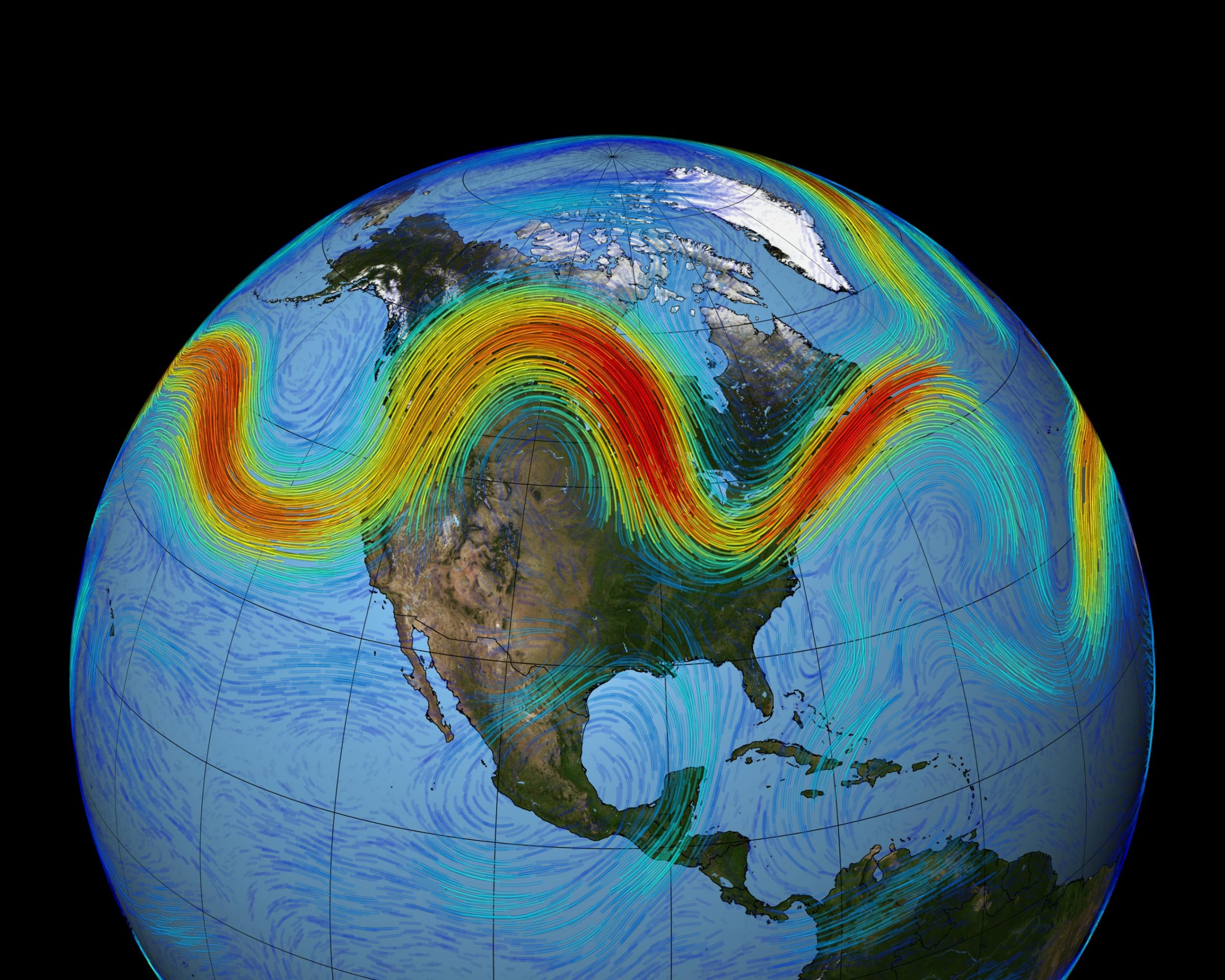
In a new study published today (December 9, 2019) in Nature Climate Change, scientists show how specific wave patterns in the jet stream strongly increase the chance of co-occurring heatwaves in major food-producing regions of Northern America, Western Europe, and Asia. Their research finds that these simultaneous heatwaves significantly reduce crop production across those regions, creating the risk of multiple harvest failures and other far-reaching societal consequences, including social unrest.
Lead author, Dr. Kai Kornhuber from the University of Oxford’s Department of Physics and Colombia University’s Earth Institute, said: ‘Co-occurring heatwaves will become more severe in the coming decades if greenhouse gases are not mitigated. In an interconnected world, this can lead to food price spikes and have impacts on food availability even in remote regions not directly affected by heatwaves.
‘We found a 20-fold increase in the risk of simultaneous heatwaves in major crop-producing regions when these global-scale wind patterns are in place. Until now this was an underexplored vulnerability in the food system. We have found that during these events there actually is a global structure in the otherwise quite chaotic circulation. The bell can ring in multiple regions at once and the impacts of those specific interconnections were not quantified previously.’
Meandering around the planet like a rollicking roller coaster in the sky, the Northern Hemisphere’s polar jet stream is a fast-moving belt of westerly winds that traverses the lower layers of the atmosphere. The jet is created by the convergence of cold air masses descending from the Arctic and rising warm air from the tropics. Deep troughs and steep ridges emerge as the denser cold air sinks and deflects warm air regions north, giving the jet stream its wavy appearance. This pattern propagates across the mid-latitudes of North America, Europe, and Asia, as pockets of cold air sporadically creep down from the Arctic — creating contrasting waves and flows that accelerate eastward due to Earth’s rotation. Credit: NASA’s Goddard Space Flight Center
Western North America, Western Europe, and the Caspian Sea region are particularly susceptible to these atmospheric patterns that get heat and drought locked into one place simultaneously where they then affect crop production yields.
Dr. Dim Coumou, a co-author from the Institute for Environmental Studies at VU Amsterdam, said: ‘Normally low harvests in one region are expected to be balanced out by good harvests elsewhere but these waves can cause reduced harvests in several important breadbaskets simultaneously, creating risks for global food production.’
Dr. Elisabeth Vogel, a co-author from Melbourne University, said: ‘During years in which two or more summer weeks featured the amplified wave pattern, cereal crop production was reduced by more than 10% in individual regions, and by 4% when averaged across all crop regions affected by the pattern.’
Dr. Radley Horton, a co-author from the Lamont-Doherty Earth Observatory at Colombia University, said: ‘If climate models are unable to reproduce these wave patterns, risk managers such as reinsurers and food security experts may face a blind spot when assessing how simultaneous heatwaves and their impacts could change in a warming climate.’
The scientists conclude that a thorough understanding of what drives this jet stream behavior could ultimately improve seasonal predictions of agricultural production at the global scale and inform risk assessments of harvest failures across multiple food-producing regions.
Reference: “Amplified Rossby waves enhance risk of concurrent heatwaves in major breadbasket regions” by Kai Kornhuber, Dim Coumou, Elisabeth Vogel, Corey Lesk, Jonathan F. Donges, Jascha Lehmann and Radley M. Horton, 9 December 2019, Nature Climate Change.
DOI: 10.1038/s41558-019-0637-z
Never miss a breakthrough: Join the SciTechDaily newsletter.
Follow us on Google and Google News.
1 Comment
Many thanks to you.