
Researchers at the University of Toronto have designed advanced membranes with embedded particles that extract ammonium and phosphate from wastewater.
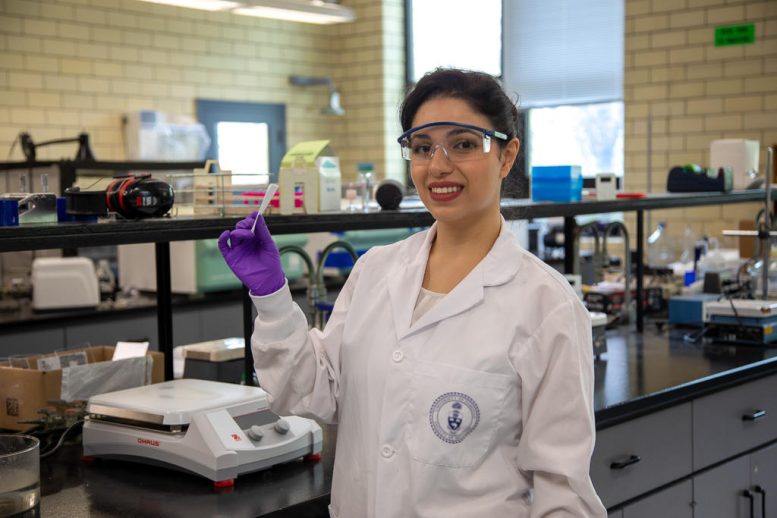
University of Toronto Engineering Ph.D. candidate Sara Abu-Obaid (ChemE) believes that a fundamental shift is overdue in the wastewater management sector.
“We need to move from seeing wastewater as a nuisance to recognizing its potential as a resource,” she says. “It can provide us with water, nutrients, energy, and other things of value that can be harvested and utilized to move toward a circular economy.”
Under the guidance of Professor Ramin Farnood (ChemE), Abu-Obaid is the lead of author of a study recently published in the journal Chemical Engineering. This research presents an eco-friendly method for extracting phosphate and ammonium from wastewater, while also enabling the reuse of these nutrients in the future.
Her new method uses advanced membranes incorporating inorganic particles for the uptake of phosphate and ammonium from wastewater. By recovering these substances in a cost-effective way, the method creates a new source of materials that can be used by manufacturers of agricultural fertilizers.
Wastewater’s Untapped Potential for Fertilizer Production
Used water from bathing, toileting, laundry, and other sources flows down drains to sewers that lead to wastewater treatment plants, where it is cleaned so it can be safely discharged into nature without impacting the environment.
The key objectives of the treatment process include removing solids, organic matter, pathogens, and nutrients, such as those that derive from household products and excreta — waste matter discharged from the body. Among these nutrients are phosphate and ammonium, two essential ingredients in agricultural fertilizers.
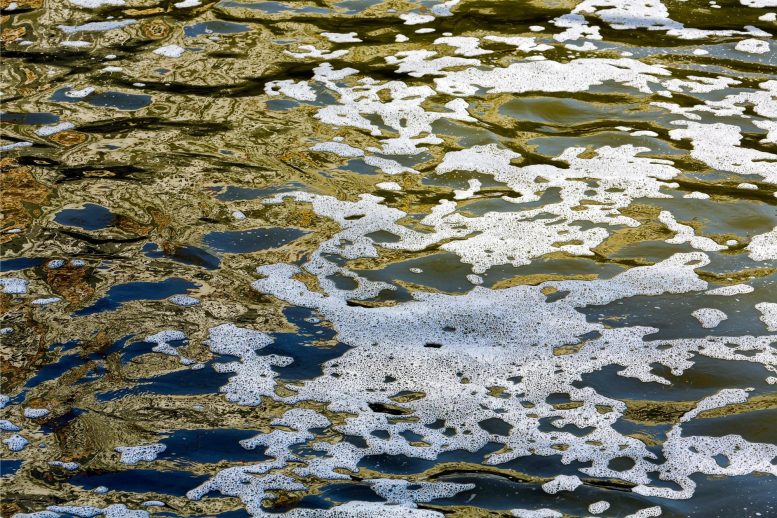
While phosphorous is essential for thriving plant life, too much of the chemical can cause eutrophication. This complex process begins when an environment becomes overly enriched by nutrients, leading to an explosion in the growth of algae. These harmful algae blooms deplete the availability of oxygen in the water, creating ‘dead zones’ where aquatic organisms suffocate. Long-term exposure to ammonium can also be toxic to aquatic life.
Current wastewater treatment facilities have established processes for removing phosphate and ammonium during the treatment process. Typically, a chemical treatment converts the phosphate into a solid form that settles at the bottom of the water, where it is then collected as sludge and sent to a landfill. Ammonium is traditionally removed using biological treatment, where bacteria consume it and turn it into nitrate and then to nitrogen gas.
“These are two high-value products that are key ingredients in fertilizers, but current wastewater treatment processes treat these nutrients as waste,” says Abu-Obaid.
“My solution is to extract the nutrients from the water completely, and so it can be used as a source for fertilizer production.”
Many scientists have warned that the current rate of agricultural phosphorus consumption could lead to critical shortages, which would disrupt food supplies globally. Abu-Obaid’s new method could help boost supply by turning wastewater into a viable source of these nutrients.
Innovative Membrane Technology for Phosphate and Ammonium Extraction
While many membranes used for water filtration rely on carefully designed pores to filter their target substances out of the water, Abu-Obaid’s approach is different. Her membrane contains tiny particles made of akaganeite and zeolite 13X with high affinities for phosphate and ammonium adsorption.
“We’re not removing the things that we want to remove through size exclusion or by applying large pressures,” says Abu-Obaid. “Rather, it is the particles within the membrane that are doing the removal, and it’s the membrane’s job to hold them in place.”
While the particles could do the job on their own, Abu-Obaid says that the difficulty would lie in removing them from the wastewater and fear of them leaching. Using a membrane to hold them in place opens up the possibility of a two-phase operation: first, the particles adsorb ammonium and phosphate from the wastewater, then the membranes are washed using a sodium hydroxide solution to simultaneously recover the nutrients and regenerate the particles.
In the study, the membranes were able to capture phosphate and ammonium ions under dynamic water flow conditions, resulting in the removal of 84% of ammonium and 100% of phosphate from synthetic wastewater — even in the presence of other competing ions.
While Abu-Obaid believes that her experiments have shown the method to have great potential for this application, she sees a need for further studies to investigate design considerations for the large-scale application of such systems.
Scaling Up for Sustainability
“This is a non-traditional use of membrane technology, which is more commonly used for size-exclusion type filtration,” she says.
“It can also be challenging to justify why we are using this technology to recover nutrients that are not yet so scarce that current supply chains are threatened. But we believe that we can benefit from being ahead of the issue and establishing potential sustainable sources for the future.”
Until then, Abu-Obaid hopes that this new solution, along with other innovative technologies to recover nutrients from wastewater, can gain more support.
“We need further techno-economical studies, long-term stability, and pilot studies to demonstrate the utility of this technology for creating a more sustainable future for wastewater management,” she says.
Reference: “Adsorptive membranes for nutrient recovery from wastewater: A novel solution for water purification challenges” by Sara Abu-Obaid, Shahram Tabe, Mohtada Sadrzadeh and Ramin R. Farnood, 18 April 2023, Chemical Engineering Journal.
DOI: 10.1016/j.cej.2023.143057
Never miss a breakthrough: Join the SciTechDaily newsletter.
Follow us on Google and Google News.
1 Comment
Need to learn more