
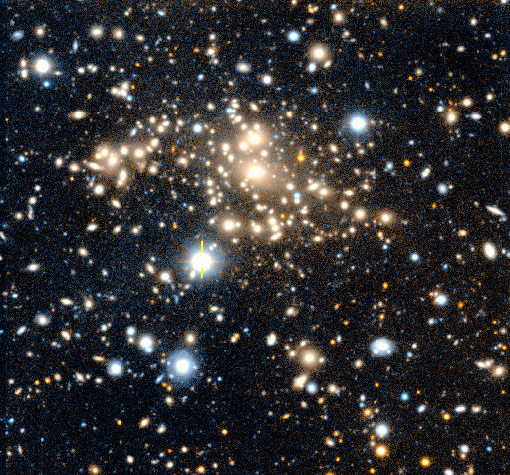
Using gravitational lensing, astronomers from the Harvard-Smithsonian Center for Astrophysics measured the spectra of carbon, nitrogen, carbon monoxide, and water in a galaxy seen a mere 800 million years after the big bang.
About fifteen years ago astronomers, using improved submillimeter wavelength telescopes, discovered a new class of very distant galaxies: submillimeter galaxies (SMGs). These objects are among the most luminous, rapidly star-forming galaxies known, and can shine brighter than a trillion Suns (about one hundred times more luminous than the Milky Way), but they are undetected in the visible. Their ultraviolet and optical light is absorbed by dust in the galaxies which is warmed and then emits in the submillimeter. SMGs are typically so distant that their light has been traveling for over ten billion years, more than 70% of the lifetime of the universe. Their power source is thought to be star formation, with some having rates as high as one thousand stars per year (in the Milky Way, the rate is more like a few stars per year), although the cause of such dramatic bursts is not understood.
Atomic and molecular lines are particularly important diagnostics of star formation, black hole activity, and interstellar gas properties. Furthermore, the shapes of the emission lines provide direct insights into the dynamics of the system. The observed far-infrared and submillimeter spectra of SMGs is dominated by such emission lines because the gas in their molecular clouds, as well as the dust, is exposed to ultraviolet flux from nearby young stars that stimulates the gas to glow.
A team of scientists including CfA astronomers Shane Bussmann, Mark Gurwell, and Giovanni Fazio wanted to study the energetics in the most distant SMGs possible in order to learn whether the processes at work during early times in the universe were similar to those currently dominant. They used the Submillimeter Array (and another facility) to measure the spectra of carbon, nitrogen, carbon monoxide, and water in a galaxy seen a mere 800 million years after the Big Bang. This object is so far away that even though it is among the most luminous SMGs known its light would normally be too faint to detect with the SMA. However, it was selected in part because it lies directly behind a massive foreground cluster of galaxies (only a few billion light-years away) whose gravity acts like a humongous lens to magnify the more distant galaxy.
The team not only detected these lines, but were able to identify at least three distinct components within them, revealing what appear to be two merging galaxies, one of them with two regions of star formation near its nucleus. The analysis indicates that surprisingly, although extraordinarily luminous, this merging system appears to have star formation activity that in character (if not in quantity) closely resembles that in normal star formation in the local universe. The results are another step in our understanding of the early universe, as well as a demonstration of the remarkable power of gravitationally lensed systems.
Reference: “[CII] and 12CO(1-0) Emission Maps in HLSJ091828.6+514223: A Strongly Lensed Interacting System at z=5.24″ by T. D. Rawle, E. Egami, R. S. Bussmann, M. Gurwell, R. J. Ivison, F. Boone, F. Combes, A. L. R. Danielson, M. Rex, J. Richard, I. Smail, A. M. Swinbank, B. Altieri, A. W. Blain, B. Clement, M. Dessauges-Zavadsky, A. C. Edge, G. G. Fazio, T. Jones, J.-P. Kneib, A. Omont, P. G. Pérez-González, D. Schaerer, I. Valtchanov, P. P. van der Werf, G. Walth, M. Zamojski and M. Zemcov, 13 February 2014, The Astrophysical Journal.
DOI: 10.1088/0004-637X/783/1/59
arXiv:1310.4090
Never miss a breakthrough: Join the SciTechDaily newsletter.
Follow us on Google and Google News.