
Close Menu
    Facebook X (Twitter) Instagram
    SciTechDaily
    • Biology
    • Chemistry
    • Earth
    • Health
    • Physics
    • Science
    • Space
    • Technology
    Facebook X (Twitter) Pinterest YouTube RSS
    SciTechDaily
    Home»Space»Astronomers Detect Time Delays between Flaring Events in a Quasar
    Space

    Astronomers Detect Time Delays between Flaring Events in a Quasar

    By Harvard-Smithsonian Center for AstrophysicsDecember 1, 2015No Comments3 Mins Read
    Facebook Twitter Pinterest Telegram LinkedIn WhatsApp Email Reddit
    Share
    Facebook Twitter LinkedIn Pinterest Telegram Email Reddit
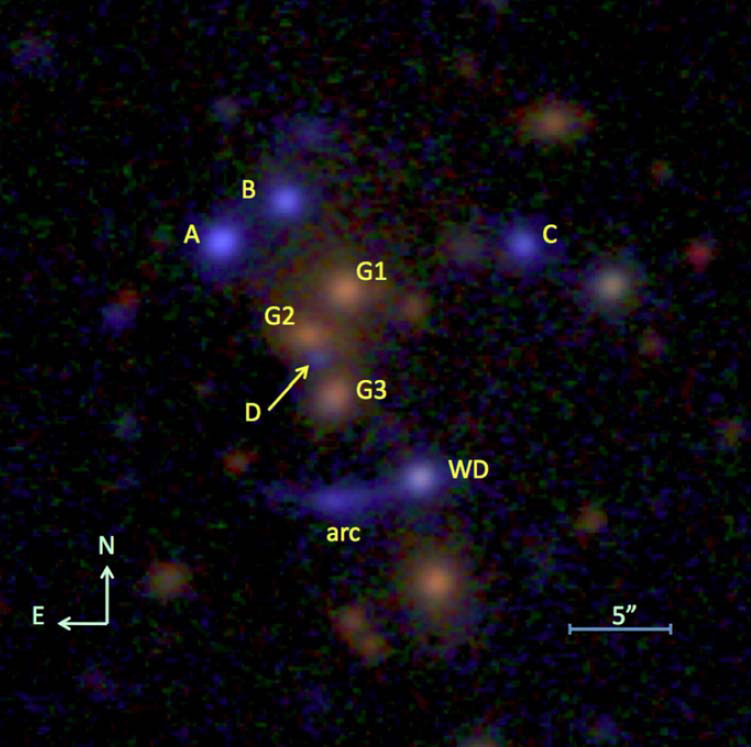
    The Quintuple Quasar SDSSJ1029+2623
    The quintuple quasar SDSSJ1029+2623 as seen in the visible. Four of these quasar images are labeled A-D; the other two images are obscured in this figure by the foreground galaxies G1-G3 (an arc produced by the lens can also be seen). Credit: Dahle and the Nordic Optical telescope

    The Quintuple Quasar SDSSJ1029+2623 has been gravitationally imaged by an intervening cluster of galaxies. Astronomers have detected time delays between flaring events in the quasar, the result of the light in different images traveling along different paths in space.

    Quasars are galaxies with massive black holes at their cores around which vast amounts of energy are being radiated. Indeed, so much light is emitted that the nucleus of a quasar is much brighter than the rest of the entire host galaxy, and their tremendous luminosities allow quasars to be seen even when they are very far away. The quasar SDSSJ1029+2623, for example, is so distant that its light has been traveling towards us for 11.4 billion years, 83% of the age of the universe. This quasar is particularly unusual because it happens to have five quasar neighbors in the sky that look very similar to it and moreover are located at the same cosmological distance.

    SDSSJ1029+2623 is actually a gravitationally lensed quasar. Its light is being magnified and distorted by the gravity of a cluster of galaxies fortuitously lying between us, in accordance with Einstein’s prediction that light can be bent by gravity. Only a few other quasars being gravitationally lensed into multiple images by clusters are known. Over fifty years ago, astronomers predicted that in such cases, because the light from each image travels along a different cosmological path, any time delays between flaring events in the images can be used to probe underlying cosmological parameters such as the age and rate of expansion of the universe. Moreover, these delays can also probe the surface density distribution of the lens. Such delays have now been detected, with the longest delays being of the order of a few years. In the case when individual galaxies (not clusters of galaxies) act as lenses, the time delays are more often weeks or months.

    CfA astronomer Matthew Bayliss and four of his colleagues undertook a campaign to monitor the time delays in the images of SDSSJ1029+2623 using the 2.56-meter (8.4-foot) Nordic Optical Telescope in the Canary Islands, Spain. Over three years of systematic observations they found a delay of 722 days between the image whose light is predicted to arrive first (“image C”) and the component that is brightest, and a 47.7-day delay between the two brightest components. Fortuitously, during this period image C underwent a sharp flux increase, and models predict that this event should be spotted in the other five images in the next few years. The data are not quite good enough to refine any cosmological parameters, at least not yet, but the team is continuing close monitoring of the quasar and hopes to determine with precision the timing delays in all six components over the next few observing seasons.

    Reference: Time Delay Measurements for the Cluster-lensed Sextuple Quasar SDSS J2222+2745″ by H. Dahle, M. D. Gladders, K. Sharon, M. B. Bayliss and J. R. Rigby, 29 October 2015, The Astrophysical Journal.
    arXiv:1505.06187
    DOI: 10.1088/0004-637X/813/1/67

    Never miss a breakthrough: Join the SciTechDaily newsletter.
    Follow us on Google and Google News.

    Astronomy Astrophysics Gravitational Lensing Harvard-Smithsonian Center for Astrophysics Quasars
    Share. Facebook Twitter Pinterest LinkedIn Email Reddit

    Related Articles

    Gravitational Lensing and Quasars: New Method Measures Galaxy Mass 3 Times More Precisely

    Astronomers Use “X-Ray Magnifying Glass” To Enhance View of Distant Black Holes

    Massive X-ray Jet – Extending for 160,000 Light-Years – Spied From Supermassive Black Hole in Early Universe

    Puzzling Astrophysics of Quasars in the Early Universe

    Astronomers Discover Distant Radio Galaxies via Gravitational Lensing

    NuSTAR Reveals the Active Galactic Nucleus of a Quasar

    Distant Galaxy Seen As It Was 800 Million Years After The Big Bang

    Astronomers Record Detailed Measurements of the Inner Region of a Quasar Nucleus

    Quasars Acting as Gravitational Lenses Viewed by Hubble

    Leave A Reply Cancel Reply

    • Facebook
    • Twitter
    • Pinterest
    • YouTube

    Don't Miss a Discovery

    Subscribe for the Latest in Science & Tech!

    Trending News

    Artificial Sweeteners May Harm Future Generations, Study Suggests

    Splashdown! NASA Artemis II Returns From Record-Breaking Moon Mission

    What If Consciousness Exists Beyond Your Brain

    Scientists Finally Crack the 100-Million-Year Evolutionary Mystery of Squid and Cuttlefish

    Beyond “Safe Levels”: Study Challenges What We Know About Pesticides and Cancer

    Researchers Have Found a Dietary Compound That Increases Longevity

    Scientists Baffled by Bizarre “Living Fossil” From 275 Million Years Ago

    Your IQ at 23 Could Predict Your Wealth at 27, Study Finds

    Follow SciTechDaily
    • Facebook
    • Twitter
    • YouTube
    • Pinterest
    • Newsletter
    • RSS
    SciTech News
    • Biology News
    • Chemistry News
    • Earth News
    • Health News
    • Physics News
    • Science News
    • Space News
    • Technology News
    Recent Posts
    • What if Dark Matter Has Two Forms? Bold New Hypothesis Could Explain a Cosmic Mystery
    • Researchers Expose Hidden Chemistry of “Ore-Forming” Elements in Biology
    • Geologists Reveal the Americas Collided Earlier Than We Thought
    • 20x Difference: Study Reveals True Source of Airborne Microplastics
    • Scientists Uncover Hidden Force Powering Yellowstone’s Supervolcano
    Copyright © 1998 - 2026 SciTechDaily. All Rights Reserved.
    • Science News
    • About
    • Contact
    • Editorial Board
    • Privacy Policy
    • Terms of Use

    Type above and press Enter to search. Press Esc to cancel.