
Close Menu
    Facebook X (Twitter) Instagram
    SciTechDaily
    • Biology
    • Chemistry
    • Earth
    • Health
    • Physics
    • Science
    • Space
    • Technology
    Facebook X (Twitter) Pinterest YouTube RSS
    SciTechDaily
    Home»Biology»“Hightech” Materials From Nature – Researchers Discover Surprising Properties of the Cytoskeleton
    Biology

    “Hightech” Materials From Nature – Researchers Discover Surprising Properties of the Cytoskeleton

    By University of GöttingenJuly 15, 2023No Comments3 Mins Read
    Facebook Twitter Pinterest Telegram LinkedIn WhatsApp Email Reddit
    Share
    Facebook Twitter LinkedIn Pinterest Telegram Email Reddit
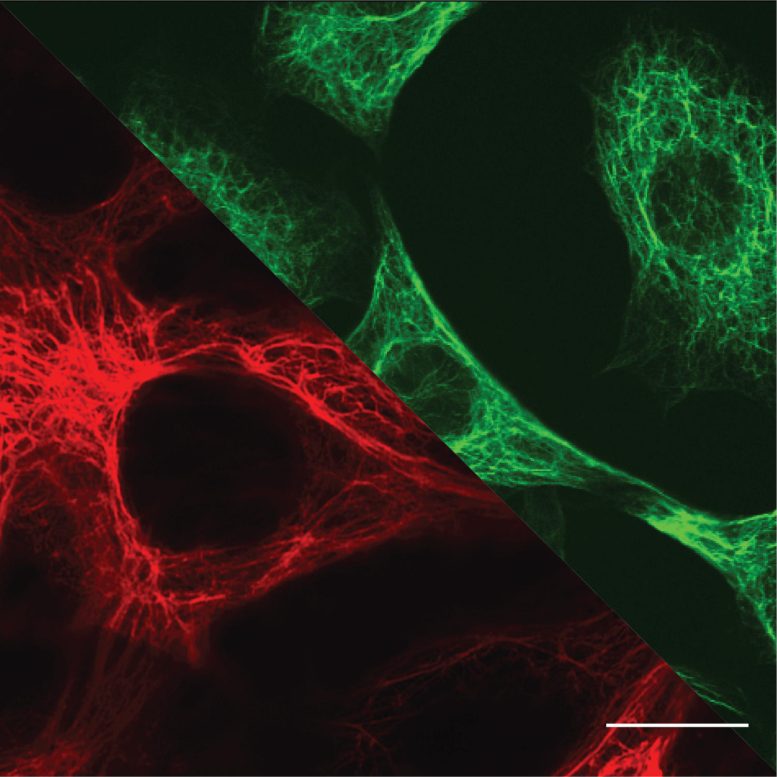
    Microscopy Images of Biological Cells
    Microscopy images of biological cells: top right (green) – Vimentin intermediate filaments in fibroblasts; bottom left (red) – Keratin intermediate filaments in epithelial cells. Scale: 10 µm. Credit: top right (green): Ulrike Rölleke. bottom left (red): Ruth Meyer

    Göttingen University Researchers Discover Surprising Properties of the Cytoskeleton

    Most biological cells have a fixed place in an organism. However, there are instances where these cells acquire mobility, enabling them to traverse the body. Such occurrences are seen during processes like wound recovery, or when cancerous cells divide indiscriminately and spread throughout the body. The characteristics of mobile and stationary cells exhibit several differences, one notable one being the structure of their cytoskeleton.

    This structure of protein filaments makes the cells stable, stretchable, and resistant to external forces. In this context, “intermediate filaments” play an important role. Interestingly, two different types of intermediate filaments are found in mobile and stationary cells. Researchers at the University of Göttingen and ETH Zurich have succeeded in precisely measuring and describing the mechanical properties of the two filaments. In the process, they discovered parallels with non-biological materials. The results have been published in the journal Matter.

    The scientists used optical tweezers to investigate how the filaments behave under tension. They attached the ends of the filaments to tiny plastic beads, which they then moved in a controlled way with the help of a laser beam. This stretched the two different types of filaments, which are known as vimentin and keratin. The researchers worked out which forces were necessary for the stretching and how the different filaments behaved when they were stretched several times.

    Surprisingly, the two different filaments behave in contrasting ways when repeatedly stretched: vimentin filaments become softer and retain their length, keratin filaments become longer and retain their stiffness.

    Parallels Between Biological and Non-Biological Materials

    The experimental results match computer simulations of molecular interactions: in vimentin filaments, the researchers assume that structures open up, similar to gels made of several components; in keratin filaments, they assume that structures shift against each other, as in metals. Both mechanisms explain that the networks of intermediate filaments in the cytoskeleton can be deformed very strongly without being damaged. However, this protective factor is explained by fundamentally different physical principles.

    “These results extend our understanding of why different cell types have such different mechanical properties,” explains Dr Charlotta Lorenz, first author of the study. Professor Sarah Köster, from Göttingen University’s Institute of X-Ray Physics and leader of the study, adds: “We can learn from nature and think about the design of new, sustainable and transformable materials whose properties can be chosen or designed to fit the requirements exactly.”

    Reference: “Keratin filament mechanics and energy dissipation are determined by metal-like plasticity” by Charlotta Lorenz, Johanna Forsting, Robert W. Style, Stefan Klumpp and Sarah Köster, 22 May 2023, Matter.
    DOI: 10.1016/j.matt.2023.04.014

    Never miss a breakthrough: Join the SciTechDaily newsletter.
    Follow us on Google and Google News.

    Biophysics Cell Biology Cells ETH Zurich University of Göttingen
    Share. Facebook Twitter Pinterest LinkedIn Email Reddit

    Related Articles

    When Cells Get Stressed, They Create Mesmerizing Growth Patterns

    Challenging Biologists’ Understanding: New Research Suggests Cells Possess Secret Communication System

    How Our Cells Kill Themselves – Scientists Decode the Exact Mechanism at the Atomic Level

    New Findings Explain Long-Standing, Baffling Cell Mystery

    Researchers Decipher the Structure of the MHC-I Peptide-Loading Complex

    Laminin Alpha 5 is Crucial to Adolescent Brain Maturation

    Scientists Discover Genes for a Longer, Healthier Life

    Chemical Model Shows How First Life Forms Might Have Packaged RNA

    Optogenetics Regulates Metabolic Activity in the Membranes of Cells

    Leave A Reply Cancel Reply

    • Facebook
    • Twitter
    • Pinterest
    • YouTube

    Don't Miss a Discovery

    Subscribe for the Latest in Science & Tech!

    Trending News

    Scientists Discover How Coffee Impacts Memory, Mood, and Gut Health

    Why Did the Neanderthals Disappear? Scientists Reveal Humans Had a Hidden Advantage

    Physicists Propose Strange Experiment Where Time Goes Quantum

    Magnesium Magic: New Drug Melts Fat Even on a High-Fat, High-Sugar Diet

    Weight-Loss Drugs Like Ozempic May Come With an Unexpected Cost

    Mezcal “Worm” in a Bottle Mystery: DNA Testing Reveals a Surprise

    New Research Reveals That Your Morning Coffee Activates an Ancient Longevity Switch

    This Is What Makes You Irresistible to Mosquitoes

    Follow SciTechDaily
    • Facebook
    • Twitter
    • YouTube
    • Pinterest
    • Newsletter
    • RSS
    SciTech News
    • Biology News
    • Chemistry News
    • Earth News
    • Health News
    • Physics News
    • Science News
    • Space News
    • Technology News
    Recent Posts
    • Quantum Breakthrough Turns Simple Forces Into Powerful New Interactions
    • Blue Origin’s New Moon Lander Passes a Crucial Test for NASA Missions
    • NASA Fires Up Record-Breaking Plasma Thruster for Future Mars Missions
    • This Popular Supplement May Boost Your Brain, Not Just Your Muscles
    • What Happened in Childhood Could Be Causing Your Gut Issues Today
    Copyright © 1998 - 2026 SciTechDaily. All Rights Reserved.
    • Science News
    • About
    • Contact
    • Editorial Board
    • Privacy Policy
    • Terms of Use

    Type above and press Enter to search. Press Esc to cancel.