
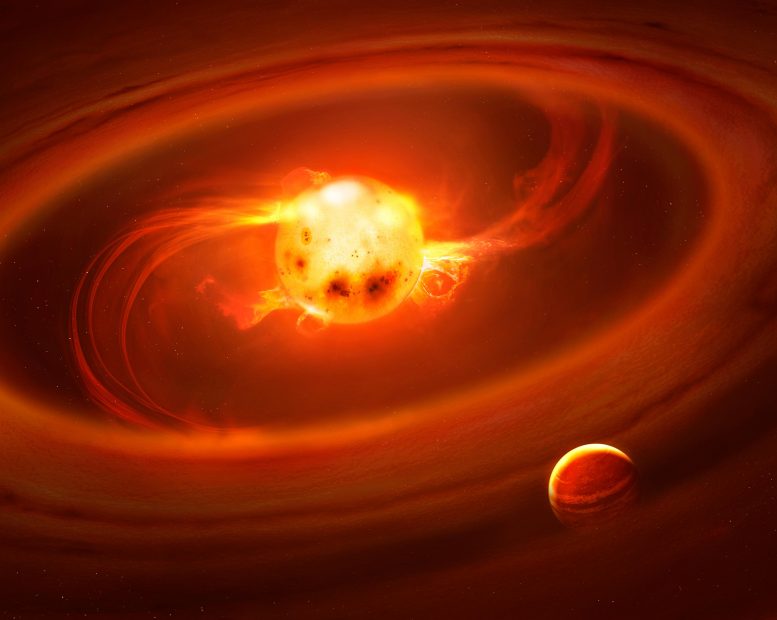
Researchers from The Ohio State University have discovered unusually strong magnetic fields in some stars, challenging current star evolution models. This potentially impacts the habitability of nearby exoplanets and could provide valuable insights into the search for extraterrestrial life.
Unexpectedly Strong Magnetic Fields in Stars
Astronomers have uncovered evidence suggesting that some stars possess surprisingly potent surface magnetic fields. This finding defies the prevailing models of star evolution.
In stars resembling our sun, surface magnetism relates to stellar spin, a process akin to the mechanics of a hand-cranked flashlight. Strong magnetic fields emerge in magnetic sunspot regions, triggering various space weather phenomena. Until now, it was believed that low-mass stars – celestial bodies with less mass than our sun, capable of rotating either very rapidly or relatively slowly – demonstrated minimal magnetic activity. This assumption positioned them as ideal host stars for potentially habitable planets.
Unraveling the Mystery of Magnetic Fields in Low-mass Stars
A new study, published on July 17 in The Astrophysical Journal Letters presents a new perspective. Researchers from The Ohio State University propose that a novel internal mechanism, termed core-envelope decoupling, could amplify the magnetic fields on cool stars. When a star’s surface and core initially spin at the same rate and subsequently drift apart, this mechanism may potentially intensify their radiation for billions of years. Such a phenomenon could impact the habitability of nearby exoplanets.
The study was made possible by a technique devised earlier this year by Lyra Cao, the study’s lead author and a graduate student in astronomy at Ohio State, and co-author Marc Pinsonneault, a professor of astronomy at Ohio State. The technique aids in creating and characterizing starspot and magnetic field measurements.
Challenging Previous Understandings of Stellar Physics
Despite low-mass stars being the most common stars in the Milky Way and frequent hosts to exoplanets, scientists have limited knowledge about them, according to Cao.
For decades, it was presumed that the physical processes of lower-mass stars mimicked those of solar-type stars. Because stars gradually lose their angular momentum as they spin down, astronomers can use stellar spins as a device to understand the nature of a star’s physical processes, and how they interact with their companions and their surroundings. However, there are times when the stellar rotation clock appears to stop in place, Cao said.
Investigating the Beehive Cluster
The team analyzed public data from the Sloan Digital Sky Survey, examining a sample of 136 stars in M44, also known as Praesepe, or the Beehive cluster. They found that the low-mass stars’ magnetic fields in this region appeared significantly stronger than current models could account for.
While previous research revealed that the Beehive cluster is home to many stars that defy current theories of rotational evolution, one of Cao’s team’s most exciting discoveries was determining that these stars’ magnetic fields may be just as unusual – much stronger than current models predicted.
Implications for Stellar Physics and Exoplanet Habitability
“To see a link between the magnetic enhancement and rotational anomalies was incredibly exciting,” said Cao. “It indicates that there might be some interesting physics at play here.” The team also hypothesized that the process of syncing up a star’s core and the envelope might induce a magnetism found in these stars that would have a starkly different origin from the kind seen on the sun.
“We’re finding evidence that there’s a different kind of dynamo mechanism driving the magnetism of these stars,” said Cao. “This work shows that stellar physics can have surprising implications for other fields.”
According to the study, these findings carry significant implications for astrophysics, particularly for the search for extraterrestrial life. “Stars experiencing this enhanced magnetism are likely going to be battering their planets with high-energy radiation,“ Cao said. “This effect is predicted to last for billions of years on some stars, so it’s important to understand what it might do to our ideas of habitability.”
Nevertheless, these findings shouldn’t deter the quest for extraterrestrial existence. Further investigation could offer more insights into the locations of planetary systems capable of supporting life. On Earth, Cao anticipates that their discoveries may lead to improved simulations and theoretical models of stellar evolution.
Cao concluded, “The next thing to do is verify that enhanced magnetism happens on a much larger scale. If we can understand what’s going on in the interiors of these stars as they experience shear-enhanced magnetism, it’s going to lead the science in a new direction.”
Reference: “Core-envelope Decoupling Drives Radial Shear Dynamos in Cool Stars” by Lyra Cao, Marc H. Pinsonneault and Jennifer L. van Saders, 17 July 2023, The Astrophysical Journal Letters.
DOI: 10.3847/2041-8213/acd780
The study was supported by The Alfred P. Sloan Foundation, the U.S. Department of Energy Office of Science and the National Science Foundation. Jennifer van Saders from the University of Hawaii was also a co-author.
Never miss a breakthrough: Join the SciTechDaily newsletter.
Follow us on Google and Google News.